Portable Power Station vs Inverter Generator
The fairest comparison in the category, because an inverter generator fixes most of what makes a generator unpleasant. Three things still separate them, and one of them is not negotiable.

At a glance
Quick picks
Tap any row to jump to the full write-up. Weight is a column here because it is the spec that decides whether you actually carry the thing.
| # | Product | Best for | Capacity · Weight | Price |
|---|---|---|---|---|
| 1 | 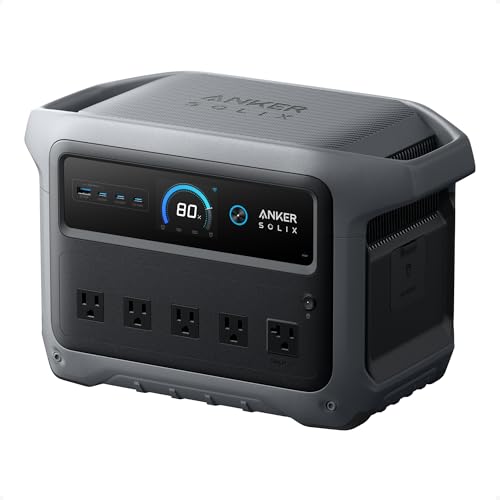 Anker SOLIX C1000 Gen 2 | The battery that matches a 2,000W generator | 1,024Wh 24.9 lb | $529.99 · View on Amazon |
| 2 | 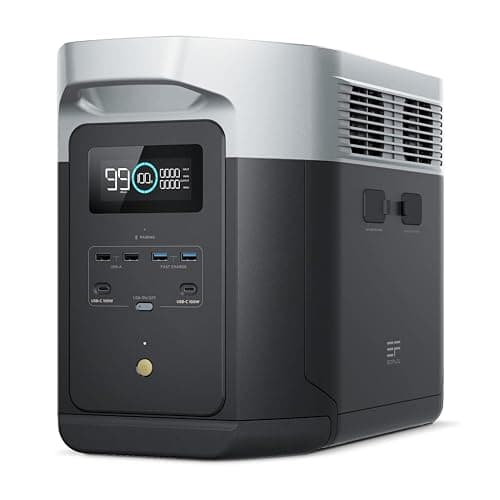 EcoFlow DELTA 2 Max | The battery that gets closest on runtime | 2,048Wh 50.7 lb | $1,028.99 · View on Amazon |
| 3 | 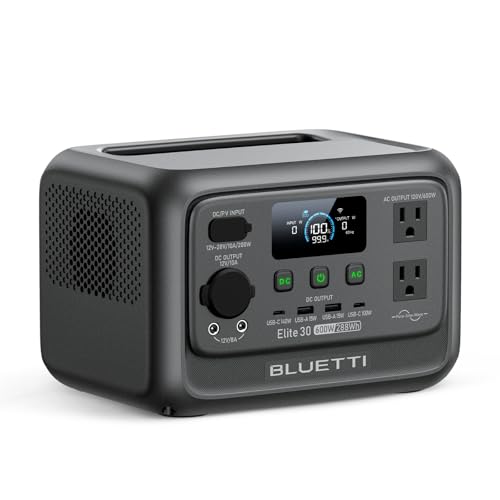 BLUETTI Elite 30 V2 | The case where a generator makes no sense at all | 288Wh 9.5 lb | $289.99 · View on Amazon |
An inverter generator is not the generator this comparison usually means. An open-frame contractor generator is loud, has rough output that some electronics will not tolerate, and runs its engine flat out regardless of load. An inverter generator encloses the engine, varies its speed with demand, and conditions the output through an inverter so it is clean enough for a laptop. It is quieter, more efficient and the version almost everybody buys for camping or home backup.
Which means the usual arguments for a battery — power quality, noise, fiddliness — get a lot weaker. Three real differences remain, and the first one is the only one that cannot be engineered away.
Difference one: carbon monoxide
An inverter generator burns petrol, so it produces carbon monoxide, so it cannot be run indoors, in a garage, on a covered balcony, in a stairwell, under an awning, in a vehicle, or in a tent. Not at low load, not with the door open, not briefly. The US Consumer Product Safety Commission has published repeatedly on portable generator carbon monoxide deaths, and the pattern in those reports is the same every storm season: the generator was close to the house or inside an enclosed space.
A power station has no combustion and no exhaust. It can sit on a kitchen counter, under a desk, in a van with the doors shut, or beside a cot in a tent. If any part of your use case is indoors or enclosed, the comparison is over at this line and nothing below changes it.
Difference two: runtime, where the generator wins
A battery holds a fixed amount of energy. A generator holds a fixed amount of energy too, but you can buy more of it at any petrol station for a few dollars. Over a multi-day outage, or a week in a remote spot with no sun, that asymmetry decides it and no battery specification closes the gap.
| Portable power station | Inverter generator | |
|---|---|---|
| Safe indoors | Yes — no combustion | No, ever — carbon monoxide |
| Noise | Below 22 dB to 25 dB where published | About 50-60 dBA at quarter load |
| Output, small class | 600W continuous at 9.5 lb | Not available at this size |
| Output, mid class | 1,800-2,400W continuous | 1,600-1,800W rated, 2,000-2,300W peak |
| Energy on board | 288Wh to 2,048Wh | Limited only by fuel you carry |
| Refill time | 49 min to 2.3 hr from a wall socket | Under a minute at a pump |
| Refill away from the grid | Solar 500-1,000W, car 800W | Any petrol station |
| Maintenance | None | Oil, filters, plugs, fuel stabiliser |
| Winter storage | Store at partial charge | Drain or stabilise the fuel |
| Cost per watt-hour delivered | High | Low |
| Starts a compressor | 2,700-3,600W surge where published | Yes, comfortably |
| Usable in a tent or van | Yes | No |
| Weight, mid class | 24.9-50.7 lb | About 45-60 lb dry, plus fuel |
Read the weight row twice, because it surprises people. A 2,048Wh power station at 50.7 lb is in the same weight class as a 2,000W inverter generator — the battery is not the obviously heavier option it was a few years ago. What the generator still has is the fuel, and fuel is where the energy density lives.
Difference three: what you are actually buying
A generator is an energy *converter*: it turns fuel you keep buying into electricity, cheaply, for as long as you feed it. A power station is an energy *container*: you fill it for almost nothing and then you have exactly that much. Those are different products that happen to have outlets on the front.
Where each one is clearly the right answer
Buy the inverter generator if
- Your outages last days, not hours, and you need a fridge, a freezer and a well pump through all of it.
- You have somewhere outdoors and well clear of the house to run it — 20 feet from any window, door or vent is the standard guidance — and you will actually put it there.
- You need to run a 240V load, an electric water heater or a central air handler. Only the very top of the battery range is in that conversation at all.
- Cost per watt-hour is the deciding number, because it is not close.
- You are already comfortable with engine maintenance and the fuel discipline that goes with seasonal equipment.
Buy the power station if
- Any part of the use is indoors or enclosed — an apartment, a garage, a van, a tent, a balcony. Best power station for an apartment is written for exactly this constraint.
- The loads are electronics rather than heat — router, laptop, phones, lights, a CPAP, a 12V fridge. That is most of what people actually plug in.
- Noise is part of the product, as it is at a campsite, during a film, or at 6am in a driveway.
- It needs to work at a venue with rules, which stadium lots and many campgrounds have. Best generator for tailgating covers why the battery is the one that gets through the gate.
- You want it to earn its keep between emergencies. A generator does nothing until the power goes out. A battery is a camping unit, a desk UPS and a tailgate power supply in between.
- You will not maintain an engine. A generator that has not been started in two years and has stale fuel in it is not a backup plan.
The honest middle answer
Plenty of households that have thought about this carefully end up owning both, and for sensible reasons: the generator lives in the shed for the multi-day storm and runs the fridge and the well pump from well outside the house, while the battery lives indoors, rides through the first ten minutes of every cut with no interruption at all, and comes camping. They are not really competing for the same job.
If you are going to own one, own the one that matches how often you will use it. Are portable power stations worth it works through the frequency question properly, and it is honest about the cases where neither purchase is the right one.
For the comparison against an open-frame contractor generator — louder, rougher output, and cheaper again — portable power station vs gas generator is the companion page. And if the question is really about a solar setup rather than a battery alone, portable power station vs solar generator clears up what is mostly a naming problem.
The picks in full
1. The battery that matches a 2,000W generator
Anker SOLIX C1000 Gen 2
- 1,024Wh
- LiFePO4 (InfiniPower LFP)
- 2,000W continuous / 3,000W surge
- 24.9 lb
- 600W
- 80% capacity after 4,000 cycles
- Full in 49 min (UltraFast, 1,600W max input)
- 5 years
2,000W continuous with a 3,000W surge is the output rating of a popular small inverter generator, delivered from a 24.9 lb box with no exhaust, no fuel and no pull cord. That equivalence is the whole reason this comparison is now close: five years ago no portable battery reached the output of the generators people actually bought.
Anker publishes 1,024Wh, a full recharge in 49 minutes at 1,600W input, a 10 ms UPS switchover, 600W of solar input, 80% capacity after 4,000 cycles, a 5-year warranty and dimensions of 15.12 x 8.19 x 9.61 in. Nothing to service, nothing to winterise, nothing that goes stale in the tank.
1,024Wh is where the comparison bites back. A 2,000W inverter generator with a two-gallon tank runs for eight to twelve hours at a quarter load and then runs for another eight if you buy more fuel. This runs for however long 1,024Wh lasts, and then stops until you charge it. That is the trade, stated plainly.
Reasons to buy
- 2,000W continuous, 3,000W surge — generator-class output
- No carbon monoxide, usable indoors
- Full recharge in 49 minutes
- Nothing to service, store or winterise
- 10 ms UPS switchover; 5-year warranty
Reasons to avoid
- 1,024Wh total — you cannot buy more energy on the way
- Two AC outlets
- Not expandable
- Heavier per watt-hour than a tank of petrol
Buy it if: you want generator output without the exhaust or the maintenance.
Skip it if: you need days of runtime away from any charging source.
2. The battery that gets closest on runtime
EcoFlow DELTA 2 Max
- 2,048Wh
- LFP (LiFePO4)
- 2,400W continuous
- 50.7 lb
- 1000W
- 3,000 cycles to 80% capacity
- 2.3 hr; 800W car/alternator charging
- 5 years
2,048Wh with 1,000W of solar input and 800W of car and alternator charging. This is the configuration that actually competes with a generator's refuelling story, because it has two ways to put energy back without a wall socket — and unlike fuel, both of them are free once you own the hardware.
EcoFlow publishes 2,400W continuous, fifteen outputs including six AC, a 2.3-hour wall recharge, a switchover under 20 ms, 3,000 cycles to 80% capacity, a 5-year warranty and expansion from 2 kWh to 6 kWh with up to two extra batteries. At 6 kWh with panels, multi-day off-grid runtime stops being a generator-only proposition.
50.7 lb — heavier than many 2,000W inverter generators, which is worth saying out loud. EcoFlow publishes no surge figure and no dimensions for this model. And a generator still wins the pure cost-per-watt-hour contest by a wide margin; you are paying for silence and indoor use.
Reasons to buy
- 2,048Wh, expandable to 6 kWh
- 1,000W solar input; 800W car charging
- 2,400W continuous; six AC outlets
- Two refill paths that cost nothing to run
- 5-year warranty
Reasons to avoid
- 50.7 lb — heavier than some generators it competes with
- No surge figure published
- Costs far more per watt-hour than fuel
- 20 ms switchover, not 10 ms
Buy it if: multi-day off-grid use where silence matters more than cost per watt-hour.
Skip it if: you are optimising purely for runtime per dollar.
3. The case where a generator makes no sense at all
BLUETTI Elite 30 V2
- 288Wh
- LiFePO4 (automotive-grade)
- 600W continuous / 1,500W surge
- 9.5 lb
- 200W
- Over 3,000 cycles; 10-year lifespan
- Full in 70 min
- 5 years
288Wh and 9.5 lb, with 600W continuous and a 1,500W surge. Nobody buys a generator to charge phones, run a CPAP, power a laptop or light a campsite — and that is the majority of what people actually plug into portable power. At this scale the comparison is not close; it is a category error.
BLUETTI publishes a 70-minute full recharge, a UPS switchover of 10 ms or less, 200W of solar input, nine output ports including USB-C PD 3.1 up to 140W, over 3,000 cycles with a stated 10-year lifespan and a 5-year warranty. The smallest inverter generator on the market is heavier, louder and cannot be used in a tent.
288Wh will not run anything that heats and will not keep a fridge going for long. BLUETTI publishes no dimensions, no AC outlet count and no cycle-retention threshold for this model. It also does not expand.
Reasons to buy
- 9.5 lb, silent, and usable inside a tent
- 600W continuous, 1,500W surge from 288Wh
- Full recharge in 70 minutes
- 10 ms or less switchover
- Over 3,000 cycles; 5-year warranty
Reasons to avoid
- 288Wh — electronics only
- No published dimensions or AC outlet count
- Not expandable
- 200W solar input
Buy it if: small continuous loads, where a generator was never the right tool.
Skip it if: you need to run power tools or anything that heats.
Questions