Best for Tailgating
The Best Power Stations for Tailgating
Four hours rarely drains a kilowatt-hour. What it does do is ask for 1,500W at one particular moment, which is where the wrong unit shuts off.
Tailgate & Travel
Short trips, public places and other people's rules. This is the corner of the category where portability stops being a preference and starts being a regulation.
Tailgating and travel share a constraint that camping does not have: you are somewhere you do not control. A stadium lot bans generators because of noise and fumes. An airline bans anything over 160 watt-hours outright. A campground has quiet hours. In every case the battery unit wins where a gas generator cannot go at all — which is most of the reason this category exists.
It also means the buying criteria shift. For camping you optimize for watt-hours per pound. Here you optimize for watts, because the loads are short, sharp and simultaneous — a griddle, a blender, a speaker and someone's phone, all at once, for three hours.
A four-hour tailgate rarely drains 1,000Wh. What it does do is ask for 1,500W at one particular moment, and that is where an under-specified unit shuts off. Look at the continuous AC rating first and the battery second — the reverse of how you shop for camping.
| Appliance | Running watts | Notes |
|---|---|---|
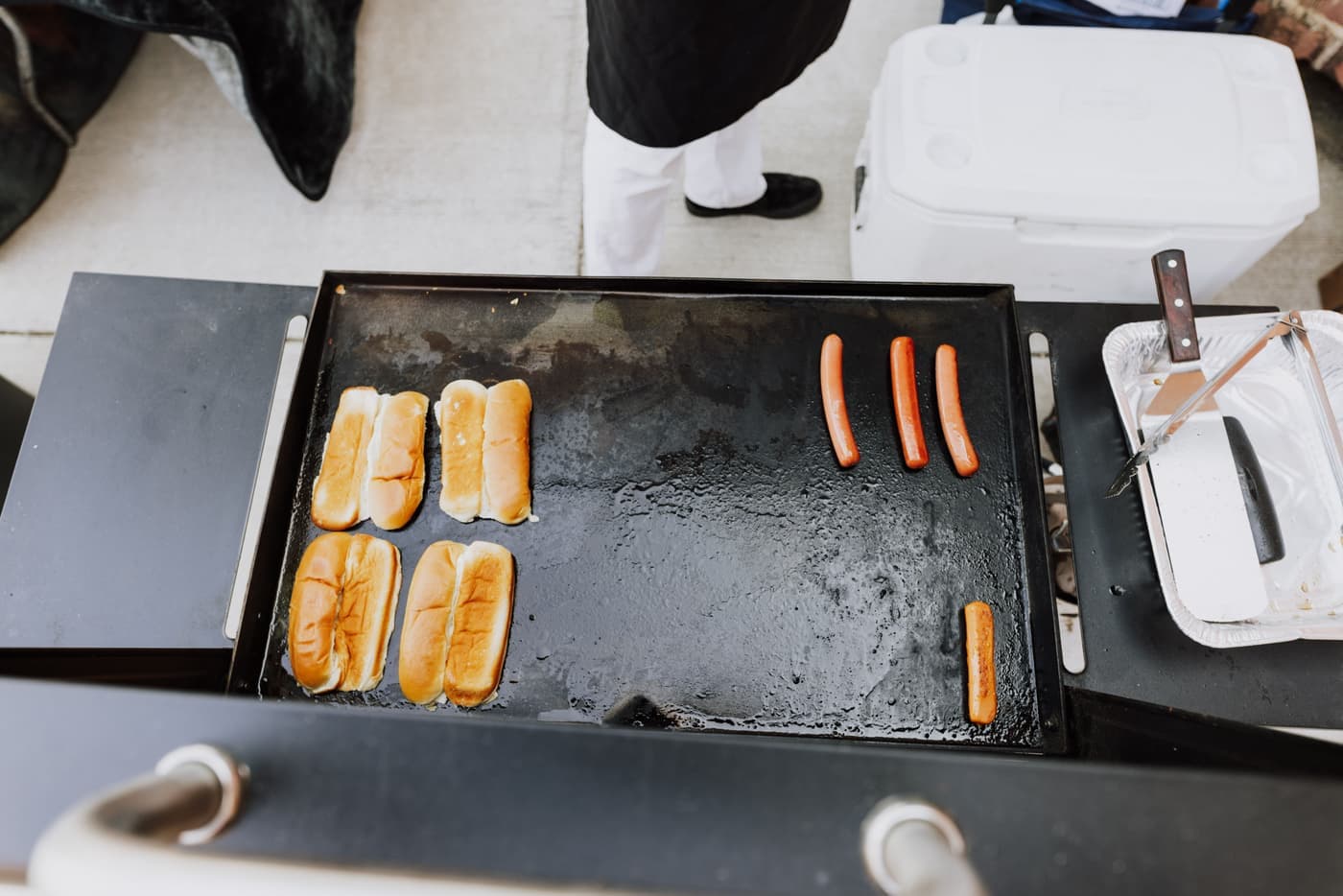
| Electric griddle | 1,200-1,500W | The load that decides the purchase |
| Blender | 300-600W | Brief but spiky |
| Slow cooker | 200-300W | Long and steady — easy on a battery |
| Bluetooth speaker / PA | 20-80W | Negligible |
| 65-inch TV | 80-150W | Easier than most people assume |
| Electric cooler | 45-60W | Cycles; see the cooler page |
| Phone charging, several | 10-30W | Rounding error |
Add a griddle to anything else and you need 1,800W or more of continuous output. That is why the tailgating roundup ranks on output rather than on capacity, and why the cheap 300W units that work perfectly well for tent camping are the wrong tool here.
If flying is anywhere in your plan, the watt-hour number on the label decides everything before price does. The FAA's thresholds are 100Wh and 160Wh, and the TSA is explicit that spare lithium batteries and power banks go in carry-on baggage only, never in checked bags. Every portable power station on this site is over 160Wh, which means none of them can fly, in either bag, on a US carrier.
Two loads bring people to this hub specifically. Satellite internet terminals draw modestly but continuously, which makes them a capacity question rather than an output one — best power station for Starlink does that arithmetic. Electric coolers behave like small fridges and cycle, so their real draw is far below their sticker rating — see best power station for an electric cooler.
For the parking lot, the tailgating roundup. For anything involving an airport, read the plane rules before you buy, not after. And if weight is your binding constraint, the lightweight roundup is a better starting point than any of these.
In this section
Best for Tailgating
Four hours rarely drains a kilowatt-hour. What it does do is ask for 1,500W at one particular moment, which is where the wrong unit shuts off.
Best for Starlink
A satellite terminal is an easy load and a relentless one. That combination makes this a capacity calculation, not an output one.
Best for an Electric Cooler
Electric coolers look like a big load and behave like a small one. Once you understand why, the purchase gets a lot cheaper.
The rules, sourced
The answer is no, and the reason is a number printed on the side of the unit. Here are the rules, cited to the regulators rather than summarized from a brand blog.
Questions