Best Power Station for a Tailgate TV
The screen is the easy part. What decides this purchase is how many other things get plugged in beside it, and how many sockets the box actually has.

At a glance
Quick picks
Tap any row to jump to the full write-up. Weight is a column here because it is the spec that decides whether you actually carry the thing.
| # | Product | Best for | Capacity · Weight | Price |
|---|---|---|---|---|
| 1 | 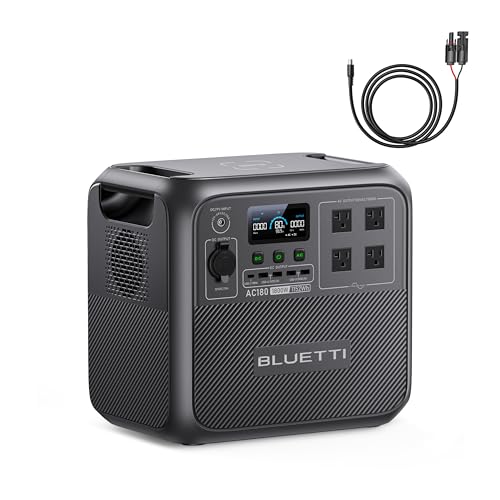 BLUETTI AC180 | Best for a TV plus everything else | 1,152Wh 35.27 lb | $499.00 · View on Amazon |
| 2 | 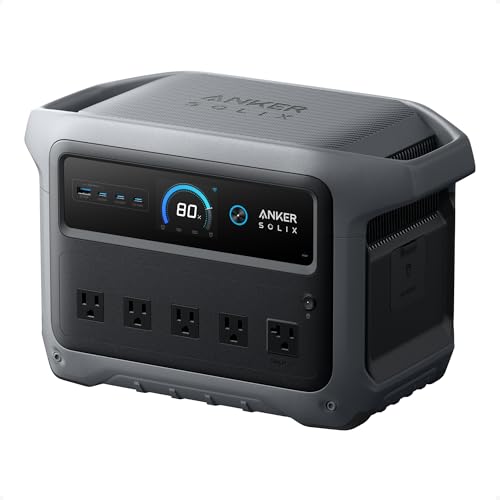 Anker SOLIX C1000 Gen 2 | Best if a blender or a grill is in the plan | 1,024Wh 24.9 lb | $529.99 · View on Amazon |
| 3 | 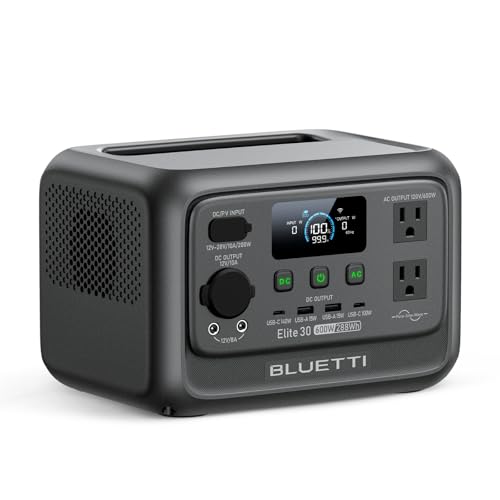 BLUETTI Elite 30 V2 | Best small unit that still runs a TV | 288Wh 9.5 lb | $289.99 · View on Amazon |
| 4 | 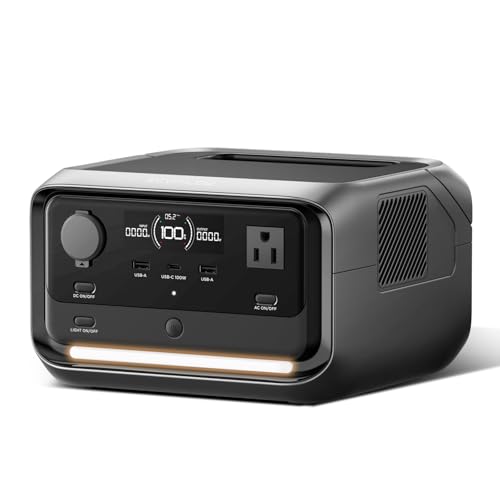 EcoFlow RIVER 3 Plus | Best small unit that grows | 286Wh 10.4 lb | Check price on Amazon |
A modern flat-panel television is a smaller load than almost everyone expects - call it 400 to 500 watt-hours for a 50-inch screen across a four-hour tailgate - so a 1kWh unit runs the TV with most of its battery untouched. The reason to buy carefully anyway is that the TV never arrives alone. By the time the receiver, the speaker, the lights and six phones are on it, you are managing sockets rather than watt-hours, which is why this page ranks outlet count alongside capacity.
What a TV actually draws
Read the plate on the back of your own set, or the energy label if it is still in the box - the figure is published by the manufacturer and it varies with panel size, backlight technology and brightness setting. The bands below are the ranges nameplates in each size class tend to fall in, and they exist so you can sanity-check your own number rather than replace it.
| Screen | Typical nameplate band | 4 hours at the midpoint |
|---|---|---|
| 24-32 in LED | 30-60W | 180Wh |
| 40-43 in LED | 50-90W | 280Wh |
| 50-55 in LED | 70-120W | 380Wh |
| 65 in LED | 100-160W | 520Wh |
| Portable 12V TV | 20-40W | 120Wh |
Why the socket count matters more than the watts
Add up the loads in that sum and you get 165W of continuous draw. Every unit on this page has at least three times that in inverter rating, so none of them is working hard. But the TV, the receiver, the speaker and the lights are four separate plugs, and two of the four units here publish fewer than four AC outlets.
A power strip fixes it, and it is worth saying plainly that there is nothing wrong with doing that - a strip on a battery is no different from a strip at home, and the inverter only sees the total. What a strip will not fix is a unit whose AC outlet count its own manufacturer does not publish, which is the case for the BLUETTI Elite 30 V2. Buy the strip with the unit and the problem disappears.
The things that break the budget
- Anything that heats. A hot plate, an electric griddle or a deep fryer is a 1,200-1,800W load and will empty any unit on this page in under an hour. Cook with fuel and leave the battery for electronics.
- A full-size fridge or a kegerator. A compressor plus a four-hour TV is a 2 kWh conversation, not a 1 kWh one. Best power station for an electric cooler covers the drinks problem with a load that actually fits.
- A projector instead of a TV, if you assume it costs more. It usually costs less: best power station for a projector finds a modern LED or laser projector in the 30-90W band, under most televisions.
- Running the screen at maximum brightness in daylight. A television outdoors at full backlight sits at the top of its nameplate band for the whole game, not the middle.
If the venue has rules
Most stadium lots that ban generators ban them because of fuel, exhaust and noise, and a battery has none of the three. That is the practical argument for this whole category at a tailgate, and best generator for tailgating covers which one gets through the gate. If you want the whole setup costed rather than just the screen, how to power a tailgate adds up a full lot - TV, speakers, grill, lights - and names the one appliance that spends more than everything else combined.
The picks in full
1. Best for a TV plus everything else
BLUETTI AC180
- 1,152Wh
- LiFePO4
- 1,800W continuous / 2,700W surge
- 35.27 lb
- 500W
- 3,500+ cycles to 80% original capacity
- 1.3-1.8 hr full (1,440W max AC input)
- 5 years
Four AC outlets and a 15W wireless charging pad on the top panel, behind 1,152Wh - the biggest battery in the 1kWh class. For this job the outlet count is not a nice-to-have: the TV needs one, the streaming stick or receiver needs one, the speaker needs one and the string lights need one. That is four before anyone asks about a blender.
BLUETTI publishes 1,800W continuous with a 2,700W surge, a 1.3-1.8 hour full recharge at up to 1,440W of AC input, a 20 ms switchover, 500W of maximum solar input, 3,500+ cycles to 80% original capacity, a 5-year warranty and dimensions of 13.39 x 9.72 x 12.48 in. The 3,500-cycle rating is the longest in its class.
35.27 lb is the heaviest thing on this page, and at a tailgate that matters less than anywhere else on this site - the unit rides in the vehicle and moves about ten feet. The 500W solar ceiling is the lowest in the class and it does not expand.
Reasons to buy
- Four AC outlets plus a wireless pad
- 1,152Wh - the biggest battery in its class
- 1,800W continuous, 2,700W surge
- 3,500+ cycles to 80%; 5-year warranty
- Compact 13.39 x 9.72 in footprint
Reasons to avoid
- 35.27 lb
- 500W solar input
- Not expandable
- 20 ms switchover, not 10 ms
Buy it if: a full lot setup with four things live at once.
Skip it if: you are carrying it any real distance.
2. Best if a blender or a grill is in the plan
Anker SOLIX C1000 Gen 2
- 1,024Wh
- LiFePO4 (InfiniPower LFP)
- 2,000W continuous / 3,000W surge
- 24.9 lb
- 600W
- 80% capacity after 4,000 cycles
- Full in 49 min (UltraFast, 1,600W max input)
- 5 years
2,000W continuous with a 3,000W surge from 1,024Wh. A television is a trivial load for this inverter; what the output buys you is everything else that turns up at a tailgate - a blender for frozen drinks, a pellet grill lighting its igniter, a coffee maker in the morning - without anyone having to think about the order they go on in.
Anker publishes a full recharge in 49 minutes at 1,600W input, a 10 ms UPS switchover, 600W of maximum solar input, 80% capacity after 4,000 cycles, a 5-year warranty, dimensions of 15.12 x 8.19 x 9.61 in and 24.9 lb. A 49-minute recharge means a Saturday game and a Sunday game need no planning at all.
Two AC outlets, and for this specific job that is the weakness. A short power strip solves it completely - the inverter cares about total draw, not socket count - but it is one more thing to remember in the boot.
Reasons to buy
- 2,000W continuous, 3,000W surge
- Full recharge in 49 minutes
- 10 ms UPS switchover
- 24.9 lb; published dimensions
- 4,000 cycles to 80%; 5-year warranty
Reasons to avoid
- Only two AC outlets - bring a strip
- Not expandable
- 600W solar input
Buy it if: a TV plus cooking or blending on the same box.
Skip it if: you want four sockets without an adapter.
3. Best small unit that still runs a TV
BLUETTI Elite 30 V2
- 288Wh
- LiFePO4 (automotive-grade)
- 600W continuous / 1,500W surge
- 9.5 lb
- 200W
- Over 3,000 cycles; 10-year lifespan
- Full in 70 min
- 5 years
600W continuous with a 1,500W surge from 288Wh, at 9.5 lb. Double the output of every other unit in its capacity class, which is what makes it viable here at all: a 100W television is a sixth of this inverter's rating, so the screen is never the problem. The battery is.
BLUETTI publishes a 70-minute full recharge, a UPS switchover of 10 ms or less, 200W of maximum solar input, nine output ports including USB-C PD 3.1 up to 140W, over 3,000 cycles with a stated 10-year lifespan and a 5-year warranty. Nine ports on a 9.5 lb box is a good ratio for a tailgate.
288Wh at 85% usable is about 245Wh, which is a 100W TV for roughly two and a half hours and nothing else. For a one-game screen with phones on the side it works; for a double-header with a speaker it does not. BLUETTI publishes no dimensions and no AC outlet count for this model, which on a job defined by how many things plug in is a real gap.
Reasons to buy
- 600W continuous, 1,500W surge from 288Wh
- 9.5 lb - carried in one hand
- Full recharge in 70 minutes
- Nine ports including USB-C PD 3.1 at 140W
- Over 3,000 cycles; 5-year warranty
Reasons to avoid
- 288Wh - roughly one game of TV
- No published dimensions or AC outlet count
- Not expandable
- 200W solar input
Buy it if: one screen, one game, and phones.
Skip it if: an all-day lot or a second appliance.
4. Best small unit that grows
EcoFlow RIVER 3 Plus
- 286Wh
- LiFePO4
- 600W continuous / 1,200W surge
- 10.4 lb
- 220W
- 3,000 cycles to 80% capacity
- 0-100% in 60 min
- Not published on the US product page
286Wh and 10.4 lb with 600W continuous and a 1,200W surge - and the only sub-11 lb unit in our registry that expands, to 858Wh with a wire-free extra battery. That expansion path is the reason it belongs on this page: 858Wh is a television for a long afternoon, bought in two stages rather than one.
EcoFlow publishes three AC outlets, a 0-100% recharge in 60 minutes, 220W of maximum solar input, a 100W USB-C port, two 12W USB-A ports, 3,000 cycles to 80% capacity and dimensions of 9.2 x 9.1 x 5.8 in. Three AC outlets on a unit this small is more than the Anker above offers.
EcoFlow does not publish a warranty term for this model on its US product page, which we note rather than fill in, and it publishes no UPS switchover figure either. The base unit on its own is the smallest battery on this page.
Reasons to buy
- Expands to 858Wh with a second pack
- Three AC outlets at 10.4 lb
- 600W continuous, 1,200W surge
- Full in 60 minutes; 220W solar input
- Published dimensions - 9.2 x 9.1 x 5.8 in
Reasons to avoid
- 286Wh in base form
- No published warranty term
- No published switchover time
Buy it if: starting small with a path to a full afternoon.
Skip it if: you want all the capacity in one box today.
Questions