Can a Power Station Run a Washing Machine?
One of the few big household appliances where the answer is a straightforward yes — as long as nobody turns the hot tap on.
The short answer
Yes, on a cold wash. A standard 120V washing machine running a cold cycle uses roughly 300-500 watt-hours and draws 400-800W while the motor and pump are working, so a 1,024Wh power station with an inverter rated 1,800W or more will run two to three cold cycles. Two things break it: a cycle that uses the machine's internal water heater, which adds 1,500-2,000W of resistive heat for much of the wash, and an electric tumble dryer, which is a 3,000-5,000W appliance that no unit in this site's registry will run at all. Check the plate on your machine.
At a glance
Quick picks
Tap any row to jump to the full write-up. Weight is a column here because it is the spec that decides whether you actually carry the thing.
| # | Product | Best for | Capacity · Weight | Price |
|---|---|---|---|---|
| 1 | 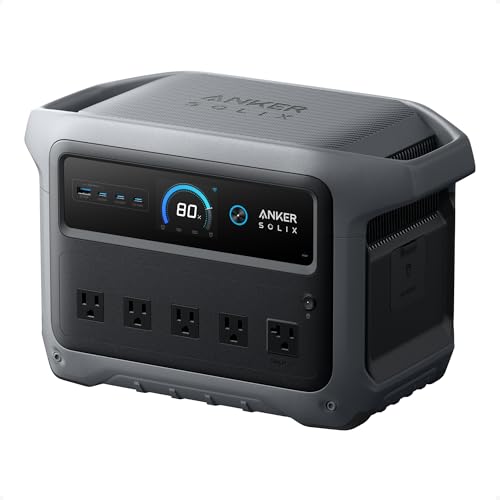 Anker SOLIX C1000 Gen 2 | Best for two or three cold washes | 1,024Wh 24.9 lb | $529.99 · View on Amazon |
| 2 | 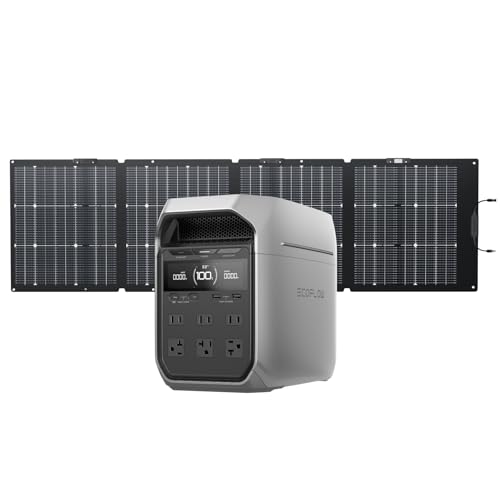 EcoFlow DELTA 3 Plus | Highest surge in the 1kWh class | 1,024Wh 27.6 lb | Check price on Amazon |
| 3 | 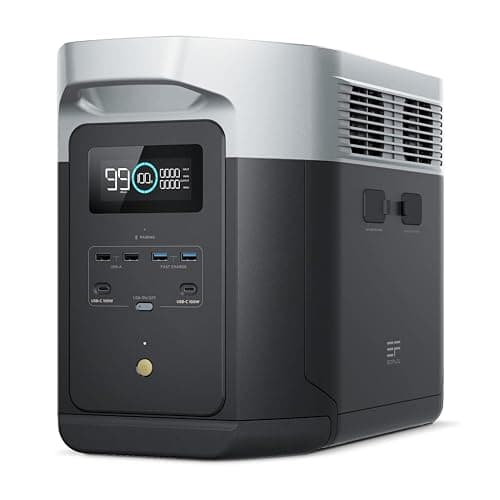 EcoFlow DELTA 2 Max | Best for a real laundry day | 2,048Wh 50.7 lb | $1,028.99 · View on Amazon |
A washing machine sounds like it should be out of reach for a battery and mostly is not, which makes it one of the more pleasant surprises in this category. The reason is that a washing machine's energy almost all goes into heating water — and if you wash cold, you simply do not spend it. What is left is a motor, a pump and a controller, and those are loads a mid-size power station handles without strain.
Machine figures below are nameplate bands. Read the plate on your own machine — usually inside the door frame or on the back panel — and note that it states the maximum draw, which is the hot-wash figure. A cold cycle will be a long way below it.
Where a wash cycle's energy goes
| Cycle | Peak draw | Energy per cycle | Cycles from 1,024Wh |
|---|---|---|---|
| Cold wash, front loader | 400-600W | 200-350Wh | 2-4 |
| Cold wash, top loader | 500-800W | 300-500Wh | 1-3 |
| Warm wash, internal heater on | 1,500-2,000W | 700-1,400Wh | Under 1 |
| Hot wash, internal heater on | 1,800-2,200W | 1,200-2,500Wh | Under 1 |
| Spin only | 400-800W | 50-100Wh | Many |
| Electric tumble dryer | 3,000-5,000W | 2,000-4,000Wh | None — will not run |
The fourth row is the whole story. A hot wash can cost five times what a cold wash costs, because heating water is resistive heating and resistive heating is what batteries are worst at. Select cold, and the appliance moves from 'impossible' to 'comfortable' in one setting change.
The spin cycle is the moment to size for
The drum motor accelerating a wet load is the biggest demand in the cycle and it is a motor-start draw, which means a brief spike well above the running figure. This is why the surge rating matters more here than the capacity does.
- Prefer a published surge rating of 2,700W or more. The highest in the 1kWh class here is EcoFlow's 3,600W; Anker publishes 3,000W; BLUETTI publishes 2,700W on the AC180.
- Older top loaders with a belt-driven transmission pull harder than modern direct-drive front loaders. If the machine predates about 2010, bias upwards.
- An inverter-drive machine is much gentler. Variable-speed drum motors ramp up rather than slamming on, which removes most of the inrush.
- Do not run the machine through a long thin extension cord. Voltage drop at the spin is exactly how a setup that should work trips instead.
- Load the machine lighter than usual. A smaller wet load is less mass for the motor to accelerate and a shorter, cheaper spin.
What you cannot do
An electric tumble dryer is out of reach and will stay out of reach. A domestic electric dryer is a 3,000-5,000W heating element, usually on a 240V circuit, and no unit in this site's registry runs one — not even the EcoFlow DELTA Pro 3 or the Anker SOLIX F3800 with their 240V outlets, which would empty themselves in under an hour trying.
A gas dryer is a different matter, because the heat comes from the gas and the electricity only runs the drum motor, the igniter and the controls — typically 300-500W. That is well inside a 1kWh unit and is one of the quiet advantages of a gas dryer in an outage. Check your own dryer's plate before assuming either way.
A washer-dryer combo that dries electrically is the worst case: it combines the wash load with a long heating phase, and the drying half is typically a multi-kilowatt-hour operation. Wash on the battery, dry on a line.
Why you might be asking
Three situations bring people to this question, and they want different answers. In an outage, laundry is rarely the priority — size for the fridge, the freezer and the router first. What size power station for a power outage builds that list properly and laundry comes last on it.
Off-grid or in a cabin, laundry is a real recurring need and the right answer is a 2kWh-plus unit with solar, because a cold wash per day is a load a few hundred watts of panel genuinely covers. Best solar generator for off-grid living is the page for that, and how much solar input do you need does the harvest arithmetic.
In a van or RV with a small portable washer, the numbers get much friendlier: compact twin-tub and portable drum washers commonly draw 200-400W and use a fraction of a full machine's water and energy. What size power station for van life totals that build.
For the broader picture on what mid-size units handle, what can a 1000W power station run lists the household loads in order, and can a power station run a refrigerator covers the other big motor-and-compressor appliance people ask about.
The picks in full
1. Best for two or three cold washes
Anker SOLIX C1000 Gen 2
- 1,024Wh
- LiFePO4 (InfiniPower LFP)
- 2,000W continuous / 3,000W surge
- 24.9 lb
- 600W
- 80% capacity after 4,000 cycles
- Full in 49 min (UltraFast, 1,600W max input)
- 5 years
2,000W continuous with a 3,000W surge is the combination that makes this comfortable rather than marginal. The hard moment in a wash cycle is the spin, when the drum motor accelerates a wet load — and that is a motor-start draw, which is exactly what a 3,000W surge rating exists for.
Anker publishes 1,024Wh, a full recharge in 49 minutes at 1,600W input, a 10 ms UPS switchover, 600W of solar input, 80% capacity after 4,000 cycles, a 5-year warranty and dimensions of 15.12 x 8.19 x 9.61 in. At a 400Wh cold cycle, 1,024Wh is two full washes with a little left over.
1,024Wh is the ceiling and it does not expand, so a full laundry day means recharging between loads — which the 49-minute figure makes practical. Two AC outlets.
Reasons to buy
- 3,000W surge — handles the spin cycle
- 2,000W continuous
- Two to three cold cycles from 1,024Wh
- Full recharge in 49 minutes
- 80% capacity after 4,000 cycles
Reasons to avoid
- 1,024Wh is two to three cycles, not a laundry day
- Not expandable
- Only two AC outlets
- 600W solar input
Buy it if: a couple of cold loads during an outage or off-grid.
Skip it if: you want to do a full day of laundry.
2. Highest surge in the 1kWh class
EcoFlow DELTA 3 Plus
- 1,024Wh
- LFP (LiFePO4)
- 1,800W continuous / 3,600W surge
- 27.6 lb
- 1000W
- 4,000 cycles to 80%+ capacity
- Full in 56 min (1,500W AC input)
- 5 years
A 3,600W surge is the highest published figure in the 1kWh class and the most headroom you can get at this size for a motor-start load. Paired with 1,800W continuous and 1,024Wh, it covers the same two-to-three cold cycles with more margin at the moment the spin begins.
EcoFlow publishes a 56-minute full wall recharge, a switchover under 10 ms, six AC outlets, two 140W USB-C ports, 1,000W of solar input across two MPPT inputs, 4,000 cycles to 80%+ capacity, expansion to 5 kWh and a 5-year warranty. Expansion is what turns this from two cycles into a laundry day.
27.6 lb for 1,024Wh is 37.1Wh per pound, which is unremarkable, and the solar ceiling is wasted money if you never buy panels. DELTA 3 vs DELTA 3 Plus covers whether the Plus is worth it for you.
Reasons to buy
- 3,600W surge — highest in the class
- Expands to 5 kWh for a full laundry day
- Six AC outlets
- 1,000W solar input
- Switchover under 10 ms
Reasons to avoid
- 1,024Wh alone is two to three cycles
- 27.6 lb
- The solar ceiling is wasted without panels
Buy it if: an older machine with a hard-starting motor, or a growth path.
Skip it if: you charge from the wall only and want the cheaper version.
3. Best for a real laundry day
EcoFlow DELTA 2 Max
- 2,048Wh
- LFP (LiFePO4)
- 2,400W continuous
- 50.7 lb
- 1000W
- 3,000 cycles to 80% capacity
- 2.3 hr; 800W car/alternator charging
- 5 years
2,048Wh is four to five cold cycles, which is a genuine laundry day rather than an emergency load, and 2,400W continuous gives any domestic machine the output it needs. It also expands from 2 kWh to 6 kWh with up to two extra batteries.
EcoFlow publishes fifteen outputs including six AC, 1,000W of solar input, 800W of car and alternator charging, a 2.3-hour wall recharge, a switchover under 20 ms, 3,000 cycles to 80% capacity and a 5-year warranty.
50.7 lb, no published surge figure and no published dimensions. The missing surge rating is the one that matters for this load specifically — it will almost certainly handle a domestic spin cycle on a 2,400W continuous rating, but EcoFlow does not publish the number that would confirm it.
Reasons to buy
- 2,048Wh — four to five cold cycles
- 2,400W continuous; six AC outlets
- Expands from 2 kWh to 6 kWh
- 1,000W solar; 800W car charging
- 5-year warranty
Reasons to avoid
- No surge figure published by EcoFlow
- 50.7 lb
- No published dimensions
- 20 ms switchover
Buy it if: several loads in a day, off-grid or through a long outage.
Skip it if: one emergency wash is the whole requirement.
Questions