How Many Watt-Hours Is 20,000mAh?
Milliamp-hours without a voltage is a number with no units. Convert it once and the whole power-bank-versus-power-station question answers itself.
The short answer
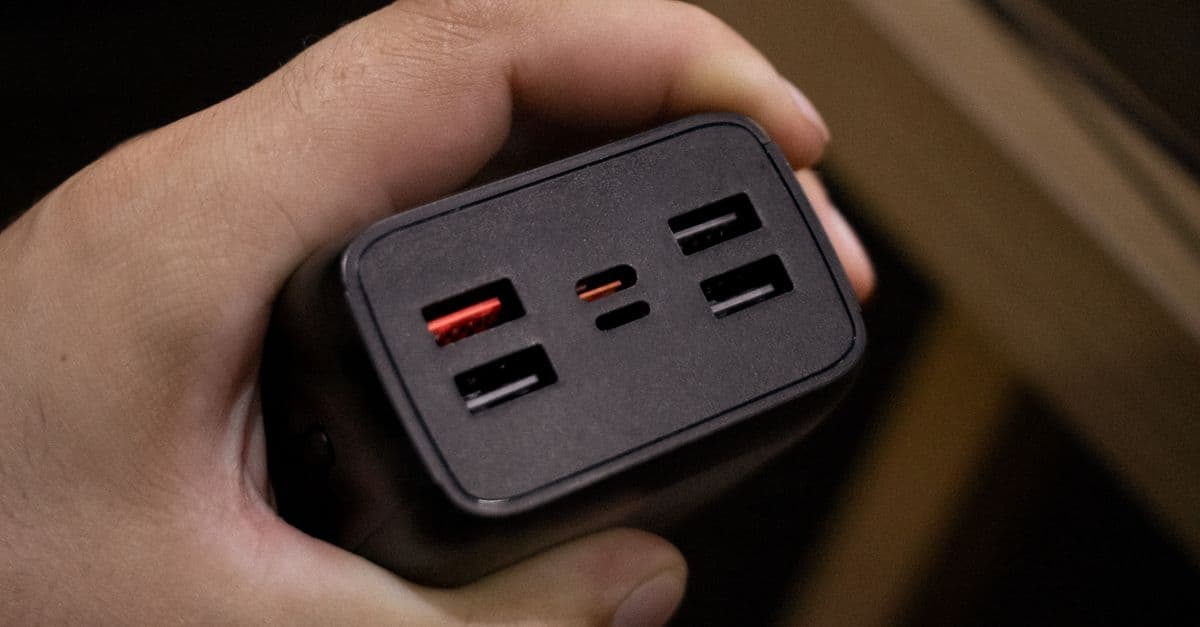
20,000mAh at the 3.7V nominal cell voltage is 74 watt-hours. The arithmetic is milliamp-hours divided by 1,000, multiplied by volts: 20,000 / 1,000 x 3.7 = 74Wh. That is the honest figure, and it is why a 20,000mAh power bank and a 286Wh power station are not competing products — the power station holds 3.9 times as much energy, and it is the smallest one on this site.
Milliamp-hours is the most misleading spec in consumer electronics, and it is misleading by accident rather than by design. It measures charge, not energy. A charge figure only becomes an energy figure when you multiply it by a voltage — and the voltage is the part nobody prints on the front of the box.
The conversion, both directions
Why the voltage you use matters so much
Here is the trick that makes mAh figures incomparable. A power bank's cells sit at about 3.7V nominal, and that is the voltage manufacturers use to generate the big mAh number. But the output is 5V over USB, or 9V, 12V or 20V over USB-C Power Delivery. Convert the same 74Wh at the 5V output and you get 14,800mAh — the *same battery*, a number 26% smaller, and both are technically true.
Which is why two power banks claiming 20,000mAh can hold measurably different amounts of energy, and why a power station that publishes watt-hours is giving you the more honest spec. Every unit on this site publishes watt-hours, which is one of the few things this category does better than the power-bank aisle.
What 74Wh actually runs
| Device | Approx. energy per charge | Charges from 74Wh |
|---|---|---|
| Smartphone | 15-20Wh | 3 to 4 |
| Tablet | 30-40Wh | 1 to 2 |
| Laptop | 50-100Wh | 0.6 to 1 |
| Wireless earbuds case | 1-2Wh | 30 or more |
| Headlamp or camp light | 5-10Wh | 6 to 12 |
| CPAP, no humidifier | 180-400Wh per night | None — not a candidate |
| 12V camping fridge | 400-550Wh per day | None |
That table is the real answer to the question people are usually asking. A 20,000mAh bank is a phone-and-earbuds product. The moment a laptop, a CPAP, a fridge or anything with a mains plug enters the conversation, you are in a different category — and the gap is not incremental. Power station vs power bank is the full comparison, and it saves people a lot of money.
The 100Wh airline rule, which is why this matters
Watt-hours are not an academic unit. They are the unit airlines regulate in. Lithium batteries up to 100Wh go in carry-on without airline approval; 100-160Wh needs approval; above 160Wh is not permitted in passenger baggage at all. That is the entire reason you cannot fly with a power station — the smallest unit on this site is 286Wh, which is 1.8 times the absolute ceiling.
It also explains why 20,000mAh is such a common size: at 3.7V it converts to 74Wh, comfortably inside the limit, and a manufacturer can go to roughly 27,000mAh before bumping into it. Can you bring a power station on a plane covers the rule and the airline-approval band properly.
When to stop buying power banks
The honest threshold is this: if you are considering a second or third power bank, buy a small power station instead. Three 74Wh banks is 222Wh of awkwardly divided energy with three separate charge cycles to manage. The EcoFlow RIVER 3 Plus is 286Wh in one box with a real AC outlet, 600W of output, and a 60-minute full recharge — and it expands to 858Wh.
If you are converting mAh because you are trying to compare a power bank to a leisure battery or a 12V setup, the unit you actually want is amp-hours: how many watt-hours in an amp hour does that conversion, which is the same arithmetic at a different voltage. And watt-hours explained is the ground-up version if the whole unit is new to you.
The picks in full
1. The smallest unit worth stepping up to
EcoFlow RIVER 3 Plus
- 286Wh
- LiFePO4
- 600W continuous / 1,200W surge
- 10.4 lb
- 220W
- 3,000 cycles to 80% capacity
- 0-100% in 60 min
- Not published on the US product page
286Wh is 3.9 times a 20,000mAh power bank, in a 10.4 lb box with three real AC outlets and 600W of continuous output. That output figure is what a bank cannot offer at any capacity: a mains plug.
0-100% in 60 minutes, and expansion to 858Wh wire-free — which is 11.6 times a 20,000mAh bank, in a package you can still carry in one hand.
286Wh will not run a fridge or a kettle, and EcoFlow publishes no warranty term for it on the US page. It is a phones-lights-laptop-CPAP unit, and it is honest about that.
Reasons to buy
- 286Wh — 3.9x a 20,000mAh bank
- 600W continuous, 1,200W surge
- Three AC outlets and a USB-C 100W
- 0-100% in 60 minutes
- Expands to 858Wh wire-free
Reasons to avoid
- No warranty term published on EcoFlow's US page
- Too big for carry-on under the 100Wh rule
- 220W solar input
- Will not run a fridge or a kettle
Buy it if: laptops, a CPAP and lights, not just phones.
Skip it if: you need something that flies with you.
2. Lightest step up from a power bank
Jackery Explorer 300 v2

- 288Wh
- LiFePO4 (LFP)
- 300W continuous / 600W surge
- 8.2 lb
- 100W
- 4,000+ cycles
- 80% in about 1 hr
- 5 years (with registration)
288Wh at a published 8.2 lb is the lightest mains-capable unit on this site — 3.9 times a 20,000mAh bank for roughly the weight of a hardback-filled tote.
Two AC outlets at 300W, a USB-C 100W, 80% charge in about an hour, 4,000+ cycles and a 5-year warranty with registration. That warranty is published where EcoFlow's is not.
300W of output is the real ceiling: it will run a laptop, a CPAP without the humidifier, lights and phones, and nothing with a heating element. Jackery's 8.2 lb figure comes from authorized-retailer listings rather than its own spec sheet, so treat it as approximate.
Reasons to buy
- 288Wh at about 8.2 lb
- 35.1Wh per pound
- 80% charge in about 1 hour
- 4,000+ cycles; 5-year warranty with registration
- Two AC outlets plus USB-C 100W
Reasons to avoid
- 300W continuous, 600W surge — the lowest here
- Weight figure not on Jackery's own spec sheet
- 100W solar input
- Not expandable
Buy it if: one night of small loads at minimum weight.
Skip it if: anything with a heating element is on the list.
Questions