Best Power Station With an RV Plug
A 30-amp socket on the front does not mean 30 amps behind it. What each RV plug delivers, which units publish one, and when a dogbone adapter is the better answer.

At a glance
Quick picks
Tap any row to jump to the full write-up. Weight is a column here because it is the spec that decides whether you actually carry the thing.
| # | Product | Best for | Capacity · Weight | Price |
|---|---|---|---|---|
| 1 | 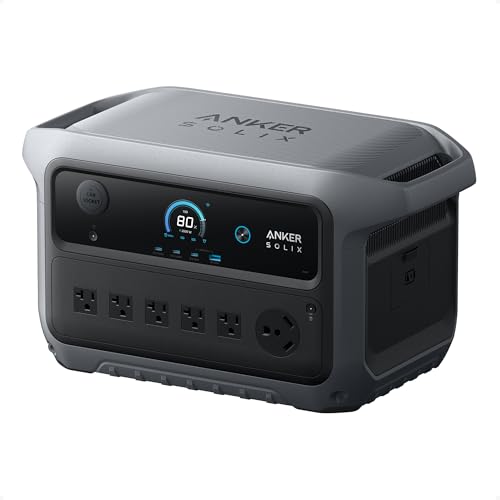 Anker SOLIX C2000 Gen 2 | The only unit here with a published TT-30R | 2,048Wh 41.7 lb | $1,499.00 · View on Amazon |
| 2 | 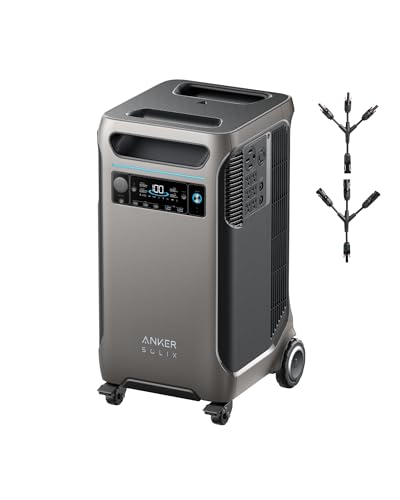 Anker SOLIX F3800 | Best for a 50-amp rig | 3,840Wh 132.3 lb | Check price on Amazon |
| 3 | 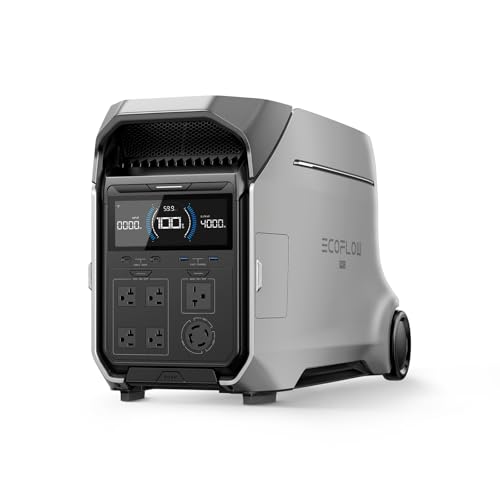 EcoFlow DELTA Pro 3 | Best 240V option | 4,096Wh Weight n/p | Check price on Amazon |
| 4 | 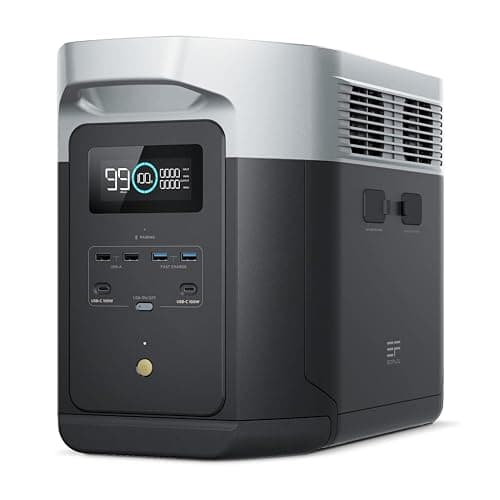 EcoFlow DELTA 2 Max | Best without an RV plug at all | 2,048Wh 50.7 lb | $1,028.99 · View on Amazon |
One unit in our registry publishes an RV receptacle you can plug a 30-amp shore cord into: the Anker SOLIX C2000 Gen 2, whose published port list includes a TT-30R. One publishes the 50-amp version, a NEMA 14-50: the Anker SOLIX F3800. Everything else needs an adapter, and for most people an adapter is fine. The plug is a convenience feature. The specification that decides what you can run is the inverter behind it, and no socket on earth raises a 1,800W inverter.
The three plugs, and what each one means
| Receptacle | Volts | Amps | Circuit ceiling | Usual use |
|---|---|---|---|---|
| NEMA 5-15 / 5-20 | 120 | 15 / 20 | 1,800W / 2,400W | Household outlet, small trailer |
| NEMA TT-30 | 120 | 30 | 3,600W | 30-amp RV shore power |
| NEMA 14-50 | 120/240 | 50 | 12,000W | 50-amp RV service, EV charging |
| NEMA L14-30 | 120/240 | 30 | 7,200W | Generator inlet, transfer switch |
The TT-30 is the one people mean by 'an RV plug'. It looks like a large three-pin household plug and it is a single 120V leg at 30 amps, which is 3,600W of circuit - not, as its shape suggests to many first-time owners, a 240V connection. The 14-50 is genuinely two 120V legs, which is where 240V appliances get their supply, and the L14-30 is the twist-lock version used on generator inlets and transfer switches rather than on cords.
Which units in our registry publish what
| Unit | RV-relevant sockets published | Continuous W |
|---|---|---|
| Anker SOLIX C2000 Gen 2 | TT-30R, NEMA 5-20R | 2,400 |
| Anker SOLIX F3800 | NEMA 14-50 (6,000W), NEMA L14-30 (6,000W), 6x NEMA 5-20 | 6,000 |
| EcoFlow DELTA Pro 3 | 120V/240V output (receptacle list not itemised) | 4,000 |
| EcoFlow DELTA 2 Max | 6x AC, household only | 2,400 |
| BLUETTI Elite 200 V2 | AC, household only | 2,600 |
| Jackery Explorer 2000 v2 | 2x AC, household only | 2,200 |
| Anker SOLIX C1000 | 6x AC, household only | 1,800 |
The dogbone adapter, and the trap in it
A dogbone is a short adapter cable with an RV plug on one end and a household plug on the other. A 30-amp-female to 15-amp-male dogbone lets you run a TT-30 shore cord from a normal outlet - including the normal outlet on a power station - and it is how most people connect a trailer to a battery.
The trap is that the adapter does nothing to the supply. Plugged into a 1,800W unit, your 30-amp cord now carries at most 1,800W, and the rig's own breaker panel still thinks it has 30 amps available. Switch on the air conditioner and the water heater together and the power station protects itself and shuts down - correctly - while the rig's breakers never move. So manage loads at the appliance, not at the panel: one big thing at a time, and nothing that heats unless you have deliberately sized for it.
The second trap is direction. A dogbone is for feeding the rig from a smaller supply. Do not improvise the reverse - a cord with plugs on both ends, used to backfeed a circuit, is the classic fatal mistake with any portable power source. If you want the battery to feed the rig's distribution panel, that is an inlet and a transfer switch fitted properly, which is exactly what the F3800's L14-30 is for.
What you can actually run through it
The load that breaks every version of this sum is the roof air conditioner. Best power station for an RV air conditioner covers it honestly, including why a 13,500 BTU unit on a 2,400W inverter is a non-starter and what a soft-start kit changes. If the question is really whether to go portable at all, power station vs a 12V house battery is the fork in the road, and charging a power station from your alternator is how a rig that drives daily keeps any of this topped up.
The picks in full
1. The only unit here with a published TT-30R
Anker SOLIX C2000 Gen 2
- 2,048Wh
- LFP (LiFePO4)
- 2,400W continuous / 4,000W surge
- 41.7 lb
- 800W
- 4,000 cycles to 80% capacity
- 100% in 58 min (2,600W AC + solar)
- 5 years
Anker's published port list for this model includes a TT-30R, which is the 30-amp RV receptacle your shore-power cord already ends in. No other unit in our registry publishes one. If you want to plug the rig's existing cord straight into a battery with no adapter in the chain, this is the single answer on this site.
Behind that socket: 2,048Wh of LFP, 2,400W continuous with a 4,000W peak, 41.7 lb, 800W of maximum solar input, a full recharge in 58 minutes at 2,600W with AC and solar together, a 10 ms UPS switchover, 4,000 cycles to 80% capacity and dimensions of 18.1 x 9.8 x 10.1 in. Four AC outlets in total, one of them a NEMA 5-20R.
Read the arithmetic before you get excited about the socket. A TT-30 circuit at the campground is 30 A x 120 V = 3,600W. This inverter is 2,400W. The plug fits; the capacity behind it is two thirds of what the pedestal would have given you, so the rig's 13,500 BTU roof air conditioner is still not happening.
Reasons to buy
- Published TT-30R - plug the shore cord straight in
- 2,400W continuous, 4,000W peak
- 2,048Wh at 41.7 lb; expandable to 4 kWh
- Full in 58 minutes; 10 ms switchover
- 4,000 cycles to 80%; published dimensions
Reasons to avoid
- 2,400W is well under a 3,600W TT-30 circuit
- 18.1 in wide - measure the bay
- 800W solar ceiling
Buy it if: a trailer or van whose shore cord you want to use unmodified.
Skip it if: you need to run a rooftop air conditioner.
2. Best for a 50-amp rig
Anker SOLIX F3800
- 3,840Wh
- LiFePO4 (LFP)
- 6,000W continuous / 9,000W surge
- 132.3 lb
- 2400W
- 3,000+ cycles
- 1,800W max AC input
- 5 years
A NEMA 14-50 outlet rated at 6,000W, plus a NEMA L14-30 also at 6,000W and six NEMA 5-20 20A sockets. The 14-50 is the 50-amp RV service plug, and this is the only unit in our registry that publishes one. For a large fifth wheel or a Class A whose cord is 14-50, nothing else here connects at all without an adapter that steps you down.
Anker publishes 3,840Wh, 6,000W continuous with a 9,000W peak, 2,400W of maximum solar input, 1,800W of AC input, 3,000+ cycles, a 5-year warranty, and expansion to 53.8 kWh across six extra batteries. 6,000W continuous is the only figure on this site that is in the same conversation as real shore power.
132.3 lb including the wheels, and 27.6 x 15.3 x 15.6 in. In an RV that is a dedicated bay and a ramp, not a thing you move between the rig and the picnic table. Anker publishes no UPS switchover time for this model.
Reasons to buy
- NEMA 14-50 at 6,000W - a real 50A RV plug
- NEMA L14-30 for a transfer-switch inlet
- 6,000W continuous, 9,000W surge
- 3,840Wh, expandable to 53.8 kWh
- 2,400W maximum solar input
Reasons to avoid
- 132.3 lb - a bay installation
- No published UPS switchover
- Needs a ramp, not a handle
Buy it if: a 50-amp rig, or a van build you want to wire permanently.
Skip it if: anything you intend to lift.
3. Best 240V option
EcoFlow DELTA Pro 3
- 4,096Wh
- LFP (EV-grade)
- 4,000W continuous / 6,000W surge
- 80% capacity after 4,000 cycles
- 80% in 50 min
- 5 years (3-year standard plus 2-year extended)
EcoFlow publishes 120V and 240V output and seven charging methods on 4,096Wh, with 4,000W continuous and a 6,000W peak. Where the Anker units above give you a specific RV receptacle, this gives you the voltage - which is what a 240V appliance or a 240V inlet actually needs, and what no amount of 120V output substitutes for.
EcoFlow publishes 80% capacity after 4,000 cycles, 80% charge in 50 minutes, a 5-year term made up of three years standard plus two extended, and expansion from 4 kWh to 48 kWh. For a rig that is parked for weeks at a time with panels out, that expansion ceiling is the reason to look at this rather than the C2000.
EcoFlow publishes no weight for this model and no maximum solar input in its overview, and we leave both blank rather than guess. On a unit destined for a storage bay, the missing weight figure is worth resolving with the seller before you commit to a mounting plan.
Reasons to buy
- 120V and 240V output
- 4,096Wh, expandable to 48 kWh
- 4,000W continuous, 6,000W surge
- 80% capacity after 4,000 cycles
- Seven charging methods
Reasons to avoid
- No published weight
- No published maximum solar input
- No published switchover time
Buy it if: a 240V load, or the largest practical house bank in a rig.
Skip it if: your whole rig is 120V and you want it simple.
4. Best without an RV plug at all
EcoFlow DELTA 2 Max
- 2,048Wh
- LFP (LiFePO4)
- 2,400W continuous
- 50.7 lb
- 1000W
- 3,000 cycles to 80% capacity
- 2.3 hr; 800W car/alternator charging
- 5 years
2,048Wh and 2,400W continuous through fifteen outputs including six AC - and no RV receptacle. It earns a place here because for most van and small-trailer owners the honest answer is that a 15-amp dogbone adapter into a six-outlet unit is more useful than a single 30-amp socket, and cheaper.
EcoFlow publishes 1,000W of maximum solar input, 800W of car and alternator charging, a 2.3-hour wall recharge, a switchover under 20 ms, 3,000 cycles to 80% capacity, 50.7 lb, a 5-year warranty and expansion from 2 kWh to 6 kWh with up to two extra batteries. The 800W alternator figure is the one that matters in a vehicle that drives most days.
EcoFlow publishes no surge figure and no dimensions for this model, both of which are blanks in its own specification. If the rig's shore cord is TT-30 and you want it to go straight in, this is not the unit - it is the unit for everything else.
Reasons to buy
- Six AC outlets, fifteen outputs total
- 1,000W solar and 800W alternator input
- 2,048Wh, expandable to 6 kWh
- 3,000 cycles to 80%; 5-year warranty
- 2.3 hr full recharge
Reasons to avoid
- No RV receptacle - needs a dogbone
- No published surge figure or dimensions
- 50.7 lb
Buy it if: a van or small trailer running appliances rather than a panel.
Skip it if: you specifically want the shore cord to plug straight in.
Questions