Best Power Station for Ice Fishing
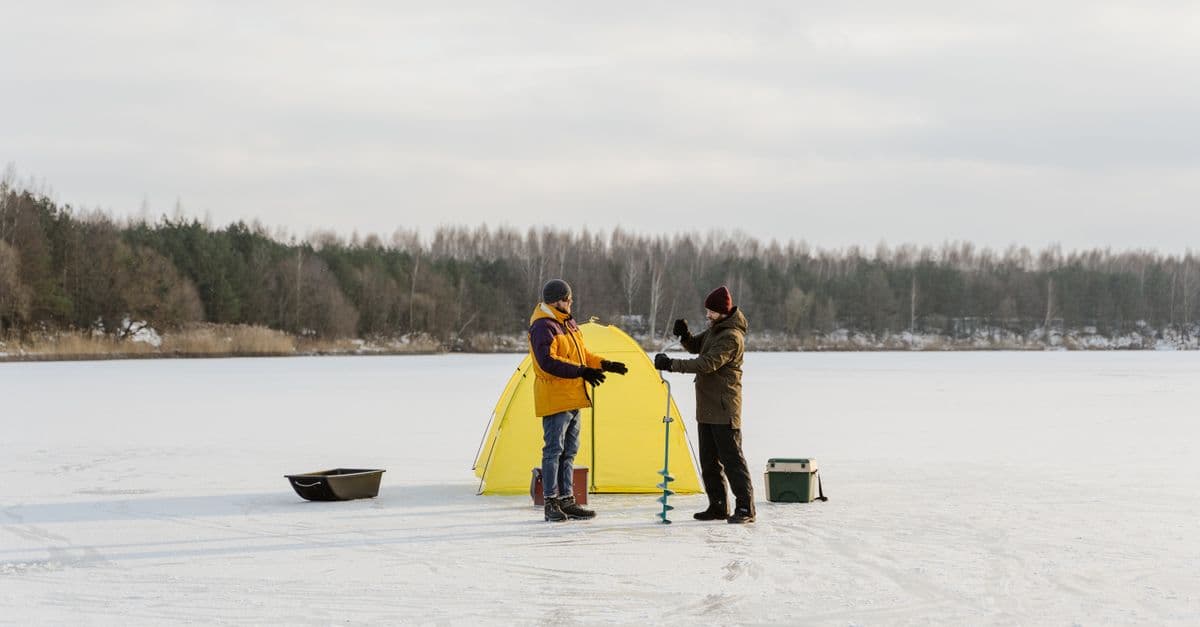
On the ice the spec that decides it is not capacity. It is whether the battery is warm enough to give you the capacity you paid for.
At a glance
Quick picks
Tap any row to jump to the full write-up. Weight is a column here because it is the spec that decides whether you actually carry the thing.
| # | Product | Best for | Capacity · Weight | Price |
|---|---|---|---|---|
| 1 |  Anker SOLIX C300 Anker SOLIX C300 | Best for a one-shelter day | 288Wh 9.1 lb | Check price |
| 2 |  BLUETTI Elite 30 V2 BLUETTI Elite 30 V2 | Best small unit with real output | 288Wh 9.5 lb | Check price |
| 3 |  Jackery Explorer 1000 v2 Jackery Explorer 1000 v2 | Best for a full day in a hub shelter | 1,070Wh 23.8 lb | Check price |
| 4 |  BLUETTI AC180 BLUETTI AC180 | Best for a towed shack | 1,152Wh 35.27 lb | Check price |
The short version: for a day on the ice with a flasher, a heater fan, lights and phones, buy the Anker SOLIX C300 — 288Wh and 300W in a 9.1 lb box that recharges to 80% in 50 minutes. If the shelter is a hub with people in it, the Jackery Explorer 1000 v2 is 1,070Wh at 23.8 lb, the best weight-to-capacity ratio here. And whichever you buy, the most important thing on this page is further down: keep it warm, and never try to charge it frozen.
Ice fishing is the hardest environment this category faces, and it is hard for a reason that has nothing to do with capacity. Every lithium battery loses usable capacity as it gets cold, and charging a LiFePO4 cell below freezing is the one thing that genuinely damages it. Every unit on this page has a battery management system that refuses to charge in those conditions — which is protection, not a fault, but it will look exactly like a dead power station if you are not expecting it.
What the cold actually does
Two separate effects, and people confuse them constantly. The first is discharge derating: a cold cell has higher internal resistance, so the watt-hours you can pull out of it shrink. The battery is not damaged and the capacity returns when it warms — you simply get less of it today. The second is charge blocking: below freezing the battery management system stops accepting a charge entirely, because plating lithium onto a frozen anode is permanent damage. Power stations in cold weather covers both in full, and it is worth reading before a January trip rather than during one.
What ice fishing actually draws
Far less than most people size for, which is why the small units lead this page. The figures below are nameplate bands for the categories — read the label on your own flasher, heater and camera, because the spread within each category is wide and your gear is the only gear that matters.
| Load | Typical draw | A day on 288Wh? |
|---|---|---|
| Flasher / sonar unit | 5-15W | Yes, many times over |
| Underwater camera | 8-20W | Yes |
| Propane heater fan and igniter | 3-10W | Yes |
| LED shelter light | 3-10W | Yes |
| Two phones charging | 10-15W each while charging | Yes |
| Laptop or tablet | 45-65W | Yes — several hours |
| Auger battery charger | 60-150W while charging | Yes — one or two packs |
| 12V heated blanket | 40-60W | Yes — a few hours |
| Electric kettle | 1,000-1,500W | No — exceeds the inverter |
That last line is the honest reading of this page. A 288Wh unit covers an ice-fishing day on paper, and it covers it comfortably in a warm shelter. It does not cover it if the unit spends eight hours at ambient temperature on a frozen lake. The cheap fix is insulation; the expensive fix is capacity. Both work, and only one of them costs money.
What an electric auger changes
Nothing, if you charge its battery at home — and that is the right answer. An electric ice auger runs on its own tool battery and draws hundreds of watts for the seconds it is cutting. Running one from an inverter through an adapter is possible and pointless. What a power station is genuinely good for is recharging that tool battery between days, which is a 60-150W load for an hour or so and well inside everything on this page.
If charging tool batteries in the field is a large part of why you are buying, best power station for power tools ranks the same registry on surge headroom instead, which is the spec that decides it for corded tools.
Is solar worth taking out?
Treat it as a bonus, never as the plan. A low winter sun for nine hours of daylight, often through cloud, with a panel you have to keep clear of snow — the harvest is a fraction of the panel's rating. How much solar input do you need shows the derate arithmetic in full. The one genuine advantage of the season is reflected light off snow, which is why a bifacial panel like the EcoFlow 220W is the type worth carrying in winter; the panel roundup covers the options.
How to choose between these four
- One rod, one bucket, walking out — Anker SOLIX C300: 9.1 lb, 288Wh, 80% in 50 minutes.
- Small but with surge headroom — BLUETTI Elite 30 V2: 600W continuous and a 1,500W lift from the same 288Wh.
- A hub shelter and a group — Jackery Explorer 1000 v2: 1,070Wh at 23.8 lb, 1,500W.
- A towed shack that stays out — BLUETTI AC180: 1,152Wh, four AC outlets, 3,500+ cycles.
- A long winter trip in a van — size it with what size power station for van life instead; a heater changes the arithmetic completely.
If you have not yet added up your own loads, do that first — what size power station do I need takes five minutes and usually moves people down a size band rather than up. And if weight across the ice is your deciding factor, the weight guide ranks the whole registry on watt-hours per pound.
What we have not done
We have not taken any of these units onto a frozen lake, measured their cold derate, or timed a recharge at 10F, and we are not going to imply we have. Every figure above is the manufacturer's published specification, linked at the foot of this page, plus arithmetic you can check and the well-documented behaviour of lithium cells at low temperature. How we choose sets out the method and its limits.
The picks in full
1. Best for a one-shelter day
Anker SOLIX C300
- 288Wh
- LFP (LiFePO4)
- 300W continuous / 600W surge
- 9.1 lb
- 100W
- 80% in 50 min
- 5 years
9.1 lb and 288Wh is the right size for what ice fishing actually draws. A flasher or sonar unit, a phone, a camera battery, a light and the fan on a propane heater are all small continuous loads — the kind 288Wh covers for a full day with margin, and the kind a 50 lb unit is pure punishment to drag across a frozen lake.
Anker publishes 300W continuous with a 600W SurgePad, an 80% recharge in 50 minutes, a 10 ms UPS switchover and 25dB at 3.3 ft. The recharge figure matters more here than almost anywhere else on the site: you get back to the truck, plug in, and the unit is usable again before you have finished loading the sled.
Anker publishes no cycle-life rating and no dimensions for this model, which is the real gap in the sheet. If documented longevity is what you are buying, the Jackery Explorer 300 v2 states 4,000+ cycles at the same capacity.
Reasons to buy
- 9.1 lb for 288Wh — easy to carry or sled
- 80% recharge in 50 minutes
- 10 ms UPS switchover
- 25dB at 3.3 ft — quiet inside a shelter
- 5-year warranty
Reasons to avoid
- No cycle-life rating published by Anker
- 300W continuous will not run anything that heats
- 100W maximum solar input
- No published dimensions or AC outlet count
Buy it if: a flasher, a phone, lights and a heater fan for a day.
Skip it if: you want a published cycle rating before you buy.
2. Best small unit with real output
BLUETTI Elite 30 V2
- 288Wh
- LiFePO4 (automotive-grade)
- 600W continuous / 1,500W surge
- 9.5 lb
- 200W
- Over 3,000 cycles; 10-year lifespan
- Full in 70 min
- 5 years
Same 288Wh class, double the output: BLUETTI publishes 600W continuous with a 1,500W lifting figure out of a 9.5 lb box. On the ice that buys the option of a load you did not plan for — a tool-battery charger, a 12V accessory through an adapter, a small pump — instead of a unit that trips at the first surprise.
It also publishes the longest documented life in the small class: over 3,000 cycles and a 10-year lifespan, a 70-minute full recharge, a UPS switchover of 10 ms or less, nine output ports including USB-C PD 3.1 at 140W, and 200W of solar input, twice the Anker's ceiling.
BLUETTI states plainly that the Elite 30 V2 does not support battery expansion, so this is the capacity you keep. For a day trip that is fine; for a weekend shack it is the reason to size up.
Reasons to buy
- 600W continuous, 1,500W surge from 288Wh
- Over 3,000 cycles and a stated 10-year lifespan
- Full recharge in 70 minutes
- 200W solar input — twice the small-class norm
- 9.5 lb; 10 ms or less switchover
Reasons to avoid
- No battery expansion, per BLUETTI
- 288Wh is still a day, not a weekend
- No dimensions published
- No cycle retention threshold published
Buy it if: a small unit you do not want to out-grow in one trip.
Skip it if: every ounce on the sled matters.
3. Best for a full day in a hub shelter
Jackery Explorer 1000 v2
- 1,070Wh
- LiFePO4 (LFP)
- 1,500W continuous / 3,000W surge
- 23.8 lb
- 400W
- 4,000 cycles to 70% capacity
- 1.7 hr wall; 1 hr emergency charge via app
- 5 years (with registration)
1,070Wh at 23.8 lb is 45.0Wh per pound, the best weight efficiency on this site, and that is the figure that matters when the unit has to come out of a truck bed, into a sled and across half a mile of ice.
1,500W continuous with a 3,000W surge covers a heater fan, a flasher, an underwater camera, a laptop for reviewing footage and the phone charging of everyone in the shelter at once. Jackery publishes 1.7 hours to full from the wall, a one-hour emergency charge from the app, and below 22 decibels in silent mode.
The 400W solar ceiling is the lowest in its class, which barely matters in January — short days and a low sun angle mean solar is not the ice-fishing recharge path anyway. Wall charging between trips is.
Reasons to buy
- 45.0Wh per pound — best on this site
- 1,070Wh and 1,500W continuous
- Full wall recharge in 1.7 hours
- Below 22 dB in silent mode
- 5-year warranty with registration
Reasons to avoid
- 400W solar input, lowest in the 1kWh class
- 4,000 cycles quoted to 70%, not 80%
- Not expandable
- Only two AC outlets
Buy it if: a hub shelter, a group, and a long day.
Skip it if: you are walking out with a bucket and one rod.
4. Best for a towed shack
BLUETTI AC180
- 1,152Wh
- LiFePO4
- 1,800W continuous / 2,700W surge
- 35.27 lb
- 500W
- 3,500+ cycles to 80% original capacity
- 1.3-1.8 hr full (1,440W max AC input)
- 5 years
1,152Wh is the biggest battery in the 1kWh class here, and four AC outlets plus four USB-A, a 100W USB-C and a 15W wireless pad make it the one that keeps a shack full of people and electronics alive without a power strip.
BLUETTI publishes 1,800W continuous with a 2,700W surge, a 1.3-1.8 hour full recharge at 1,440W input, a 20 ms UPS switchover and 3,500+ cycles to 80% of original capacity — the longest cycle rating here measured against the stricter threshold.
35.27 lb for 1,152Wh is 32.7Wh per pound, the worst weight efficiency in its class. In a shack you tow out once and leave, that is irrelevant. On a sled you pull by hand, it is the whole story.
Reasons to buy
- 1,152Wh — biggest battery in its class
- Four AC outlets plus a wireless charging pad
- 3,500+ cycles to 80% original capacity
- 1,800W continuous, 2,700W surge
- 5-year warranty
Reasons to avoid
- 35.27 lb — 32.7Wh per pound
- Not expandable
- 500W solar input
- Heaviest unit here you would still call portable
Buy it if: a towed shack that stays out all season.
Skip it if: you carry it any real distance.
Questions