Best Power Station for an Oxygen Concentrator
Two very different machines wear the same name. Size for the one you have, and read the manufacturer's manual before you read any shortlist.

At a glance
Quick picks
Tap any row to jump to the full write-up. Weight is a column here because it is the spec that decides whether you actually carry the thing.
| # | Product | Best for | Capacity · Weight | Price |
|---|---|---|---|---|
| 1 | 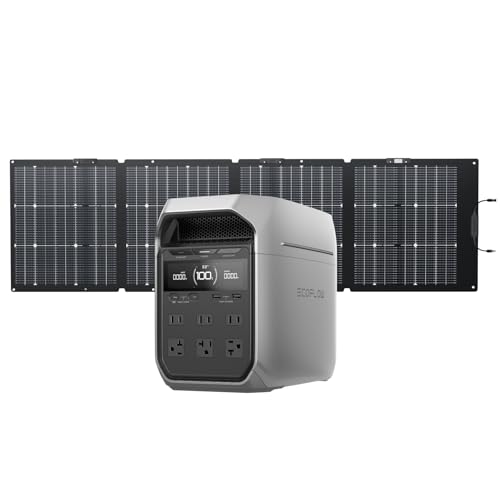 EcoFlow DELTA 3 Plus | Best for a home concentrator | 1,024Wh 27.6 lb | Check price on Amazon |
| 2 | 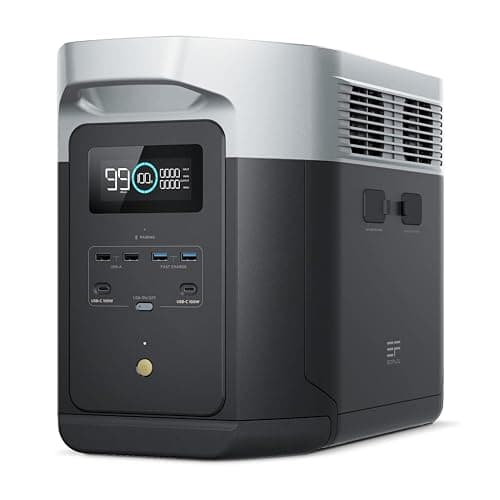 EcoFlow DELTA 2 Max | Best single-box runtime | 2,048Wh 50.7 lb | $1,028.99 · View on Amazon |
| 3 |  Anker SOLIX C300 | Best for a portable concentrator away from home | 288Wh 9.1 lb | Check price on Amazon |
| 4 | 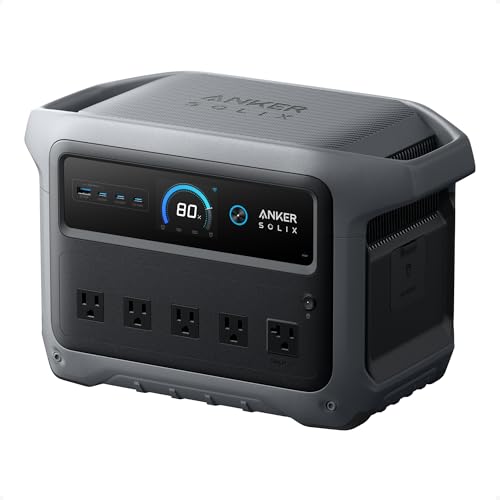 Anker SOLIX C1000 Gen 2 | Best output headroom | 1,024Wh 24.9 lb | $529.99 · View on Amazon |
With that said: the sizing question has a clear answer, and it depends entirely on which kind of concentrator you have. The two machines sold under that name differ by about a factor of ten in power draw, and almost every bad recommendation on this topic comes from treating them as one product.
Portable versus stationary: the whole decision
| Machine | Typical draw | Per hour | Hours from 1,024Wh | Hours from 2,048Wh |
|---|---|---|---|---|
| Portable, pulse dose, low setting | 20-40W | 20-40Wh | 20-40 | 40-80 |
| Portable, pulse dose, high setting | 40-80W | 40-80Wh | 10-20 | 20-40 |
| Portable, continuous flow mode | 100-150W | 100-150Wh | 5-8 | 11-16 |
| Home unit, 5L continuous flow | 300-450W | 300-450Wh | 2-3 | 4-5 |
| Home unit, 10L continuous flow | 500-650W | 500-650Wh | 1-2 | 3-4 |
Read the bottom two rows and the honest conclusion is plain: no portable power station in this site's registry runs a stationary home concentrator through a long outage on its own. A 1kWh unit buys you two to three hours. What a battery is genuinely good for is bridging a short cut, covering the gap while you move to a backup plan, or — with expansion batteries and solar input — stretching to something longer. Read the top three rows and the picture reverses entirely: a portable pulse-dose unit runs for a day or more from a mid-size battery, and for many hours from a 9 lb one.
The spec most buyers miss: switchover time
If the point is riding through an outage rather than powering a trip, switchover is the specification to buy on, and it is not the same as capacity. In UPS or pass-through mode the unit sits between the wall and the device; when the grid drops, the inverter takes over. How long that takes decides whether the machine carries on or restarts.
- Under 10 ms — EcoFlow publishes this for the DELTA 3 Plus. Fast enough that most mains equipment does not register the gap.
- 10 ms — Anker publishes this for the C1000 Gen 2 and the C300.
- 20 ms — EcoFlow publishes this for the DELTA 2 Max and BLUETTI for the AC180. Slower, and closer to the edge of what sensitive electronics tolerate.
- Check the device manual for its own tolerance. This is the number that matters and only the device maker publishes it. Do not infer it from a power station's spec sheet.
Pass-through charging explained covers how that mode works and what it costs the battery, and power station as a UPS for wifi and router is the same setup applied to a simpler load if you want to see the pattern first.
Working out your own number
If the outage is the reason you are shopping
Then size for a whole night or a whole day, not for the concentrator alone, and look seriously at expansion. Every pick above except the C300 has an expansion path or is already at 2kWh; best expandable power stations ranks the registry on exactly that specification, because buying a second battery later is far cheaper than buying a second power station.
Solar is the other half of a serious plan. A unit accepting 1,000W of input can put real watt-hours back during daylight, which against a portable concentrator's draw is more than it uses. How much solar input do you need has the realistic-harvest arithmetic, and best portable solar panels for power stations covers the panels.
And if the household need is bigger than a portable battery — a home concentrator plus a fridge for medication plus lights, for days — the honest answer is that you are shopping for home backup equipment rather than a portable unit. Best portable power stations for home backup covers where that line falls, and the 240V units at the top of it.
On the road
For travel with a portable concentrator the constraints are different again: weight, recharge speed, and whether you can top up from a car. The C300 at 9.1 lb with an 80% recharge in 50 minutes is built for that, and the DELTA 2 Max's published 800W of car charging is the fastest route to refilling a big battery while driving. Charging a power station from your alternator explains how that works and where it goes wrong.
Flying is a separate matter entirely and the answer is restrictive: power stations are above the watt-hour limits airlines permit in either cabin or hold. Can you bring a power station on a plane sets out the rules, and concentrator batteries themselves are governed by different rules you should confirm with the airline directly.
The picks in full
1. Best for a home concentrator
EcoFlow DELTA 3 Plus
- 1,024Wh
- LFP (LiFePO4)
- 1,800W continuous / 3,600W surge
- 27.6 lb
- 1000W
- 4,000 cycles to 80%+ capacity
- Full in 56 min (1,500W AC input)
- 5 years
A stationary home concentrator is a continuous load, commonly published in the 300-600W band at typical flow settings, and the two specifications that matter are therefore switchover time and expandable capacity. EcoFlow publishes a switchover under 10 ms on this unit — fast enough that equipment plugged through it does not see the grid fail — and expansion from 1,024Wh to 5 kWh with extra batteries.
EcoFlow publishes 1,800W continuous, a 3,600W surge, six AC outlets, 1,000W of solar input across two MPPT inputs, a 56-minute full wall recharge, 4,000 cycles to 80%+ capacity and a 5-year warranty. The 1,000W solar ceiling is what makes a multi-day outage plan possible rather than theoretical.
On its own, 1,024Wh against a 400W continuous draw is roughly two hours. That is the honest number and it is why the expansion path, not the base capacity, is the reason this unit tops the list. 27.6 lb and 37.1Wh per pound are unremarkable.
Reasons to buy
- Switchover under 10 ms
- Expands from 1,024Wh to 5 kWh
- 1,000W solar input across two inputs
- 1,800W continuous, 3,600W surge
- Six AC outlets; 5-year warranty
Reasons to avoid
- 1,024Wh alone is about two hours at 400W
- The expansion batteries are a separate purchase
- 27.6 lb
Buy it if: a stationary home unit and a plan that scales past one battery.
Skip it if: you need days of runtime from a single box.
2. Best single-box runtime
EcoFlow DELTA 2 Max
- 2,048Wh
- LFP (LiFePO4)
- 2,400W continuous
- 50.7 lb
- 1000W
- 3,000 cycles to 80% capacity
- 2.3 hr; 800W car/alternator charging
- 5 years
2,048Wh is twice the battery of the 1kWh class and the most runtime here without buying a second pack: against a 400W continuous draw that is roughly four hours, and against a portable concentrator's much smaller pulse-dose draw it is a very long time indeed. It also expands from 2 kWh to 6 kWh with up to two extra batteries.
EcoFlow publishes 2,400W continuous, fifteen outputs including six AC, 1,000W of solar input, 800W of car and alternator charging, a 2.3-hour wall recharge, a switchover under 20 ms and 3,000 cycles to 80% capacity. The 800W car-charging figure matters for anyone whose plan includes driving somewhere with power.
50.7 lb, no published surge figure and no published dimensions. The 20 ms switchover is slower than the DELTA 3 Plus — still inside what most equipment tolerates, but check your device's manual rather than assuming.
Reasons to buy
- 2,048Wh — the most runtime in one box here
- Expands from 2 kWh to 6 kWh
- 1,000W solar; 800W car charging
- 2,400W continuous
- 5-year warranty
Reasons to avoid
- 50.7 lb — not portable in any useful sense
- No surge figure published
- 20 ms switchover, not 10 ms
- No published dimensions
Buy it if: runtime in hours from a single unit you will not move.
Skip it if: the concentrator travels with you.
3. Best for a portable concentrator away from home
Anker SOLIX C300
- 288Wh
- LFP (LiFePO4)
- 300W continuous / 600W surge
- 9.1 lb
- 100W
- 80% in 50 min
- 5 years
A portable pulse-dose concentrator is a small load — published figures for the class commonly sit in the 20-60W band in pulse mode — and against that, 288Wh in a 9.1 lb box is genuinely useful rather than token. Anker publishes a 10 ms UPS switchover, 300W continuous with a 600W SurgePad, and 80% recharge in 50 minutes.
The 50-minute recharge is the specification that makes this work as travel equipment: a stop for lunch puts most of the battery back. Anker also publishes 25dB at 3.3 ft, a 5-year warranty, LFP chemistry and four USB-C ports up to 140W, which covers the phone and tablet that travel alongside.
300W continuous rules out any stationary home concentrator — do not buy this for one. Anker publishes no cycle-life rating, no dimensions and no AC outlet count for this model, which are real gaps. Our Anker SOLIX C300 review lists them all.
Reasons to buy
- 9.1 lb — travels easily
- 10 ms UPS switchover
- 80% recharge in 50 minutes
- 25dB at 3.3 ft
- 5-year warranty
Reasons to avoid
- 300W continuous — portable units only
- No cycle-life rating published by Anker
- 100W maximum solar input
- No published dimensions
Buy it if: a pulse-dose portable unit on a road trip or a day out.
Skip it if: the machine is a stationary home concentrator.
4. Best output headroom
Anker SOLIX C1000 Gen 2
- 1,024Wh
- LiFePO4 (InfiniPower LFP)
- 2,000W continuous / 3,000W surge
- 24.9 lb
- 600W
- 80% capacity after 4,000 cycles
- Full in 49 min (UltraFast, 1,600W max input)
- 5 years
2,000W continuous with a 3,000W surge from 1,024Wh and 24.9 lb is the widest output envelope per pound in the registry, and it is the pick if the concentrator shares the unit with anything else — a nebuliser, a CPAP, a fridge for medication, a laptop. Anker publishes a 10 ms UPS switchover and a full recharge in 49 minutes at 1,600W input.
Also published: 80% capacity after 4,000 cycles, a 5-year warranty, 600W of solar input, a 140W USB-C port and dimensions of 15.12 x 8.19 x 9.61 in. The 49-minute recharge is the fastest here, which matters when grid power comes back intermittently.
Two AC outlets is the limitation that bites in exactly the scenario this pick is for, and it does not expand — so the 1,024Wh is the ceiling, roughly two hours at a 400W continuous draw. Consider a power strip, and read the device manual on whether that is acceptable for your equipment.
Reasons to buy
- 2,000W continuous, 3,000W surge
- 10 ms UPS switchover
- Full recharge in 49 minutes
- 80% capacity after 4,000 cycles
- 24.9 lb for 1,024Wh
Reasons to avoid
- Only two AC outlets
- Not expandable — 1,024Wh is the ceiling
- 600W solar input
Buy it if: the concentrator shares a unit with other equipment.
Skip it if: you need more than about two hours.
Questions