Are Portable Power Stations Loud?
Quieter than any generator and not silent. The noise comes from a cooling fan, which means you can predict it - and mostly avoid it.

The short answer
No, not by the standards of anything they replace - a power station has no engine, and its only moving part is a cooling fan. At rest it is silent; running a small load it is usually silent; under heavy load or while fast charging the fan runs and it becomes clearly audible. Two manufacturers in our registry publish a figure: Anker states 25dB at 3.3 ft for the SOLIX C300, and Jackery publishes a quiet mode below 22 decibels on the Explorer 1000 v2. Everyone else publishes nothing, which is why the reliable way to keep a unit quiet is to understand when the fan runs rather than to shop on a number.
At a glance
Quick picks
Tap any row to jump to the full write-up. Weight is a column here because it is the spec that decides whether you actually carry the thing.
| # | Product | Best for | Capacity · Weight | Price |
|---|---|---|---|---|
| 1 |  Anker SOLIX C300 | The only published small-unit figure | 288Wh 9.1 lb | Check price on Amazon |
| 2 | 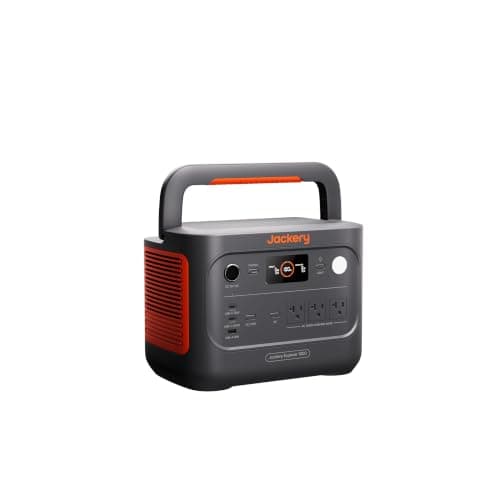 Jackery Explorer 1000 v2 | Best published quiet mode in the 1kWh class | 1,070Wh 23.8 lb | $559.00 · View on Amazon |
| 3 | 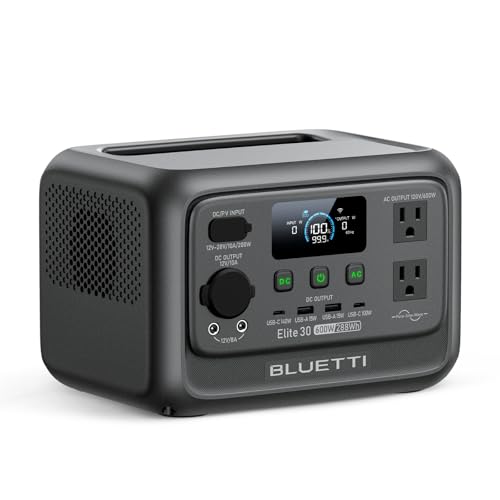 BLUETTI Elite 30 V2 | Most output from a unit with no fan to work hard | 288Wh 9.5 lb | $289.99 · View on Amazon |
Where the noise comes from
One source: a cooling fan. A power station has no engine, no alternator and no moving parts other than that fan, so unlike a generator its noise is not continuous and not proportional to what it is doing - it is a thermostat behaviour. The fan runs when the electronics get warm, and stops when they cool.
Which means the question 'is it loud' has four different answers depending on what it is doing at the time.
| State | Fan behaviour | What you hear |
|---|---|---|
| Switched off | Off | Nothing |
| On, nothing plugged in | Off | Nothing |
| DC loads only, small | Off | Usually nothing |
| AC inverter on, light load | Occasional | Brief, intermittent |
| AC load near its continuous rating | Continuous | Clearly audible |
| Charging slowly from solar | Off or occasional | Usually nothing |
| Fast charging from the wall | Continuous, often maximum | The loudest it gets |
| Hot ambient temperature | Earlier and longer | More than you expect |
Read the fast-charging row twice, because it reverses what people assume. The loud moment is not when the unit is working hardest for you - it is when it is refilling at 1,500 or 2,600 watts, which is several times most discharge loads. A unit recharging in 49 minutes is dissipating a lot of heat to do it.
The two published figures, in context
Anker publishes 25dB at 3.3 ft for the SOLIX C300. Jackery publishes below 22 decibels in a quiet mode for the Explorer 1000 v2. Those are the only noise specifications in our registry, and both are low - in the region of a quiet room, well below normal conversation. Neither is a measurement we have made, and we are not going to imply we have a lab.
Every other manufacturer in our registry - BLUETTI, EcoFlow, and Anker on its other models - publishes nothing at all. That is an unsatisfying answer and it is the true one. Where a specification does not exist, this site says so rather than finding a number somewhere and presenting it as the maker's.
How to keep it quiet, in order of effect
- Charge it before you need quiet. Fast charging is the loud state, so refill it during the day or on the drive, not at the campsite at 10pm. This single habit removes most of the noise anyone ever hears from one of these.
- Use a slower charge rate. Several brands expose a charge-speed setting in their app - a 1,000W charge is quieter than a 1,600W one, and overnight you do not need the 49-minute figure you paid for.
- Run DC loads from the car or USB ports. Lights, fans, a 12V cooler and phone charging through USB-C never switch the inverter on, and the inverter is usually what starts the fan.
- Switch the AC output off when nothing needs it. An idling inverter produces heat for no benefit, and on a small unit that is enough to cycle the fan.
- Give it air. A unit in a closed box, a tight cupboard or a car footwell with a bag on it will run its fan far more than the same unit on an open surface. This is the most common self-inflicted cause.
- Keep it out of direct sun. Ambient temperature moves the fan's threshold. A unit at 35C starts its fan at a load that would be silent at 20C.
Compared with a generator, it is not close
An inverter generator - the quiet, enclosed, variable-speed kind, not an open-frame contractor unit - commonly sits around 50 to 60 dBA at a quarter load. Decibels are logarithmic, so the gap between that and a 25dB power station is not a modest improvement; it is the difference between a machine you can hear across a campsite and one you cannot hear from the next tent.
And a generator's noise is constant while it runs, because it is an engine turning. A power station's is intermittent and load-dependent, which is why the practical experience of owning one is mostly silence punctuated by a fan. Portable power station vs inverter generator sets the two out in full, including the two things a generator still wins.
For the places where quiet is the point of the purchase: best power station for tent camping and best power station for astrophotography both rank with noise in mind, and best power station for a home office is the indoor version - where the specification you notice by week two is the fan during a recharge.
The picks in full
1. The only published small-unit figure
Anker SOLIX C300
- 288Wh
- LFP (LiFePO4)
- 300W continuous / 600W surge
- 9.1 lb
- 100W
- 80% in 50 min
- 5 years
Anker publishes 25dB at 3.3 ft on its C300 product page - the only hard noise specification on a small unit anywhere in our registry, and the reason this is the pick for anyone buying primarily on quiet. 25dB at a metre is in the region of a quiet room rather than a quiet appliance.
288Wh at 9.1 lb with 300W of AC and a 600W SurgePad peak, a 10 ms UPS switchover, 100W of maximum solar input, seven device ports - four USB-C at 140W, 100W, 20W and 15W, two 12W USB-A, and a 120W car socket - 80% charge in 50 minutes and a 5-year warranty.
The port list is the practical half of the quiet story: with four USB-C ports and a car socket, most of what you would plug in never needs the inverter at all, and the inverter is what usually starts the fan. Anker publishes no cycle life, no dimensions and no AC outlet count for this model.
Reasons to buy
- 25dB at 3.3 ft - published
- Four USB-C ports, so the inverter can stay off
- 9.1 lb; 10 ms switchover
- 80% charge in 50 minutes
- 5-year warranty
Reasons to avoid
- 300W AC output
- No published cycle life or dimensions
- 100W solar input
Buy it if: a tent, a bedside, or anywhere quiet matters most.
Skip it if: you need real AC output.
2. Best published quiet mode in the 1kWh class
Jackery Explorer 1000 v2
- 1,070Wh
- LiFePO4 (LFP)
- 1,500W continuous / 3,000W surge
- 23.8 lb
- 400W
- 4,000 cycles to 70% capacity
- 1.7 hr wall; 1 hr emergency charge via app
- 5 years (with registration)
Jackery publishes a quiet mode below 22 decibels on this model, which is the lowest figure quoted by any manufacturer in our registry. It is a mode rather than a constant - a unit charging at 1,000W is not going to be at 22dB - but it means the behaviour has been designed for rather than left to the thermostat.
1,070Wh at 23.8 lb, the lightest 1kWh unit we cover, with 1,500W continuous and a 3,000W surge, a 1.7-hour wall recharge, 400W of maximum solar input, 4,000 cycles to 70% capacity, a switchover under 20 ms, a 5-year warranty with registration, and dimensions of 12.87 x 8.82 x 9.72 in.
The 1.7-hour recharge is slower than the 49-minute and 56-minute figures elsewhere in the class, and on a page about noise that is a feature rather than a fault - a slower charge is a quieter charge. Two AC outlets and no expansion.
Reasons to buy
- Quiet mode published below 22 dB
- 1,070Wh at 23.8 lb
- Slower charge rate means a quieter charge
- 4,000 cycles; 5-year warranty with registration
- Published dimensions
Reasons to avoid
- Two AC outlets
- 400W solar input
- Not expandable
Buy it if: a kilowatt-hour near where people are sleeping.
Skip it if: you want the fastest recharge in the class.
3. Most output from a unit with no fan to work hard
BLUETTI Elite 30 V2
- 288Wh
- LiFePO4 (automotive-grade)
- 600W continuous / 1,500W surge
- 9.5 lb
- 200W
- Over 3,000 cycles; 10-year lifespan
- Full in 70 min
- 5 years
600W continuous and a 1,500W surge from 288Wh. The relevance to noise is indirect but real: a unit with a large inverter relative to the load it is given runs cool, and a cool unit does not spin its fan. 600W asked to deliver 50W is working at a twelfth of its rating.
BLUETTI publishes a 70-minute full recharge, a UPS switchover of 10 ms or less, 200W of maximum solar input, nine output ports including USB-C PD 3.1 up to 140W, over 3,000 cycles with a stated 10-year lifespan and a 5-year warranty.
BLUETTI publishes no decibel figure for this model, and no dimensions or AC outlet count either, so the quiet claim here is inference from the specification rather than a manufacturer statement - which we would rather say than imply a number we do not have.
Reasons to buy
- 600W continuous from 288Wh - runs cool at light loads
- 9.5 lb; nine output ports
- 70-minute recharge; 10 ms or less switchover
- Over 3,000 cycles; 5-year warranty
Reasons to avoid
- No published noise figure
- No published dimensions or outlet count
- 288Wh total
Buy it if: light loads on a big inverter, kept cool.
Skip it if: you want a published decibel number.
Questions