Can a Power Station Power a House?
It can run the part of the house you actually need during an outage. The whole house is a different product, and anyone telling you otherwise is selling something.

The short answer
No portable power station runs a whole house, and nothing in our registry comes close - central air conditioning, an electric water heater, an electric range and an electric dryer together are tens of kilowatts, and our largest single unit is 3.84. What a power station does run, well, is the critical-loads list: a refrigerator, a freezer, the internet, lights, phones, a laptop, a CPAP and a furnace blower. That list typically totals 2 to 5 kWh a day, which puts a 2 kWh unit at half a day and an expandable 3.84 kWh system with solar input at genuinely open-ended. The honest framing is 'which circuits', not 'the house'.
At a glance
Quick picks
Tap any row to jump to the full write-up. Weight is a column here because it is the spec that decides whether you actually carry the thing.
| # | Product | Best for | Capacity · Weight | Price |
|---|---|---|---|---|
| 1 | 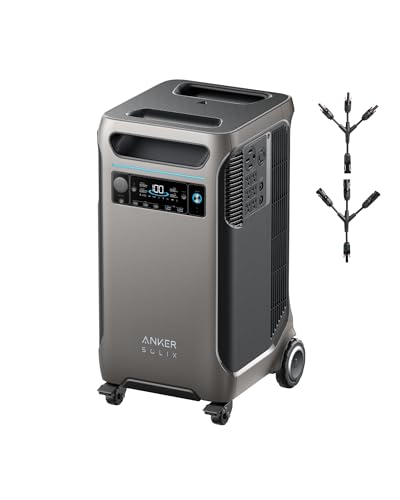 Anker SOLIX F3800 | The only unit that can feed a panel | 3,840Wh 132.3 lb | Check price on Amazon |
| 2 | 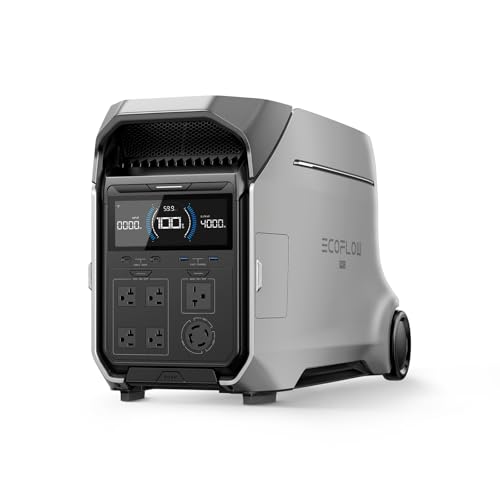 EcoFlow DELTA Pro 3 | Largest single pack, 240V included | 4,096Wh Weight n/p | Check price on Amazon |
| 3 | 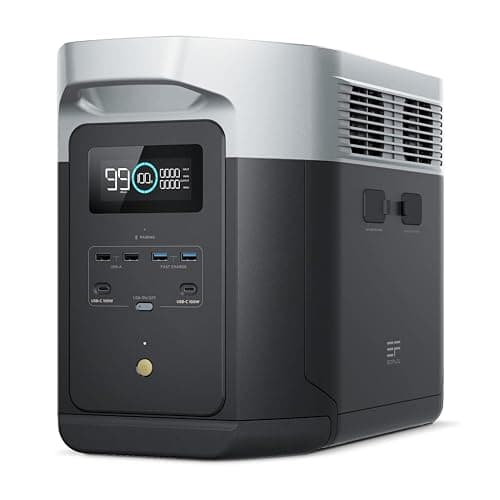 EcoFlow DELTA 2 Max | Best realistic critical-loads unit | 2,048Wh 50.7 lb | $1,028.99 · View on Amazon |
What a house actually uses, and why the answer is no
The reason 'whole house' is not available from any portable unit is the heating and cooling loads. Everything else in a home is small; the things that convert electricity to heat are enormous, and there is no way to engineer around the physics of it. Read your own appliance plates, but these are the bands that decide it.
| Load | Typical nameplate band | Our largest unit |
|---|---|---|
| Central air conditioning | 3,000-6,000W, running for hours | Starts it; empties in under an hour |
| Electric water heater | 4,500-5,500W | Runs it for well under an hour |
| Electric range or oven | 2,000-5,000W per element | One element, briefly |
| Electric clothes dryer | 3,000-5,000W | One load, maybe |
| Electric furnace with strip heat | 10,000-20,000W | No |
| Furnace blower only (gas heat) | 300-800W | Yes, for many hours |
| Refrigerator | 150-250W running | Days |
| Freezer | 100-200W running | Days |
| Router, modem, ONT | 10-30W | Weeks |
| LED lighting, whole house | 100-200W | Days |
| Well pump, 120V jet | 800-1,500W running | Yes, intermittently |
| Sump pump | 500-1,000W running | Yes, intermittently |
Read the two furnace rows together, because that distinction saves a lot of households a lot of money. A gas or oil furnace needs electricity only for its blower, its igniter and its controls - a few hundred watts - so a portable unit keeps the heat on through an outage very comfortably. An electric furnace with resistance strip heat is ten to twenty kilowatts and is not a battery proposition at any size we cover.
The critical-loads list, costed
The refrigerator figures there assume a duty cycle, which is how a compressor actually behaves - it runs in bursts rather than continuously. How many watt-hours does a refrigerator use works that properly, and best power station for a freezer explains why a full freezer holds cold for about 48 hours unopened and therefore needs top-ups rather than continuous running.
How to connect it: three options, in order of honesty
Extension leads. Unglamorous and completely legitimate. The unit sits in the kitchen or the hall, the fridge and the router plug into it, and a lead runs to a lamp. Nothing to install, nothing to permit, nothing that can be wired wrong. For most households during most outages, this is the correct answer and there is no shame in it.
A manual transfer switch with an inlet. An electrician fits a transfer switch next to your panel and an exterior inlet box, and selected circuits - the fridge circuit, the furnace, a lighting circuit - can be switched from the grid to your unit. This is what the F3800's NEMA L14-30 is for. It is a permitted job in most jurisdictions and it is the right way to feed circuits rather than appliances.
An interlock kit on the main panel. A mechanical plate that makes it physically impossible to have the main breaker and the generator breaker closed at the same time. Cheaper than a transfer switch, equally legitimate when installed correctly, and equally a job for an electrician and an inspection.
What makes it last longer
- Solar input. This is the single biggest factor and it changes the category of the answer. 1,000-2,400W of panel turns a fixed battery into a daily allowance. How much solar input do you need sizes it.
- Expansion batteries. Our registry runs to 53.8 kWh on the F3800 and 48 kWh on the DELTA Pro 3. At that scale this is a home battery, not a portable unit, and the price reflects it.
- Leaving the freezer shut. A full chest freezer holds cold for about 48 hours unopened. Treating it as intermittent rather than continuous cuts a third off the daily figure.
- Running DC where you can. Lights, fans and a 12V cooler from the car socket skip the inverter and its conversion loss - this site's guides put that loss around 12% on AC-run loads.
- Switching the AC inverter off when nothing needs it. An idling inverter is a standby draw, and on a multi-day outage it is a real one.
If what you are really sizing is one specific outage rather than a philosophy, what size power station for a power outage is the arithmetic page, and best portable power stations for home backup is the shortlist. If the reason you are asking is a storm season rather than a one-off, best power station for hurricane season is written around multi-day outages specifically.
The picks in full
1. The only unit that can feed a panel
Anker SOLIX F3800
- 3,840Wh
- LiFePO4 (LFP)
- 6,000W continuous / 9,000W surge
- 132.3 lb
- 2400W
- 3,000+ cycles
- 1,800W max AC input
- 5 years
A NEMA L14-30 rated at 6,000W, which is the twist-lock inlet a manual transfer switch expects, plus a NEMA 14-50 also at 6,000W and six NEMA 5-20 outlets. That L14-30 is the specification that makes 'powering the house' a real conversation rather than an extension-lead exercise: wired through a transfer switch by an electrician, this unit feeds selected circuits properly.
Anker publishes 3,840Wh of LiFePO4, 6,000W continuous with a 9,000W peak, 2,400W of maximum solar input, 1,800W of AC input, 3,000+ cycles, a 5-year warranty, and expansion to 53.8 kWh across six extra batteries. 6,000W continuous and 240V output together mean a well pump and a furnace are in range, which they are not on anything else here.
132.3 lb on wheels, 27.6 x 15.3 x 15.6 in including them, and Anker publishes no UPS switchover time for this model - so it transfers over, it does not ride through. At 53.8 kWh with panels this stops being a portable product and becomes a home battery that you could, in principle, move.
Reasons to buy
- NEMA L14-30 at 6,000W for a transfer switch
- 6,000W continuous, 240V output
- 3,840Wh, expandable to 53.8 kWh
- 2,400W maximum solar input
- 3,000+ cycles; 5-year warranty
Reasons to avoid
- 132.3 lb
- No published switchover time
- Needs an electrician to install properly
Buy it if: a critical-loads panel and a real outage plan.
Skip it if: you want something portable.
2. Largest single pack, 240V included
EcoFlow DELTA Pro 3
- 4,096Wh
- LFP (EV-grade)
- 4,000W continuous / 6,000W surge
- 80% capacity after 4,000 cycles
- 80% in 50 min
- 5 years (3-year standard plus 2-year extended)
4,096Wh with 120V and 240V output, 4,000W continuous and a 6,000W peak - the largest single pack in our registry and the other unit here that reaches 240V. EcoFlow publishes seven charging methods and expansion from 4 kWh to 48 kWh, which is the widest growth path we cover.
4,096Wh at 85% usable is about 3,482Wh. Against a critical-loads list of 2 to 5 kWh a day, that is most of one day as a single unit - and with expansion batteries it becomes a multi-day plan without changing the inverter.
EcoFlow publishes 80% capacity after 4,000 cycles, 80% charge in 50 minutes and a 5-year term made up of three years standard plus two extended. It publishes no weight, no maximum solar input in its overview, and no receptacle breakdown - so whether it presents an inlet-compatible socket is a question for the seller.
Reasons to buy
- 4,096Wh - the largest single pack here
- 120V and 240V output
- Expandable from 4 kWh to 48 kWh
- 80% capacity after 4,000 cycles
- Seven charging methods
Reasons to avoid
- No published weight or receptacle list
- No published maximum solar input
- No published switchover time
Buy it if: the biggest capacity with room to grow.
Skip it if: you need the socket list before you buy.
3. Best realistic critical-loads unit
EcoFlow DELTA 2 Max
- 2,048Wh
- LFP (LiFePO4)
- 2,400W continuous
- 50.7 lb
- 1000W
- 3,000 cycles to 80% capacity
- 2.3 hr; 800W car/alternator charging
- 5 years
2,048Wh and 2,400W continuous through six AC outlets, expandable to 6 kWh with up to two extra batteries. This is the shape of unit that actually covers a critical-loads list for most households - a fridge, the internet, lights and devices - without a wiring job or a 132 lb appliance.
EcoFlow publishes 1,000W of maximum solar input, 800W of car and alternator charging, a 2.3-hour wall recharge, a switchover under 20 ms, 3,000 cycles to 80% capacity, 50.7 lb and a 5-year warranty. The 1,000W solar figure is what turns a half-day of capacity into something that refills daily.
No 240V and no inlet receptacle, so this is an extension-lead plan: the fridge, the router and a lamp plugged into the unit directly. EcoFlow publishes no surge figure and no dimensions for this model, and for a fridge restart the missing surge figure is a genuine gap.
Reasons to buy
- 2,048Wh, expandable to 6 kWh
- 2,400W continuous, six AC outlets
- 1,000W solar and 800W alternator input
- Under 20 ms switchover
- 3,000 cycles to 80%; 5-year warranty
Reasons to avoid
- No published surge figure or dimensions
- No 240V output; no inlet socket
- 50.7 lb
Buy it if: the fridge, the internet and the lights, with no wiring.
Skip it if: you want circuits rather than extension leads.
Questions