Surge Watts vs Running Watts
Two numbers on every spec sheet, measuring two different things, and the one most people shop on is the one that matters less.
The short answer
Running watts - also called continuous or rated watts - is the power a unit can supply indefinitely, and it decides what you can keep running. Surge watts, also called peak or starting watts, is the much larger figure it can supply for a brief instant, and it decides whether a motor-driven appliance will start at all. Anything with a compressor, a pump or a motor needs the surge figure checked first, because a unit that cannot supply the inrush does not run the appliance weakly - it trips and stops. Anything that only heats or only glows needs only the running figure.
At a glance
Quick picks
Tap any row to jump to the full write-up. Weight is a column here because it is the spec that decides whether you actually carry the thing.
| # | Product | Best for | Capacity · Weight | Price |
|---|---|---|---|---|
| 1 | 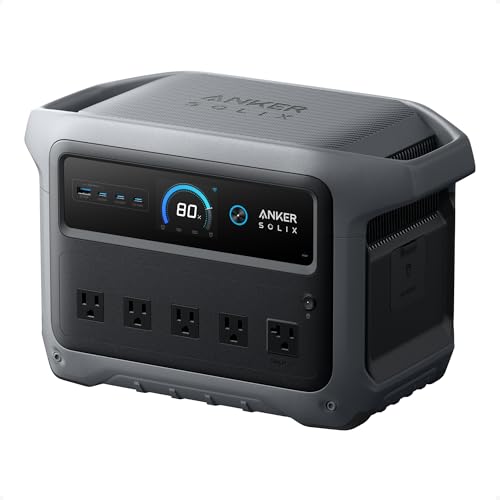 Anker SOLIX C1000 Gen 2 | Best running-watt figure per pound | 1,024Wh 24.9 lb | $529.99 · View on Amazon |
| 2 | 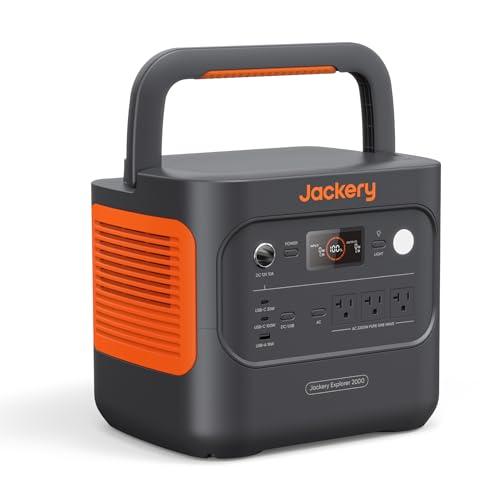 Jackery Explorer 2000 v2 | Best surge ratio at scale | 2,042Wh 39.5 lb | $999.00 · View on Amazon |
| 3 | 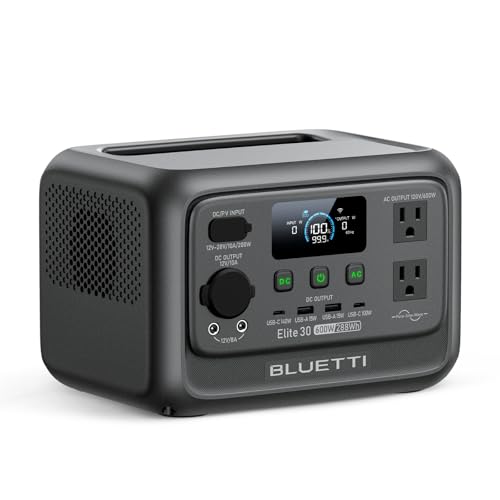 BLUETTI Elite 30 V2 | Highest surge ratio in the registry | 288Wh 9.5 lb | $289.99 · View on Amazon |
What each figure is measuring
Running watts is a thermal limit. The inverter's transistors, its heatsink and its fan can dissipate a certain amount of waste heat indefinitely, and the continuous rating is the output at which that balance holds. Exceed it for long and the unit either throttles or shuts down to protect itself. This is the figure that tells you what you can keep running, and it is the figure almost every roundup leads with.
Surge watts is a current limit over a short window. For a fraction of a second the same transistors can pass far more current than they can sustain, because the heat has not had time to build up. That window is what an electric motor needs: at the instant it starts, a motor draws several times its running current, and the inrush collapses as soon as the rotor is turning.
So the two numbers answer two different questions. Running watts: *can this unit keep my things on?* Surge watts: *will my things come on in the first place?* If the second answer is no, the first is irrelevant.
Which appliances need which figure
| Load | Starting surge? | Which figure decides it |
|---|---|---|
| Phone and laptop chargers | No | Running watts |
| LED lights, string lights | No | Running watts |
| Television, router, console | No | Running watts |
| Kettle, toaster, hot plate | No - resistive | Running watts |
| Space heater, electric blanket | No - resistive | Running watts |
| Microwave | Yes - its magnetron draws more than the plate says | Both |
| Refrigerator, freezer | Yes - compressor | Surge first |
| Window or portable air conditioner | Yes - compressor | Surge first |
| Sump pump, well pump | Yes - motor under load | Surge first |
| Power tools, circular saw | Yes - motor | Surge first |
| Blender, food processor | Yes - motor | Surge first |
| Pellet grill | Brief - igniter, then small | Surge, briefly |
The microwave row is the one that catches people. A 1,000W microwave is rated by the cooking power it delivers, not by what it draws - the input is commonly half again as much, and it is a sharp draw rather than a smooth one. What size power station to run a microwave has the full arithmetic.
Where to find your appliance's real numbers
On the nameplate, which is a sticker or a stamped plate on the back, the base or inside the door. For a motor appliance it typically publishes two figures that matter: RLA or rated load amps, which is the running current, and LRA or locked rotor amps, which is the worst-case starting current. Multiply each by your supply voltage to get watts.
Three traps in the surge figure
Nobody publishes the duration. No manufacturer in our registry states how long its peak rating is held for, and that is the specification that would tell you whether the figure is useful. Treat every surge number as a ceiling rather than a promise, and leave margin accordingly.
Some peaks are voltage tricks. Several brands publish a boost mode that runs a resistive load at reduced voltage so it fits inside the inverter's limit - EcoFlow's X-Boost gets 2,200W out of an 1,800W inverter this way, and BLUETTI publishes a 3,900W 'Power Lifting' figure for purely resistive loads on the Elite 200 V2. Both are honest about the restriction, and it is an important one: a motor fed reduced voltage draws more current and runs hotter, so these modes are for kettles and heaters only.
A figure can be missing entirely. EcoFlow publishes no surge rating for the DELTA 2 Max, a 2,400W unit. That is a blank in the manufacturer's own specification, and for a hard-start load it should disqualify a unit from your shortlist rather than be assumed away. Best power station for high-surge loads ranks the whole registry on this figure and says plainly which units publish nothing.
The same two numbers on a generator
Fuel generators use exactly this vocabulary, and it is where most people first meet it: a '2,200W' inverter generator typically means 2,200W of peak with around 1,800W of running output. The convention is the same and so is the reason for it - an engine and alternator can also be overloaded briefly. If you are comparing the two product categories, portable power station vs inverter generator sets them side by side on both figures.
Once both numbers check out, the remaining question is capacity - how long it all runs - and that is a different calculation again. What size power station do I need is the one to read next, and watt-hours explained covers why watts and watt-hours are not interchangeable units.
The picks in full
1. Best running-watt figure per pound
Anker SOLIX C1000 Gen 2
- 1,024Wh
- LiFePO4 (InfiniPower LFP)
- 2,000W continuous / 3,000W surge
- 24.9 lb
- 600W
- 80% capacity after 4,000 cycles
- Full in 49 min (UltraFast, 1,600W max input)
- 5 years
2,000W continuous with a 3,000W surge, from 24.9 lb. In our registry nothing else delivers that much sustained output for that little weight, and the running figure is the one that sets the envelope: at 2,000W you are not thinking about which appliance to unplug before using another.
Anker publishes 1,024Wh of LFP, a full recharge in 49 minutes at 1,600W input, 600W of maximum solar input, a 10 ms UPS switchover, 80% capacity after 4,000 cycles, a 5-year warranty and dimensions of 15.12 x 8.19 x 9.61 in.
The 1.5x surge-to-continuous ratio is modest - several units in our registry publish 2.0x - but it is 1.5x of a large number. 3,000W of peak clears most household compressors. Two AC outlets, and no expansion.
Reasons to buy
- 2,000W continuous from 24.9 lb
- 3,000W surge clears most compressors
- 10 ms switchover; 49-minute recharge
- 4,000 cycles to 80%; 5-year warranty
Reasons to avoid
- 1.5x surge ratio, not 2x
- Two AC outlets
- Not expandable
Buy it if: a wide envelope of appliances, one at a time or two.
Skip it if: you need a specific 240V load started.
2. Best surge ratio at scale
Jackery Explorer 2000 v2
- 2,042Wh
- LiFePO4 (LFP)
- 2,200W continuous / 4,400W surge
- 39.5 lb
- 4,000 cycles to 70%+ capacity
- 1.33 hr full with Emergency Super Charge
- 3 years, extendable to 5
4,400W of surge over 2,200W continuous - a full 2.0x ratio on a 2 kWh unit, and the largest peak figure in our registry outside the two wheeled units. For hard-start loads this is the specification that matters, and it comes in a box that still goes in a car at 39.5 lb.
Jackery publishes 2,042Wh of LiFePO4, 4,000 cycles to 70%+ capacity, a 1.33-hour full recharge with Emergency Super Charge, and dimensions of 13.2 x 10.4 x 11.5 in, with a 3-year warranty extendable to 5.
Jackery publishes no maximum solar input figure and no UPS switchover time for this model, and only two AC outlets. On a page about output specifications it is worth noting that two of the figures a buyer wants are simply absent from the manufacturer's own page.
Reasons to buy
- 4,400W surge, 2,200W continuous - 2.0x
- 2,042Wh at 39.5 lb
- Full recharge in 1.33 hr
- 4,000 cycles to 70%+
Reasons to avoid
- No published solar input or switchover
- Two AC outlets
- 39.5 lb
Buy it if: starting compressors and pumps on 120V.
Skip it if: you want every figure published.
3. Highest surge ratio in the registry
BLUETTI Elite 30 V2
- 288Wh
- LiFePO4 (automotive-grade)
- 600W continuous / 1,500W surge
- 9.5 lb
- 200W
- Over 3,000 cycles; 10-year lifespan
- Full in 70 min
- 5 years
600W continuous with a 1,500W surge, from 288Wh. That is a 2.5x ratio - the highest anywhere in our registry - and it is the clearest demonstration of why the two numbers are different specifications rather than two versions of the same one. A 9.5 lb box starts things that 300W units refuse.
BLUETTI publishes a 70-minute full recharge, a UPS switchover of 10 ms or less, 200W of maximum solar input, nine output ports including USB-C PD 3.1 up to 140W, over 3,000 cycles with a stated 10-year lifespan and a 5-year warranty.
The running figure is the limit here, not the surge: 600W runs a television, a laptop, lights and a blender in bursts, and nothing that heats. BLUETTI publishes no dimensions, no AC outlet count and no cycle-retention threshold for this model.
Reasons to buy
- 1,500W surge from 600W continuous - 2.5x
- 9.5 lb; nine output ports
- Full recharge in 70 minutes
- Over 3,000 cycles; 5-year warranty
Reasons to avoid
- 600W continuous is the real ceiling
- No published dimensions or outlet count
- 288Wh total
Buy it if: small motor loads in a unit you carry one-handed.
Skip it if: anything with a heating element.
Questions