What Size Power Station to Run a Window Air Conditioner?
Cooling is the most expensive thing you can ask a battery to do. Here is what it actually costs, and the honest point at which to stop.

The short answer
A small 5,000-6,000 BTU window air conditioner draws roughly 450-600W while running and several times that for the fraction of a second its compressor starts, so you need an inverter rated 1,800W continuous or more and you should expect about two hours of cooling per kilowatt-hour of battery. In practical terms: a 1,024Wh unit gives you a bit under two hours, a 2,048Wh unit gives you three to four, and running a window unit overnight needs 4kWh or more. Check the plate on your own air conditioner — it states the amps, and amps multiplied by 120 gives you watts.
At a glance
Quick picks
Tap any row to jump to the full write-up. Weight is a column here because it is the spec that decides whether you actually carry the thing.
| # | Product | Best for | Capacity · Weight | Price |
|---|---|---|---|---|
| 1 | 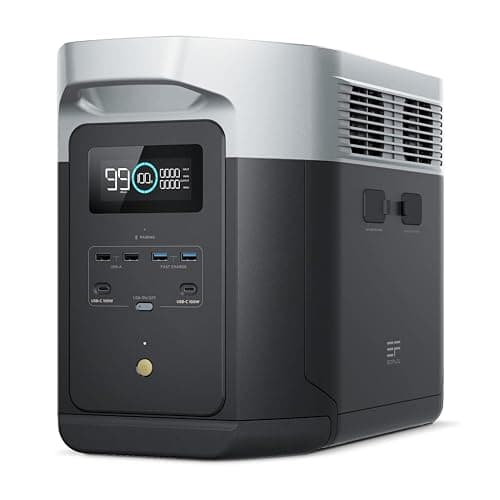 EcoFlow DELTA 2 Max | The smallest honest answer | 2,048Wh 50.7 lb | $1,028.99 · View on Amazon |
| 2 | 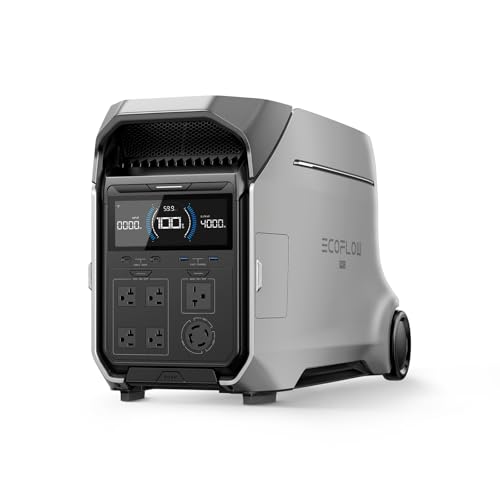 EcoFlow DELTA Pro 3 | The only unit that makes this routine | 4,096Wh Weight n/p | Check price on Amazon |
| 3 | 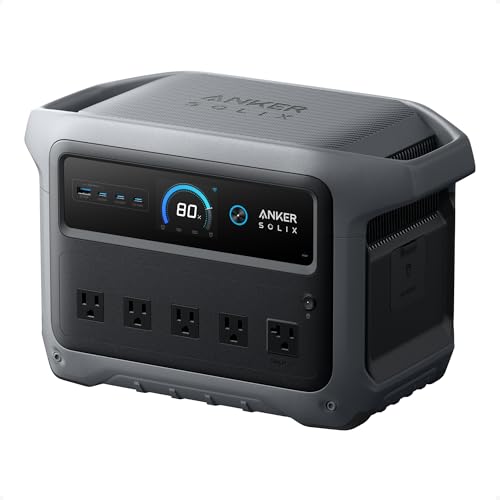 Anker SOLIX C1000 Gen 2 | Best surge headroom if you only need an hour | 1,024Wh 24.9 lb | $529.99 · View on Amazon |
This is one of the two questions where the honest answer disappoints people, and it is worth being straight about why. A battery stores energy; an air conditioner moves heat, and moving heat out of a room costs hundreds of watts continuously for as long as you want the room cool. There is no clever duty-cycle trick that changes the order of magnitude.
Air conditioner figures below are nameplate bands. Read the plate on your own unit — on a window air conditioner it is on the side of the chassis or inside the front grille, and it will state the amps. Multiply by 120 for watts.
What a window unit draws
| Unit | Running draw | Per hour at 75% duty | From 1,024Wh | From 2,048Wh | From 4,096Wh |
|---|---|---|---|---|---|
| 5,000 BTU | 450-500W | 340-375Wh | 2.3-2.6 hr | 4.6-5.1 hr | 9.3-10.2 hr |
| 6,000 BTU | 500-600W | 375-450Wh | 1.9-2.3 hr | 3.9-4.6 hr | 7.7-9.3 hr |
| 8,000 BTU | 650-800W | 490-600Wh | 1.5-1.8 hr | 2.9-3.5 hr | 5.8-7.1 hr |
| 10,000 BTU | 900-1,100W | 675-825Wh | 1.1-1.3 hr | 2.1-2.6 hr | 4.2-5.2 hr |
| 12,000 BTU | 1,100-1,400W | 825-1,050Wh | 0.8-1.1 hr | 1.7-2.1 hr | 3.3-4.2 hr |
Runtimes above assume 85% of rated capacity is usable, which is the realistic figure once inverter losses and the reserve the battery management system holds back are accounted for. They also assume a 75% duty cycle, which is what a window unit actually does in genuine heat — the 30-40% figures you see quoted are for mild weather, when you would not have the air conditioner on.
The surge problem
An air conditioner compressor is an induction motor and it draws several times its running current for a fraction of a second at startup. A unit that runs happily at 500W can ask for 1,500-3,000W at that instant, and an inverter that cannot supply it simply refuses — usually with an overload indicator rather than an explanation.
- Look for 1,800W continuous as a floor, and prefer a published surge rating of 2,700W or more. The highest surge figure in the 1kWh class here is EcoFlow's 3,600W on the DELTA 3 Plus.
- Inverter-compressor air conditioners are much easier on this. A variable-speed compressor ramps up rather than slamming on, which removes most of the inrush. If your unit is described as an inverter model, the surge requirement drops a long way.
- Avoid long thin extension cords. Voltage drop makes the inrush worse and converts a working setup into a tripping one.
- Start the air conditioner first, let the compressor settle, then plug anything else in.
Five ways to make the number smaller
- Cool one small room, with the door shut. Cooling capacity needed scales with the volume you are cooling and how much heat leaks into it. A bedroom with the door closed and the curtains drawn is a fraction of an open-plan floor.
- Pre-cool on grid power. Run the air conditioner hard while the power is on, then switch to the battery to hold the temperature rather than to achieve it. Holding costs far less than cooling down.
- Use a fan instead where you can. A box fan or a ceiling fan is 20-75W against an air conditioner's 500W. For a lot of nights, moving air is enough, and a fan runs for a day on a 1kWh battery rather than two hours.
- Set a higher target temperature. Every degree you give up reduces the duty cycle, and duty cycle is what multiplies the hourly cost.
- Shade the window and seal the gaps. The air conditioner's job is set by how much heat arrives. Foil or a blind on the sun-facing window reduces the load before any battery is involved.
What about a portable AC, or a mini split?
A free-standing 'portable' air conditioner with a hose is usually worse, not better: single-hose designs pull conditioned air out of the room and draw warm outside air in to replace it, so they do more work for the same cooling. Expect figures at the higher end of the bands above for the same BTU rating.
A mini split is a different proposition again — most are 240V and hardwired, which rules out every unit in this registry except the EcoFlow DELTA Pro 3 and the Anker SOLIX F3800, both of which publish 240V output. A mini split's inverter compressor is also much gentler on startup and more efficient while running, so the per-hour cost is lower even though the installation is harder.
And if the air conditioner in question is on the roof of an RV, that is a separate problem with its own page: best power station for an RV air conditioner covers the units and the soft-start question.
Where this load sits against everything else
Air conditioning and space heating are the two loads this site consistently tells people to think carefully about, for the same reason: both move heat, and moving heat costs hundreds of watts continuously. What size power station to run a space heater is the winter version of this page and reaches the same conclusion from the other direction.
If the reason you are reading this is a summer outage, size for the fridge and the fans first and treat cooling as a bonus. What size power station for a power outage builds that list, best power station for a freezer covers the appliance with the most money inside it, and best power station for hurricane season is the seasonal version.
There is one air conditioner a portable battery handles well, and it is not this one: can a power station run a mini split covers inverter-driven heads, whose compressors ramp up from zero instead of slamming on, so the starting spike that makes a window unit difficult simply is not there. A 115V 9,000 BTU head runs two to four hours on a 2 kWh unit.
The picks in full
1. The smallest honest answer
EcoFlow DELTA 2 Max
- 2,048Wh
- LFP (LiFePO4)
- 2,400W continuous
- 50.7 lb
- 1000W
- 3,000 cycles to 80% capacity
- 2.3 hr; 800W car/alternator charging
- 5 years
2,048Wh and 2,400W continuous. Against a 500W window unit running at a realistic 70-80% duty cycle in real heat, that is roughly four to five hours — long enough to cool a bedroom before sleep, or to get through the hottest part of an afternoon outage. It also expands from 2 kWh to 6 kWh with up to two extra batteries, which is the only route to an overnight run.
EcoFlow publishes fifteen outputs including six AC, 1,000W of solar input, 800W of car and alternator charging, a 2.3-hour wall recharge, a switchover under 20 ms, 3,000 cycles to 80% capacity and a 5-year warranty. The 1,000W solar ceiling matters here more than almost anywhere: air conditioning demand peaks when the sun is strongest.
50.7 lb, and EcoFlow publishes no surge figure for this model — which for a compressor load is the gap you would most want filled. No dimensions published either.
Reasons to buy
- 2,048Wh — four to five hours of a small window unit
- 2,400W continuous
- Expands from 2 kWh to 6 kWh
- 1,000W solar input
- 5-year warranty
Reasons to avoid
- No surge figure published by EcoFlow
- 50.7 lb
- Still not an overnight solution on its own
- No published dimensions
Buy it if: cooling one room for a few hours, with a path to more.
Skip it if: you want the air conditioner on all night.
2. The only unit that makes this routine
EcoFlow DELTA Pro 3
- 4,096Wh
- LFP (EV-grade)
- 4,000W continuous / 6,000W surge
- 80% capacity after 4,000 cycles
- 80% in 50 min
- 5 years (3-year standard plus 2-year extended)
4,096Wh and 4,000W continuous with a 6,000W surge, at 120V and 240V. This is the only unit in the registry where a window air conditioner stops being an endurance exercise: a 500W unit at a 75% duty cycle is roughly eight to nine hours, which is a night. It expands from 4 kWh to 48 kWh.
EcoFlow publishes 80% charge in 50 minutes, 80% capacity after 4,000 cycles, seven charging methods, 120V/240V output and a 5-year warranty made up of a 3-year standard plus a 2-year extended term. The 240V output also puts a mini split and a well pump in scope, which no other unit here can claim.
EcoFlow publishes neither a weight nor a maximum solar input figure for this model, which are two significant omissions. This is wheeled home-backup equipment rather than a portable battery, and it should be bought as such — read EcoFlow DELTA Pro 3 vs Anker SOLIX F3800 before committing at this level.
Reasons to buy
- 4,096Wh — a night of a small window unit
- 4,000W continuous, 6,000W surge
- 120V and 240V output
- Expands from 4 kWh to 48 kWh
- 80% charge in 50 minutes
Reasons to avoid
- No weight published by EcoFlow
- No maximum solar input published
- Wheeled equipment, not portable
- Far more unit than most buyers need
Buy it if: an air conditioner through a whole night or a long outage.
Skip it if: you want something you carry.
3. Best surge headroom if you only need an hour
Anker SOLIX C1000 Gen 2
- 1,024Wh
- LiFePO4 (InfiniPower LFP)
- 2,000W continuous / 3,000W surge
- 24.9 lb
- 600W
- 80% capacity after 4,000 cycles
- Full in 49 min (UltraFast, 1,600W max input)
- 5 years
2,000W continuous with a 3,000W surge is enough to start a small window unit's compressor, which is the hard part, and 1,024Wh is enough to run it for a bit under two hours. For cooling a bedroom down before bed and then switching to a fan, that is a genuinely useful amount.
Anker publishes a full recharge in 49 minutes at 1,600W input, a 10 ms UPS switchover, 600W of solar input, 80% capacity after 4,000 cycles, a 5-year warranty and dimensions of 15.12 x 8.19 x 9.61 in. At 24.9 lb it is the only unit on this page you would carry upstairs.
1,024Wh is the ceiling and it does not expand, so this is a cool-down unit rather than a cooling unit. Two AC outlets.
Reasons to buy
- 3,000W surge — starts a small compressor
- 2,000W continuous from 24.9 lb
- Full recharge in 49 minutes
- 80% capacity after 4,000 cycles
- 10 ms UPS switchover
Reasons to avoid
- 1,024Wh is under two hours of cooling
- Not expandable
- Only two AC outlets
- 600W solar input
Buy it if: cooling a room down, then switching to a fan.
Skip it if: you need sustained cooling.
Questions