Anker SOLIX C1000 Gen 2 vs EcoFlow DELTA 3
Identical capacity, identical chemistry, identical cycle rating, identical warranty. Everything that actually decides this is in the sockets and the handle.

These two units have the same battery. 1,024Wh, lithium iron phosphate, 4,000 cycles to 80% capacity, a five-year warranty and a sub-one-hour wall recharge, from both manufacturers, published on both product pages. Comparisons that treat them as different classes of machine are inventing a difference. The real decision is narrower and much easier to make: the Anker is the lighter, stronger, faster box with two sockets, and the EcoFlow is the heavier box with six sockets and somewhere to grow.
The full specification, side by side
| Anker SOLIX C1000 Gen 2 | EcoFlow DELTA 3 | |
|---|---|---|
| Capacity | 1,024Wh | 1,024Wh |
| Chemistry | LiFePO4 (InfiniPower LFP) | LFP (LiFePO4) |
| AC continuous | 2,000W | 1,800W |
| Surge | 3,000W | 3,600W |
| Weight | 24.9 lb | 27.6 lb |
| Watt-hours per pound | 41.1 | 37.1 |
| AC outlets | 2 | 6 |
| Total outputs | 2 AC, 1 USB-C 140W, 2 USB-A, car socket, XT60i | 13, including 6 AC and 2 USB-C |
| Max solar input | 600W | 500W |
| Full AC recharge | 49 min at 1,600W | 56 min at 1,500W |
| UPS switchover | 10 ms | Under 10 ms |
| Cycle rating | 80% after 4,000 cycles | 4,000 cycles to 80%+ |
| Warranty | 5 years | 5 years |
| Expansion | None | Up to 5 kWh |
| Dimensions | 15.12 x 8.19 x 9.61 in | Approx. 15.7 x 8.0 x 11.2 in |
Where the 200 watts actually shows up
2,000W against 1,800W sounds like a rounding error and is not. It is the line a specific set of household appliances sits on. A 1,500W kettle, a 1,500W space heater and a 1,440W microwave run on both. An 1,800W hair dryer on its high setting, an 1,875W travel dryer, a two-slice toaster rated at 1,800W and most full-size coffee makers with a hot plate sit right at the EcoFlow's ceiling and comfortably inside the Anker's. If one of those is the reason you are buying a power station, this is the comparison's whole answer.
Surge runs the other way. EcoFlow publishes 3,600W against Anker's 3,000W, and surge is what a motor draws in the half-second it starts - a fridge compressor, a pump, a circular saw. Neither unit is a tool unit, but a 600W difference in starting headroom is real, and surge watts vs running watts explains how to find both numbers on your own appliance before you decide which of the two figures matters to you.
Two sockets versus six
This is the difference people underestimate before they own the unit and notice immediately afterward. Two AC outlets is enough for a laptop and a light. It is not enough for a desk, a kitchen counter, a campsite with a fridge and a fan, or anywhere two people are charging things at once. The workaround is a power strip, which works - the strip does not care that its supply is a battery - but adds a cable, a connection and a thing to trip over, and it does nothing about the shared limit on total watts.
Six outlets, by contrast, is more than most single situations need, and that is the point: you stop planning around the socket panel. If the unit is going to live under a desk, behind a television or in a van's cabinet rather than being carried to a tent pad, the sockets are worth more than the 2.7 lb. Our best power station for a home office page makes the same argument at length for exactly that use.
Expansion is the long-horizon difference
The DELTA 3 accepts extra batteries up to 5 kWh. The C1000 Gen 2 accepts none. If you think there is any chance you will want more capacity inside two or three years - a longer outage, a van build that grew, a second fridge - that is a structural advantage no amount of inverter watts offsets, because the alternative is buying a second unit and owning two chargers, two screens and two things to carry.
The honest counterweight: expansion batteries are not cheap and they are not small. Adding one turns a single carryable box into a two-box system that nobody takes camping. Plenty of people buy an expandable unit, never expand it, and have paid in weight and continuous watts for an option they did not use. Best expandable power stations ranks the whole registry on this question, including the units where the expansion path is better value than the base unit.
Charging, solar and the UPS question
Anker charges faster from the wall - 49 minutes against 56 - and takes more solar, 600W against 500W. On a one-kilowatt-hour battery, a 600W ceiling is roughly a two-hour refill in good sun against two and a half hours at 500W. Neither is a limitation most buyers will feel, but if solar is your primary charging plan rather than a backup, the Anker's extra 100W of headroom is the one spec here that compounds over a week off-grid. How much solar input do you need covers why the unit's ceiling governs and the panel's rating does not.
On switchover they are effectively tied: Anker publishes 10 ms, EcoFlow publishes under 10 ms, and both are comfortably inside what a desktop computer, a router, a games console or a television will ride through. Either unit works as a desk UPS. If that is the main job you have in mind, best power stations with UPS mode ranks our whole registry on published switchover figures and is clear about which manufacturers publish nothing at all.
What about the DELTA 3 Plus and the DELTA 3 Classic?
EcoFlow sells three units with nearly the same name and the same 1,024Wh battery. The DELTA 3 compared here is the middle one at 1,800W with 500W of solar input. The DELTA 3 Plus is the same box with the solar input doubled to 1,000W across two MPPT inputs and faster USB-C; our EcoFlow DELTA 3 vs DELTA 3 Plus page is the dedicated version of that question. The DELTA 3 Classic is the cheaper variant. At the time of writing the Plus is listed on Amazon only as part of a solar-panel bundle rather than on its own, which is a reason to compare the plain DELTA 3 here: it is the version of this unit you can actually buy by itself.
The decision, stated plainly
- It gets carried to a tent, a beach or a tailgate -> Anker SOLIX C1000 Gen 2. 2.7 lb and 200W both go your way, and two sockets is enough for a trip.
- It lives under a desk or behind a television -> EcoFlow DELTA 3. Six outlets removes the power strip and the unit never moves, so the weight is irrelevant.
- You want to run an 1,800W appliance -> Anker. It is the only one of the two with the headroom.
- You might want more capacity in two years -> EcoFlow. Expansion to 5 kWh is an option the Anker simply does not offer.
- Solar is your main charging plan -> Anker, by 100W of input ceiling. If you want more than that, look at the DELTA 3 Plus instead of either.
- You cannot decide -> Anker, on the grounds that two sockets and a power strip is a smaller compromise than 2.7 lb you have to lift every time.
Either way you are buying a well-specified 1 kWh unit with a five-year warranty and a 4,000-cycle rating, which is a far better starting position than this category offered three years ago. If neither is quite right, best 1000W power stations ranks the rest of the class, and our Anker SOLIX C1000 Gen 2 review goes deeper on the Anker alone. If you are tempted by a wider socket panel without giving up 2,000W, the OUPES Mega 1 review covers a 1 kWh unit with four AC outlets and a 4,500W surge that neither of these two matches.
The picks in full
1. Buy this one if it has to be carried
Anker SOLIX C1000 Gen 2
- 1,024Wh
- LiFePO4 (InfiniPower LFP)
- 2,000W continuous / 3,000W surge
- 24.9 lb
- 600W
- 80% capacity after 4,000 cycles
- Full in 49 min (UltraFast, 1,600W max input)
- 5 years
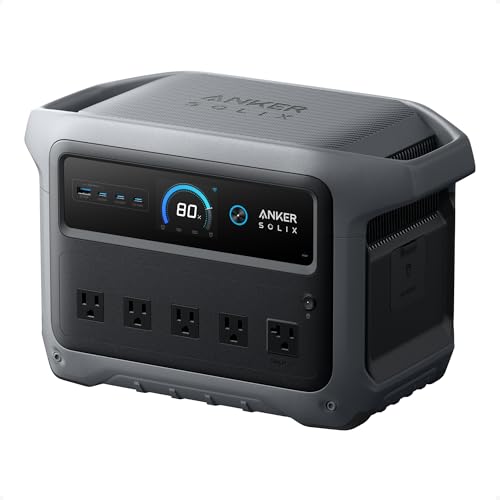
Anker publishes 1,024Wh of InfiniPower LFP, 2,000W of continuous AC with a 3,000W surge, 24.9 lb, 600W of maximum solar input through an XT60i port, a full recharge in 49 minutes at a 1,600W input, a 10 ms UPS switchover, 80% capacity after 4,000 cycles, a 5-year warranty and dimensions of 15.12 x 8.19 x 9.61 in.
Three of those numbers are the reason to choose it over the DELTA 3. It is 2.7 lb lighter for the same battery, which is 41.1 watt-hours per pound against EcoFlow's 37.1. It is 200W stronger on continuous output, which is the specification that decides whether a 1,500W kettle or an 1,800W hair dryer runs at all. And it refills seven minutes faster, from a higher 1,600W input ceiling - a small gap on paper that compounds if you are topping up between trips rather than overnight.
The cost of all that is the socket panel. Two AC outlets, against six on the EcoFlow, and no expansion battery of any kind. What you buy is what you own, permanently, and anything past two plugs needs a power strip you supply yourself.
Reasons to buy
- 2,000W continuous - the higher figure here
- 24.9 lb; 41.1 watt-hours per pound
- Full recharge in 49 minutes at 1,600W
- 600W maximum solar input
- 10 ms published switchover; 4,000 cycles to 80%
Reasons to avoid
- Two AC outlets only
- No expansion battery exists for it
- 3,000W surge is the lower figure here
Buy it if: camping, tailgating and anything you lift in and out of a car.
Skip it if: you need more than two plugs or room to grow.
2. Buy this one if it mostly sits still
EcoFlow DELTA 3
- 1,024Wh
- LFP (LiFePO4)
- 1,800W continuous / 3,600W surge
- 27.6 lb
- 500W
- 4,000 cycles to 80%+ capacity
- 56 min at 1,500W
- 5 years
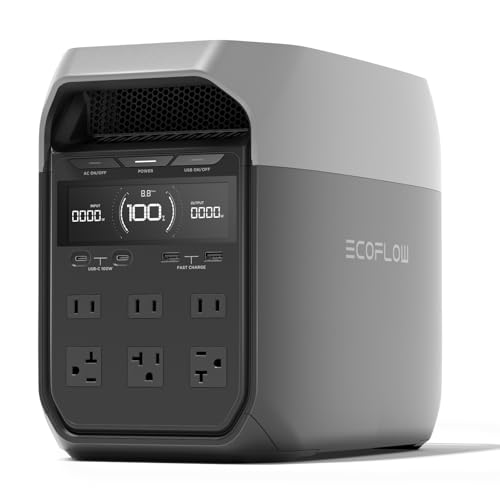
EcoFlow publishes 1,024Wh of LFP, 1,800W of continuous AC with a 3,600W surge, 27.6 lb, 500W of maximum solar input, a full recharge in 56 minutes at a 1,500W input, a switchover under 10 ms, 4,000 cycles to 80%+ capacity, a 5-year warranty, thirteen outputs including six AC outlets, and expansion to 5 kWh with extra batteries.
Six sockets is not a small difference in practice. A desk during an outage is a computer, a monitor, a router, a lamp and a phone charger - five plugs before you have thought about it. A fridge, a modem and two lights at a campsite is four. Every time you avoid a power strip you avoid a loose connection, a tripping hazard and a conversion loss you do not need.
The expansion path matters more than the sockets on a longer horizon. 1,024Wh now, up to 5 kWh later, without replacing the unit you already own. The Anker has no equivalent. Against that, the DELTA 3 is heavier for the same battery, 200W weaker on continuous output, and takes 100W less solar - and EcoFlow's published dimensions for it are approximate, which is unusual and worth knowing if you are measuring a cabinet.
Reasons to buy
- Six AC outlets; thirteen outputs total
- Expandable to 5 kWh later
- 3,600W surge - the higher figure here
- Switchover published as under 10 ms
- 4,000 cycles to 80%+; 5-year warranty
Reasons to avoid
- 27.6 lb for the same 1,024Wh
- 1,800W continuous, not 2,000W
- 500W solar ceiling - the lower figure here
Buy it if: home backup, a van, a desk, anywhere with several plugs.
Skip it if: weight is the deciding factor.
Questions