OUPES Mega 1 Review
A smaller brand with a bigger socket panel. Four AC outlets and 4,500W of surge from a one-kilowatt-hour battery that the big four do not match.
The short answer
Buy it if you need more than two plugs and more starting headroom than the mainstream 1 kWh units offer. OUPES publishes 1,024Wh of LFP, 2,000W of continuous pure sine wave with a 4,500W surge, four NEMA 5-20R outlets, two 100W USB-C ports, four USB-A ports, 800W of maximum solar input, a full recharge in 58 minutes at 1,400W, a switchover under 20 ms, over 3,500 cycles to 80%, and expansion to 5,120Wh with two B2 packs - all at 27.8 lb and a five-year warranty extendable to six on registration. The catches are real and specific: it is the heaviest 1 kWh unit in our registry, its 3,500-cycle rating is below the 4,000 Anker and EcoFlow publish, and OUPES is a far smaller company than the brands it is priced against.
What it is good at
Four AC outlets on a 1 kWh unit is genuinely unusual. The Anker SOLIX C1000 Gen 2 publishes two. The Jackery Explorer 1000 v2 publishes two. EcoFlow's DELTA 3 publishes six, and is the only unit in the class that beats this one on sockets. If you have ever run a campsite, a market stall or a desk off a power station, you know the two-socket limit is the thing you hit first and the thing a power strip only half solves. Four NEMA 5-20R outlets, each rated 120V/20A, is a socket panel sized for the job rather than for the spec sheet.
A 4,500W surge is the biggest starting headroom in the class by a wide margin. Anker publishes 3,000W on the C1000 Gen 2, EcoFlow 3,600W on the DELTA 3, Jackery 3,000W on the Explorer 1000 v2. Surge is the half-second a motor draws as it starts - a fridge compressor, a sump pump, a circular saw, a shop vacuum - and it is the specification that decides whether an appliance starts at all rather than how long it runs. 4,500W out of a one-kilowatt-hour box is the kind of figure the 2 kWh class publishes. Surge watts vs running watts is the page to read if you are not sure which of your appliance's two numbers to compare against it.
2,000W continuous matches the strongest unit in the class. That clears a 1,500W kettle, a 1,500W space heater, an 1,800W hair dryer and most full-size coffee makers. It ties the Anker SOLIX C1000 Gen 2 at the top of the 1 kWh class for continuous output and beats EcoFlow's DELTA 3 by 200W - a gap our Anker SOLIX C1000 Gen 2 vs EcoFlow DELTA 3 comparison works through appliance by appliance.
800W of maximum solar input is the highest in the class except one. Anker's C1000 Gen 2 takes 600W, EcoFlow's DELTA 3 takes 500W, Jackery's Explorer 1000 v2 takes 400W. Only the DELTA 3 Plus, at 1,000W across two MPPT inputs, takes more. On a 1,024Wh battery an 800W ceiling is roughly a 90-minute refill in good sun, which turns this into a unit you can genuinely live off a panel array rather than one you charge before you leave. For how to size the panels against that ceiling, how much solar input do you need does the arithmetic.
Expansion to 5,120Wh with two B2 packs. Five kilowatt-hours is a genuinely different machine from the one you started with - several days of a fridge, or a week of a CPAP and a phone. The Anker C1000 Gen 2 does not expand at all; the DELTA 3 tops out at 5 kWh, which is effectively the same ceiling. Buying expandable and never expanding is common and not a tragedy, but the option is worth having when it costs nothing on day one. Best expandable power stations covers which expansion paths are worth the money and which are not.
A 58-minute full recharge, and an unusually generous warranty. 1,400W of fast AC input fills the battery in 58 minutes, with a quieter 700W mode that takes 1.9 hours if you would rather not run the fan hard. The warranty is five years as standard, extendable to six if you register the unit - the longest published term of any unit in our registry, and from the smallest company in it, which is a combination worth noting in both directions.
Where it falls short
27.8 lb is the heaviest 1 kWh unit we list. The Jackery Explorer 1000 v2 is 23.8 lb for slightly more battery, the Anker C1000 Gen 2 is 24.9 lb, the EcoFlow DELTA 3 is 27.6 lb. In watt-hours per pound the Mega 1 is last in the class at 36.8 against Jackery's 45.0 - a 22% penalty in carrying efficiency. That gap is the price of the four outlets and the 4,500W inverter, and it is a fair trade for a van or a stall. It is a poor trade for a tent you walk to. If weight is your deciding factor, best lightweight power stations ranks the class on exactly that.
Over 3,500 cycles to 80% is the weakest cycle rating of the four units compared below. Anker and EcoFlow both publish 4,000 cycles and BLUETTI publishes 6,000+ on its larger units. On an occasional-use unit the difference is academic - 3,500 cycles is roughly a decade of charging it every single day. On a unit that genuinely cycles daily, a trading stall or a van you live in, it is the first specification to weigh, because cycle life is what cost per kilowatt-hour delivered actually depends on. How long do portable power stations last works that arithmetic through properly.
The switchover is under 20 ms, not under 10. That is fast enough for a router, a modem, a television or a games console, and it is slower than the 10 ms figures Anker and EcoFlow publish on their current 1 kWh units. For a desktop computer with a marginal power supply that difference occasionally matters. If an uninterrupted desk is the main job, best power stations with UPS mode ranks the registry on this one number.
OUPES publishes its fast-charge figure two ways on the same page. The specification table says 58 minutes at 1,400W; the marketing copy elsewhere on the page says 1.3 hours. We quote the specification table and flag the discrepancy rather than picking the flattering number silently - which is the rule applied to every unit on this site, set out in how we choose.
It is a smaller company, and that is a real consideration on a five-year warranty. OUPES does not have the service network, the firmware-update cadence or the resale market of Jackery, Anker, EcoFlow or BLUETTI. A six-year warranty is only worth what the company behind it is worth in year five. That is not a reason to avoid the unit - the specification is genuinely competitive and the listing is current - but it is a reason to weigh the warranty term less heavily than the same term from a larger brand, and it is why this is a value pick rather than a default recommendation.
No published noise figure. OUPES publishes no decibel rating for the Mega 1, which is the same gap Anker and EcoFlow leave on their 1 kWh units; a 2,000W inverter with a 1,400W charger has a fan and it runs. Are portable power stations loud covers the handful of manufacturers who do publish a number.
How it compares in the 1 kWh class
| OUPES Mega 1 | Anker C1000 Gen 2 | EcoFlow DELTA 3 | Jackery Explorer 1000 v2 | |
|---|---|---|---|---|
| Capacity | 1,024Wh | 1,024Wh | 1,024Wh | 1,070Wh |
| AC continuous | 2,000W | 2,000W | 1,800W | 1,500W |
| Surge | 4,500W | 3,000W | 3,600W | 3,000W |
| AC outlets | 4 | 2 | 6 | 2 |
| Weight | 27.8 lb | 24.9 lb | 27.6 lb | 23.8 lb |
| Watt-hours per pound | 36.8 | 41.1 | 37.1 | 45.0 |
| Max solar input | 800W | 600W | 500W | 400W |
| Full AC recharge | 58 min at 1,400W | 49 min at 1,600W | 56 min at 1,500W | 1.7 hr |
| Switchover | Under 20 ms | 10 ms | Under 10 ms | Under 20 ms |
| Cycle rating | 3,500+ to 80% | 4,000 to 80% | 4,000 to 80%+ | 4,000 to 70%+ |
| Expansion | To 5,120Wh | None | To 5 kWh | 4 kWh kit |
| Warranty | 5 yr, 6 on registration | 5 years | 5 years | 3 yr, extendable to 5 |
Read across that table and the Mega 1's position is clear. It wins outright on surge and on solar input, ties for the lead on continuous output, comes second on sockets, and loses on weight, cycle rating and switchover. There is no row where it is embarrassed and no row where it is the obvious default. That is what a well-judged value unit from a smaller brand looks like, and it is a more honest outcome than most second-tier brands manage.
What 1,024Wh actually runs
Who should buy it, and who should not
Buy it if you are powering more than two things at once - a market stall, a vendor booth, a work site, a van cabinet, a desk during outages - and you want the surge headroom for a fridge or a pump. The four-outlet panel and the 4,500W surge are a combination nothing else at this capacity offers, and the 800W solar ceiling makes it a credible off-grid unit rather than a wall-charged one. Our best power station for a food truck page ranks it for exactly that use.
Do not buy it if the unit gets carried any distance - at 36.8 watt-hours per pound it is the least efficient carry in the class, and the Jackery Explorer 1000 v2 review covers the unit that wins that argument. Do not buy it if you cycle it daily and intend to keep it a decade, where the 3,500-cycle rating is the weakest here. And do not buy it if brand service matters more to you than specification, which for a lot of buyers is a perfectly reasonable position to hold.
If you want the same capacity from a larger brand, best 1000W power stations is the full ranking of the class, and best portable power stations is the site-wide shortlist across every size.
This is no longer the only second-tier brand on the site. The UDPOWER S1200 review reaches a similar verdict for similar reasons: a genuinely competitive specification - 1,191Wh, five AC outlets, 45.8 watt-hours per pound, a 10 ms switchover - sold against a thinner service network and no resale market. Where this unit trades weight for surge headroom, the S1200 trades surge headroom for capacity, with a 1,200W inverter and an 1,800W maximum against the Mega 1's 2,000W and 4,500W.
The picks in full
1. Widest socket panel at 1 kWh
OUPES Mega 1
- 1,024Wh
- LFP (LiFePO4)
- 2,000W continuous / 4,500W surge
- 27.8 lb
- 800W
- Over 3,500 cycles to 80%
- 58 min at 1,400W (fast); 1.9 hr at 700W (slow)
- 5 years, extendable to 6 with registration
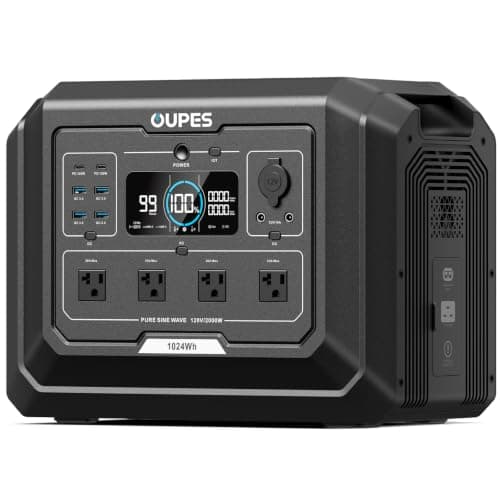
1,024Wh of LFP behind a 2,000W pure sine wave inverter with a published 4,500W surge, feeding four NEMA 5-20R outlets rated 120V/20A each. The surge figure is the largest in the 1 kWh class by 900W and the outlet count is beaten only by EcoFlow's DELTA 3 - a combination nothing else at this capacity offers.
OUPES publishes 800W of maximum solar input, a full wall recharge in 58 minutes at 1,400W (1.9 hours at 700W in the quieter slow mode), a UPS switchover under 20 ms, over 3,500 cycles to 80% capacity, expansion to 5,120Wh with two B2 packs, 15.1 x 9.1 x 11.6 in, and a five-year warranty extendable to six years on registration.
The honest limits are weight, cycles and company size: 27.8 lb is 36.8 watt-hours per pound, the worst carrying efficiency in the class; 3,500 cycles is the shortest rating of the four units we compare it against; the switchover is under 20 ms rather than the 10 ms Anker and EcoFlow publish; and OUPES does not have the service network or the resale market of the brands it is priced beside.
Reasons to buy
- Four NEMA 5-20R AC outlets at 1,024Wh
- 4,500W surge - the largest in the class
- 2,000W continuous, matching the strongest 1 kWh unit
- 800W maximum solar input; full recharge in 58 min
- Expandable to 5,120Wh; 5-year warranty, 6 on registration
Reasons to avoid
- 27.8 lb - 36.8 watt-hours per pound, last in the class
- Over 3,500 cycles to 80% is the shortest rating of the four
- Switchover under 20 ms, not under 10 ms
- Charge time published two ways on the same page
- Smaller company; thinner service network and resale market
Buy it if: you run four or five things at once and want surge headroom.
Skip it if: you carry it any distance, or you cycle it daily for a decade.
Questions