UDPOWER S1200 Review
A brand nobody has heard of, with the biggest battery and the smallest inverter in the one-kilowatt-hour class. The specification sheet is honest about what it traded away, which is more than some bigger names manage.

The short answer
Buy it if you want the most watt-hours you can carry and your loads are all small. UDPOWER publishes 1,191Wh - the biggest battery in the one-kilowatt-hour class - at 26.0 lb, which is 45.8 watt-hours per pound and the best figure in the class. Five AC outlets, fourteen ports, 400W of solar input, a 10 ms switchover and a five-year warranty are all competitive with the big four. Do not buy it if anything you plug in has a motor or a heating element. 1,200W of continuous output and an 1,800W maximum are the lowest figures in the class by 300W and 600W respectively, which rules out kettles, hair dryers, microwaves and most power tools, and makes a full-size fridge compressor start a genuine question rather than a formality.
What it is good at
1,191Wh is the largest battery anyone sells in this class. Everything it competes with is smaller: the BLUETTI AC180 at 1,152Wh, the Jackery Explorer 1000 v2 at 1,070Wh, the Anker SOLIX C1000 at 1,056Wh, and the Anker C1000 Gen 2, EcoFlow DELTA 3 and OUPES Mega 1 all at 1,024Wh. Against the 1,024Wh units that is 16% more stored energy, which is roughly an extra six hours of a camping fridge or an extra night of a CPAP. Capacity is usually where units in a class are identical and output is where they differ; here it is the other way round.
26.0 lb for 1,191Wh is 45.8 watt-hours per pound - the best in the class. The Jackery Explorer 1000 v2 manages 45.0, the Anker C1000 Gen 2 41.1, the EcoFlow DELTA 3 37.1, the OUPES Mega 1 36.8 and the BLUETTI AC180 just 32.7. In practical terms the S1200 carries 40% more energy per pound than the AC180 does, which is the difference between a unit you take on a trip and one you leave in the garage. Best lightweight power stations ranks the registry on this measure, and power station weight guide covers what each band feels like to move.
Five AC outlets on a 1 kWh unit is near the top of the class. Only EcoFlow's DELTA 3 with six and the original Anker SOLIX C1000 with six do better; the Anker C1000 Gen 2 and the Jackery Explorer 1000 v2 publish two each. The two-socket limit is the first wall most people hit with a power station, and a power strip only half solves it - every strip is another connection to work loose and another thing to trip over in a tent at night. Fourteen ports in total, including two USB-C at 100W combined, four USB-A, two DC5521 sockets and a 12V car port, is a panel sized for a real campsite rather than for a spec sheet.
400W of maximum solar input, through a sensible 12-75V window. That matches the Jackery Explorer 1000 v2 and sits below the Anker units at 600W and the OUPES Mega 1 at 800W, but it is a serious figure rather than a token one: 400W of panel in good sun will refill this battery inside a long day. The wide 12-75V MPPT range also means it will take most third-party panels rather than only the manufacturer's own. How much solar input do you need sizes an array against a capacity.
A 10 ms switchover and a five-year warranty - both at the top tier. Ten milliseconds or less is the figure Anker and EcoFlow publish on their current flagships, and it is faster than the under-20 ms the OUPES Mega 1 and the Jackery Explorer 1000 v2 claim. Five years matches Anker, EcoFlow and BLUETTI, and beats Jackery's three-year standard term. Best power stations with UPS mode ranks the registry on switchover alone.
Where it falls short
1,200W of continuous output is the lowest in the class and the reason to think twice. The Anker C1000 Gen 2 and the OUPES Mega 1 publish 2,000W, the EcoFlow DELTA 3 and the BLUETTI AC180 and the Anker C1000 publish 1,800W, the Jackery Explorer 1000 v2 publishes 1,500W. At 1,200W a 1,500W kettle will not run, a 1,500W space heater on high will not run, an 1,800W hair dryer will not run, and a 1,000W microwave drawing 1,400W from the wall will not run. Surge watts vs running watts explains which figure on your appliance to compare, and what size power station to run a microwave shows why microwave labels mislead.
An 1,800W maximum is the smallest surge headroom in the class by 600W. Surge is the fraction of a second a motor draws as it starts - a fridge compressor, a sump pump, a circular saw, a shop vacuum - and the class norm is between 2,400W and 4,500W. At 1,800W a modern efficient refrigerator will usually start, an older one may not, and a power tool is a gamble. If starting a motor is on your list, best power station for high surge loads is the page, and can a power station run a refrigerator covers the compressor question properly.
800W of AC input means about 1.5 hours to full, where the class standard is under an hour. Anker publishes 49 minutes on the C1000 Gen 2, EcoFlow 56 minutes on the DELTA 3, OUPES 58 minutes on the Mega 1. An hour and a half is not slow in absolute terms and a slower charge is gentler on cells, but it does mean this is a less convenient unit to top up between trips or in the gap between two outages.
3,000 cycles to 80% is behind the 4,000 Anker and EcoFlow publish. On an occasional-use unit that gap is academic - 3,000 cycles is more than eight years of charging it every single day. On a unit that genuinely cycles daily, a van you live in or a trading stall, cycle life is the specification that sets cost per kilowatt-hour delivered, and this is the weaker end of the class. How long do portable power stations last works that arithmetic through.
No expansion, and no pairing. There is no extra battery for the S1200, and UDPOWER's own FAQ states that two S1200 units cannot be connected in parallel or in series. That is a more final answer than most units give - the EcoFlow DELTA 3 reaches 5 kWh and the OUPES Mega 1 reaches 5,120Wh. If a growth path matters, best expandable power stations is the page.
It is a small brand, and on a five-year warranty that is a real consideration. UDPOWER does not have the service network, the firmware cadence or the resale market of Jackery, Anker, EcoFlow or BLUETTI. A five-year term is only worth what the company behind it is worth in year four. That is not a reason to avoid the unit - the specification is genuinely competitive and the listing is current - but it is a reason to weigh the warranty less heavily than the same term from a larger brand, and it is why this is a value pick rather than a default recommendation. The OUPES Mega 1 review covers the other second-tier brand on this site and reaches the same conclusion for the same reason.
How it compares in the 1 kWh class
| UDPOWER S1200 | Anker C1000 Gen 2 | EcoFlow DELTA 3 | Jackery Explorer 1000 v2 | OUPES Mega 1 | |
|---|---|---|---|---|---|
| Capacity | 1,191Wh | 1,024Wh | 1,024Wh | 1,070Wh | 1,024Wh |
| AC continuous | 1,200W | 2,000W | 1,800W | 1,500W | 2,000W |
| Surge / max | 1,800W | 3,000W | 3,600W | 3,000W | 4,500W |
| AC outlets | 5 | 2 | 6 | 2 | 4 |
| Weight | 26.0 lb | 24.9 lb | 27.6 lb | 23.8 lb | 27.8 lb |
| Watt-hours per pound | 45.8 | 41.1 | 37.1 | 45.0 | 36.8 |
| Max solar input | 400W | 600W | 500W | 400W | 800W |
| Full AC recharge | About 1.5 hr | 49 min | 56 min | 1.7 hr | 58 min |
| Switchover | 10 ms or less | 10 ms | Under 10 ms | Under 20 ms | Under 20 ms |
| Cycle rating | 3,000 to 80%+ | 4,000 to 80% | 4,000 to 80%+ | 4,000 to 70% | 3,500+ to 80% |
| Expansion | None | None | To 5 kWh | None | To 5,120Wh |
| Warranty | 5 years | 5 years | 5 years | 5 yr with registration | 5 yr, 6 on registration |
The pattern is clean. The S1200 wins on capacity, on watt-hours per pound and on outlet count among the mainstream units; it loses on continuous output, on surge, on recharge speed, on cycle rating and on expansion. Nothing about it is embarrassing and nothing about it is a default recommendation - which is a fair description of a well-judged value unit from a company that cannot outspend Anker on engineering. Best 1000W power stations is the full ranking of the class, and the Anker SOLIX C1000 Gen 2 vs EcoFlow DELTA 3 comparison covers the two units most people choose between instead.
What 1,191Wh actually runs
That shape - long duration, modest draw - is the job this unit is built for, and it maps neatly onto camping and van use where almost everything is a fridge, a fan, a light, a laptop or a phone. What size power station for van life and best portable power stations for camping size the class against those loads.
Who should buy it, and who should not
Buy it if you run four or five small things at once, for a long time, and you carry the unit yourself: a campsite with a fridge, lights, a fan and two phones; a van cabinet; a desk through an outage; a CPAP for a long weekend. The capacity advantage and the five-outlet panel are real and the weight advantage compounds every time you move it. It is also the honest choice for a buyer who wants 1 kWh of LFP and does not want to pay a big-brand premium for inverter headroom they will never use.
Do not buy it if your list includes a kettle, a coffee maker, a hair dryer, a microwave, a space heater on high or a power tool - the 1,200W ceiling and the 1,800W surge are the hard limits here and no amount of battery changes them. In that case the Anker SOLIX C1000 Gen 2 review covers the 2,000W unit in the same class, and if you want the same low-inverter, high-capacity character at twice the size, the Anker SOLIX S2000 review is the 2 kWh version of exactly this trade.
And if brand service matters more to you than specification, that is a perfectly reasonable position to hold - best portable power stations is the site-wide shortlist, which leans on the big four for precisely that reason.
The picks in full
1. Most battery per pound at 1 kWh
UDPOWER S1200
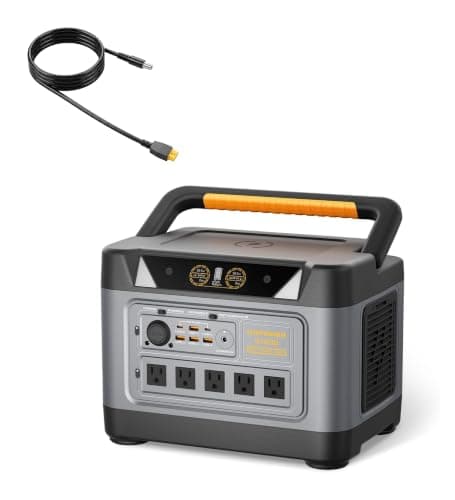
- 1,191Wh
- LiFePO4
- 1,200W continuous / 1,800W surge
- 26 lb
- 400W
- 80%+ capacity after 3,000 cycles
- About 1.5 hr with the fast AC charger (800W maximum AC input)
- 5 years
UDPOWER publishes 1191Wh of LiFePO4, 1200W of rated pure sine wave output at 120V/60Hz with an 1800W maximum, 26.0 lb, 13.7 x 9.5 x 9.7 in, 400W of maximum solar input through a DC7909 socket rated 12-75V at 12A, an 800W AC input ceiling that fills the battery in about 1.5 hours, a response time of 10 ms or less, 80%+ capacity after 3,000 cycles, a five-year warranty, and fourteen ports including five AC outlets.
Two figures put it at the front of its class. 1,191Wh is the largest battery in the 1 kWh group - more than the 1,152Wh BLUETTI AC180, the 1,070Wh Jackery Explorer 1000 v2 and the 1,024Wh units from Anker, EcoFlow and OUPES. And 26.0 lb for that battery is 45.8 watt-hours per pound, the best carrying efficiency in the class, narrowly ahead of the Jackery at 45.0 and a long way ahead of the OUPES Mega 1 at 36.8. Five AC outlets is beaten only by the six on EcoFlow's DELTA 3 and the original Anker C1000.
The trade is the inverter, and it is a big one. 1,200W of continuous output is 300W behind the weakest big-brand unit in the class and 800W behind the strongest. The 1,800W maximum is the lowest surge figure here by 600W, which is the number that decides whether a fridge compressor or a power tool starts. And the 800W AC input ceiling means about 1.5 hours to full where Anker, EcoFlow and OUPES all publish under an hour.
Reasons to buy
- 1,191Wh - the largest battery in the 1 kWh class
- 45.8 watt-hours per pound, best in the class
- Five AC outlets; fourteen ports in total
- 10 ms or less switchover; 5-year warranty
- 400W maximum solar input, matching Jackery's flagship
Reasons to avoid
- 1,200W continuous - lowest in the class by 300W
- 1,800W maximum surge - lowest in the class by 600W
- 800W AC input ceiling; about 1.5 hr to full
- 3,000 cycles to 80%, against 4,000 from Anker and EcoFlow
- No expansion, and UDPOWER states two units cannot be paralleled
- A small brand: thin service network and no resale market
Buy it if: several modest loads at once, carried by hand, for a long time.
Skip it if: you need to start a motor or boil a kettle.
Questions