Anker SOLIX S2000 Review
Anker built a two-kilowatt-hour battery that one person can actually carry, then fitted it with the smallest inverter in its class and left the 12V socket off. Whether that is a bargain or a mistake depends entirely on what you plug in.

The short answer
Buy it if you need a lot of watt-hours and not many watts. The Anker SOLIX S2000 is the lightest and most energy-dense two-kilowatt-hour unit we list - 2,010Wh at 35.7 lb, which is 56.3 watt-hours per pound against 49.1 for Anker's own C2000 Gen 2 - and its 6,000-cycle rating ties the longest on this site. Do not buy it if your load list has a big number on it. 1,500W of continuous output is 700W behind every rival in the class, there is no 12V car socket at all, the 400W solar ceiling is the lowest here relative to capacity, and no expansion battery exists for it. It is a superb long-duration, low-draw battery and a poor high-draw one, and those are not close calls.
What it is good at
It is the only two-kilowatt-hour unit on this site that one person carries without resenting it. 35.7 lb is still a two-handed lift, but set it against the alternatives: the Anker SOLIX C2000 Gen 2 is 41.7 lb, the Jackery Explorer 2000 v2 is 39.5 lb, the EcoFlow DELTA 2 Max is 50.7 lb and BLUETTI's Elite 200 V2 is 53.4 lb. Carrying a 50 lb box from a car to a campsite twice is a different activity from carrying a 36 lb one, and Anker's claim to the lightest 2 kWh unit holds up against everything in our registry. Power station weight guide sets out what each weight band actually feels like to move.
56.3 watt-hours per pound is the best figure in our registry, full stop. Not the best in its class - the best anywhere on this site, ahead of the Jackery Explorer 1000 v2's 45.0 and the Explorer 2000 v2's 51.7. If your job is to carry as much stored energy as possible for each pound you lift, this is the unit that does it, and no amount of inverter headroom on a rival changes that arithmetic. Best lightweight power stations ranks the whole registry on exactly this measure.
6,000 cycles to 80% capacity, and 10,000 to 60%, is a rating only one other unit here matches. Anker and EcoFlow typically publish 4,000 cycles on their current units; Jackery publishes 4,000 to a softer 70% threshold. Only BLUETTI's Elite 200 V2 also reaches 6,000+. Cycle life is the least exciting specification on any power station and the one that determines cost per kilowatt-hour delivered, because a battery you charge daily for a decade has to survive roughly 3,650 cycles to get there. At 6,000 cycles this unit is rated for sixteen years of daily charging before it drops to 80%. How long do portable power stations last works that calculation through properly.
A 10 ms switchover and AC outlets on two faces. Ten milliseconds is the fast tier - the figure Anker and EcoFlow publish on their current flagships, and quick enough that a desktop computer, a router, a modem or a games console will not notice the grid dropping. Anker also puts AC outlets on both the front and the rear of the chassis, which sounds like a detail until you have a unit pushed against a wall in a closet or wedged into a cabinet and need one more plug on the side facing you. Best power stations with UPS mode ranks the registry on switchover alone.
2.3 hours to full, with an asterisk worth knowing. The AC input ceiling is 1,600W, which fills 2,010Wh in about 2.3 hours - but Anker caps the default input at 1,150W and you have to turn UltraFast Mode on in the app to get the faster figure. That is not a flaw, it is a battery-health default, and it is worth doing once when you first set the unit up rather than discovering it during an outage.
Where it falls short
1,500W of continuous output is the lowest figure in the 2 kWh class by 700W. The C2000 Gen 2 publishes 2,400W, the DELTA 2 Max 2,400W, the Elite 200 V2 2,600W, the Explorer 2000 v2 2,200W. This matters in one specific and unavoidable way: continuous watts decide whether an appliance runs at all, while watt-hours only decide how long. A 1,500W kettle sits exactly on the ceiling. A 1,500W space heater on its high setting sits on the ceiling. An 1,800W hair dryer, a 1,700W full-size coffee maker and most microwaves above 1,000W of draw simply will not start. You are buying 2 kWh of energy behind a 1 kWh-class inverter. Surge watts vs running watts explains which of your appliance's two numbers to compare against that 1,500W, and what size power station do I need is the page to read before you commit.
There is no 12V car port, and Anker says so plainly. Every other unit in this class fits one. On a site built around camping, vans and tailgates this is the single most consequential omission on the spec sheet, because the whole 12V ecosystem - compressor fridges, fans, water pumps, air compressors, LED strips, diesel heaters - plugs into exactly that socket. You can run 12V gear from a 120V AC adapter instead, but you pay two conversion losses for the privilege and you occupy an AC outlet doing it. If any part of your kit is 12V, read power station vs a 12V house battery and best power station for a camping fridge before choosing this unit.
400W of maximum solar input on a 2,010Wh battery is the weakest ratio in the class. Five watt-hours of capacity for every watt of panel the unit will accept, against 2.56 on the C2000 Gen 2 and 2.05 on the DELTA 2 Max. In practice a 400W array in good sun puts something like 300W into the battery, so a full refill from empty is a six-to-seven-hour solar day with the panels tracked and clean - and a two-day job in anything less than ideal conditions. This is a unit you charge from the wall and then use, not one you live off a panel array. How much solar input do you need does that arithmetic for each capacity band.
No expansion battery exists for it. Anker lists Expandable Battery as No. What you buy is what you own, permanently. That is the same answer the C1000 Gen 2 gives and it catches people out for the same reason - a 2 kWh unit feels like the start of a system rather than the end of one. If a growth path matters to you, the C2000 Gen 2 reaches 4 kWh and the DELTA 2 Max reaches 6 kWh; best expandable power stations covers which of those paths is worth paying for.
Anker does not publish a readable port breakdown. The specification panel on the S2000 product page is an image rather than text, and Anker's own summary wording is "8 Outlets, Front and Rear, 6 Ways to Recharge". We quote that rather than invent a count per connector type, which is the rule we apply to every unit on this site and which is set out in how we choose. Eight outlets total is a reasonable panel for the capacity; we cannot tell you how many of them are AC without the listing in front of you.
How it compares in the 2 kWh class
| Anker S2000 | Anker C2000 Gen 2 | Jackery Explorer 2000 v2 | EcoFlow DELTA 2 Max | BLUETTI Elite 200 V2 | |
|---|---|---|---|---|---|
| Capacity | 2,010Wh | 2,048Wh | 2,042Wh | 2,048Wh | 2,074Wh |
| AC continuous | 1,500W | 2,400W | 2,200W | 2,400W | 2,600W |
| Surge | 3,000W | 4,000W | 4,400W | Not published | 3,900W |
| Weight | 35.7 lb | 41.7 lb | 39.5 lb | 50.7 lb | 53.4 lb |
| Watt-hours per pound | 56.3 | 49.1 | 51.7 | 40.4 | 38.8 |
| Max solar input | 400W | 800W | Not published | 1,000W | 1,000W |
| Cycle rating | 6,000 to 80% | 4,000 to 80% | 4,000 to 70%+ | 3,000 to 80% | 6,000+ to 80% |
| Full AC recharge | 2.3 hr (UltraFast) | 58 min | 1.33 hr | 2.3 hr | 1.4 hr |
| Switchover | 10 ms | 10 ms | Not published | Under 20 ms | 15 ms or less |
| 12V car port | No | Yes | Yes | Yes | Yes |
| Expansion | None | To 4 kWh | Not published | To 6 kWh | Not published |
| Warranty | 5 years | 5 years | 3 yr, extendable to 5 | 5 years | 5 years |
Read across that table and the S2000's shape is unmistakable. It wins outright on weight, on watt-hours per pound and on cycle rating. It loses outright on continuous output, on surge, on solar ceiling, on expansion and on the car port. There is no row where it is middling - it is either first or last - which makes this an unusually easy unit to decide about once you know your own load list. Best 2000W power stations is the full ranking of the class if you want the units with the bigger inverters.
What 2,010Wh actually runs
That list is the honest shape of this unit. Long duration on modest loads is where 2,010Wh behind a 1,500W inverter is an excellent trade, and a multi-day outage with a fridge, a router and some lights is precisely that job. What size power station for a power outage sizes the capacity against the length of outage you actually get where you live.
Who should buy it, and who should not
Buy it if your load list tops out around 1,000W and your problem is duration: a multi-day outage with a refrigerator and a router, a CPAP for a week of camping, a home office you need to keep alive, a long trip where you carry the unit in and out of a vehicle by hand. The weight advantage is real and it compounds every single time you move the box, and the cycle rating means it will still be doing this job in a decade. Best portable power stations for home backup and best power station for a home office are the pages for those uses.
Do not buy it if anything on your list draws more than 1,500W - a kettle, a full-size coffee maker, a hair dryer, a microwave, a space heater on high, most power tools. Do not buy it if your kit includes 12V gear, because the missing car socket is not a workaround-friendly omission. And do not buy it if you plan to run it mainly from panels, where the 400W ceiling will frustrate you. In all three cases the Anker SOLIX C2000 Gen 2 review covers the unit that solves it, at six more pounds and a bigger inverter.
If 2 kWh is more than you need, the 1 kWh class is lighter again and much cheaper to get into - best 1000W power stations ranks it, and the UDPOWER S1200 review covers the newest value entry in that class, which has the same low-inverter, high-capacity character as this one in a smaller box.
The picks in full
1. Lightest 2 kWh unit we list
Anker SOLIX S2000
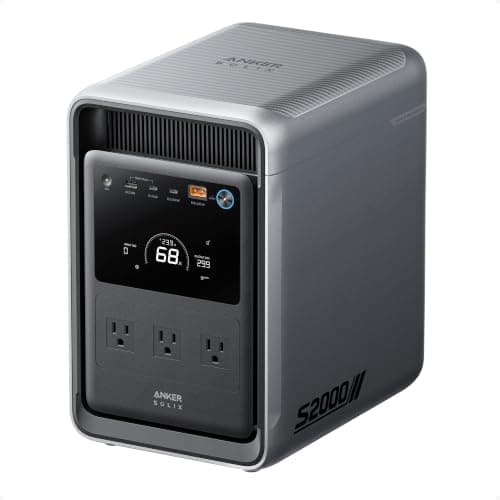
- 2,010Wh
- LFP (314Ah LFP cells)
- 1,500W continuous / 3,000W surge
- 35.7 lb
- 400W
- 6,000 cycles to 80% capacity; 10,000 cycles to 60%
- Full in 2.3 hr in UltraFast Mode (max 1,600W input; 1,150W default)
- 5 years
Anker publishes 2,010Wh of 314Ah LFP cells, 1,500W of rated AC output with a 3,000W peak, 35.7 lb, 8.2 x 11.1 x 12.7 in, a 10 ms UPS switchover, 6,000 cycles to 80% capacity and 10,000 cycles to 60%, a five-year warranty, eight outlets with AC on both the front and rear faces, an AC input ceiling of 1,600W that fills the battery in 2.3 hours once UltraFast Mode is switched on in the app, and Expandable Battery: No.
Two of those numbers are genuinely class-leading. 35.7 lb for 2,010Wh is 56.3 watt-hours per pound - the best carrying efficiency of any unit in our registry, and a long way clear of the 49.1 the Anker SOLIX C2000 Gen 2 manages or the 38.8 of BLUETTI's Elite 200 V2. And 6,000 cycles to 80% ties the longest cycle rating we list, which is the specification that actually decides what a kilowatt-hour from this box costs you over its life.
The cost is the inverter and the socket panel. 1,500W of continuous output is the lowest in the 2 kWh class by 700W, which puts a 1,500W kettle at the limit and an 1,800W hair dryer out of reach entirely. There is no 12V car port - Anker states this outright - so a 12V fridge, a 12V fan or a 12V water pump needs an inverter-fed adapter rather than the socket every rival fits. And the 400W solar ceiling is the weakest capacity-to-solar ratio in the class: five watt-hours of battery for every watt of panel it will accept.
Reasons to buy
- 56.3 watt-hours per pound - best in our registry
- 6,000 cycles to 80%, 10,000 to 60%
- 35.7 lb for 2,010Wh; one-person carry
- 10 ms published switchover; 5-year warranty
- AC outlets on both the front and rear faces
Reasons to avoid
- 1,500W continuous - lowest in the 2 kWh class by 700W
- No 12V car port, which Anker states explicitly
- 400W maximum solar input on a 2,010Wh battery
- No expansion battery exists for it
- Full 2.3 hr charge needs UltraFast Mode enabled in the app
Buy it if: a long, quiet, light-load job - outages, a desk, a CPAP, a camp you carry it to.
Skip it if: you run high-wattage appliances or any 12V gear.
Questions