Best 2000W Power Stations
The class where a weekend battery becomes a house battery. Also the class where 14 pounds separates the lightest unit from the heaviest for the same capacity.

At a glance
Quick picks
Tap any row to jump to the full write-up. Weight is a column here because it is the spec that decides whether you actually carry the thing.
| # | Product | Best for | Capacity · Weight | Price |
|---|---|---|---|---|
| 1 | 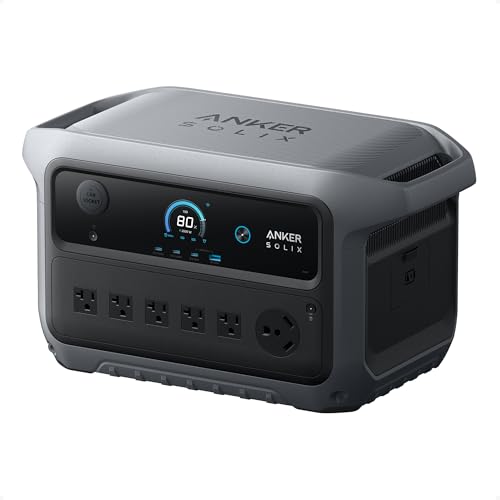 Anker SOLIX C2000 Gen 2 | Best 2 kWh unit overall | 2,048Wh 41.7 lb | $1,499.00 · View on Amazon |
| 2 | 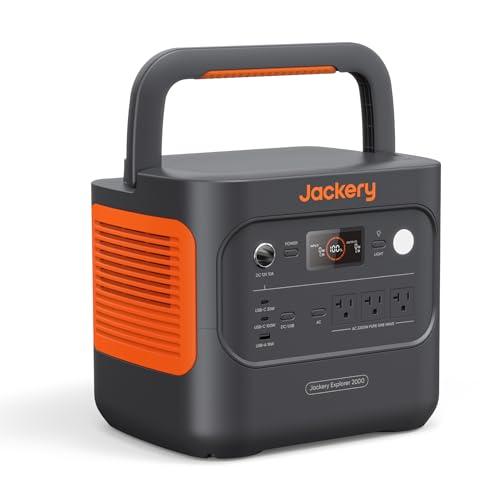 Jackery Explorer 2000 v2 | Best if you have to lift it | 2,042Wh 39.5 lb | $999.00 · View on Amazon |
| 3 | 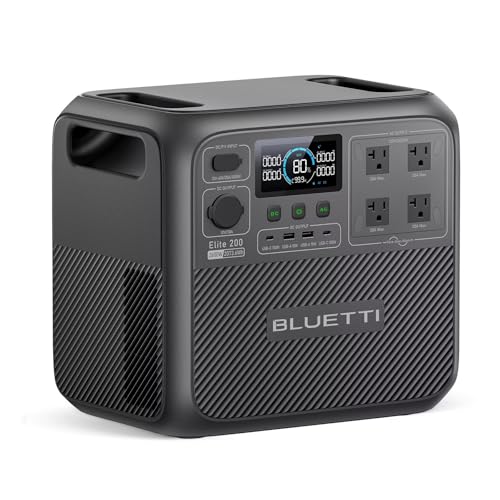 BLUETTI Elite 200 V2 | Most output, and the longest cycle rating | 2,074Wh 53.4 lb | $898.99 · View on Amazon |
| 4 | 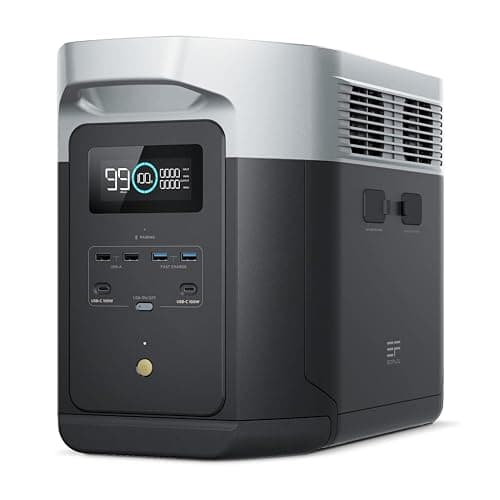 EcoFlow DELTA 2 Max | Best for outlet count and deep expansion | 2,048Wh 50.7 lb | $1,028.99 · View on Amazon |
First: 2000W and 2000Wh are different specifications
This is the same trap that sits under the tier below, and it catches more people here because the numbers are bigger. 2000W is the inverter's maximum continuous output — how much you can draw at any one instant. 2000Wh is the battery's capacity — how much energy it holds in total. A listing titled '2000W power station' almost always means roughly two kilowatt-hours of battery, with an inverter somewhere between 2,000W and 2,600W. They are independent specifications, and a unit can be good at one and ordinary at the other.
Why it matters: output decides what you can plug in, capacity decides how long it runs. A 2,600W inverter on a 1 kWh battery will boil a kettle and then be empty. A 1,500W inverter on a 3 kWh battery will run a fridge for two days and never boil that kettle. The four units below all carry roughly 2 kWh of battery, so the whole contest is in the other columns. If you are not sure which number you actually need, what size power station do I need is a five-minute exercise that usually moves people a whole band before they spend anything.
How we ranked these
Four criteria, applied in this order. Every figure is the manufacturer's own published number, read from the pages listed at the foot of this page. Nothing here is a field test — we do not pretend to have one, and how we choose explains exactly what that means.
- Continuous AC output, then surge. This is the specification the search term is reaching for. Continuous output sets the hard ceiling on what will run at all; surge decides whether a compressor or a motor can start without tripping the inverter.
- Watt-hours per pound. Our own arithmetic on published capacity and published weight. In this class the spread is 33%, which is the single biggest difference between these four units and the one most listings never mention.
- Charging input — solar ceiling and wall time. The input ceiling, not the panel you own, governs how fast a 2 kWh battery refills. A unit that takes 58 minutes and one that takes 2.3 hours behave like different products on a Saturday.
- Longevity on a stated threshold. A cycle count only means something with a retention figure attached. 4,000 cycles to 80% and 4,000 cycles to 70% are not the same promise, and we say which one each manufacturer published.
The four units, side by side
| Anker C2000 Gen 2 | Jackery 2000 v2 | BLUETTI Elite 200 V2 | EcoFlow DELTA 2 Max | |
|---|---|---|---|---|
| Capacity | 2,048Wh | 2,042Wh | 2,073.6Wh | 2,048Wh |
| AC continuous | 2,400W | 2,200W | 2,600W | 2,400W |
| Peak / surge | 4,000W | 4,400W | 3,900W (resistive) | Not published |
| Weight | 41.7 lb | 39.5 lb | 53.4 lb | 50.7 lb |
| Wh per pound | 49.1 | 51.7 | 38.8 | 40.4 |
| Max solar input | 800W | Not published | 1,000W | 1,000W |
| Full AC recharge | 58 min (AC + solar) | 1.33 hr | 1.4 hr | 2.3 hr |
| Cycle rating | 4,000 to 80% | 4,000 to 70%+ | 6,000+ to 80% | 3,000 to 80% |
| UPS switchover | 10 ms | Not published | 15 ms or less | Under 20 ms |
| AC outlets | 4 (incl. TT-30R) | 2 | Nine outputs total | 6 of 15 outputs |
| Expandable to | 4 kWh | 4 kWh kit | Unclear | 6 kWh |
| Warranty | 5 years (line) | 3 years, +2 | 5 years | 5 years |
Read across the capacity row and these four units are the same product. Read down the Wh-per-pound column and the spread is 33% — 13.9 lb between the lightest and the heaviest for a difference of 32Wh of battery. Read the recharge row and the spread is 2.4x. Weight and charging speed are what separate the 2 kWh class; capacity does not move at all.
What two kilowatt-hours actually runs
The figures below are nameplate bands. Read the plate on your own equipment — the sticker on the back, the base or inside the door — because the spread inside a product category is far wider than the spread between these four units. The runtimes also allow for inverter conversion losses, so they assume you never get 100% of the rated capacity out to an AC socket.
| Load | Typical draw | Runtime |
|---|---|---|
| Router and modem | 10-20W | 4-6 days |
| CPAP, humidifier off | 30-60W | 4-6 nights |
| Laptop and phone | 50-80W | 24-36 hours |
| Starlink Mini | 20-40W continuous | 2-3 days |
| 12V camping fridge | 45W cycling at 40% | About 4 days |
| Full-size refrigerator | 150W cycling at 35% | About 1.5 days |
| Chest freezer | 100W cycling at 30% | About 2.5 days |
| Pellet grill after ignition | 40-60W | 32-48 hours |
| Electric kettle | 1,500W | About 16 boils |
| Microwave | 1,200W | About 80 min of cooking |
| Window air conditioner | 500-1,200W | 1.5-3.5 hours |
| 1,500W space heater | 1,500W | About 70 min |
The useful way to read that table is top to bottom: 2 kWh is days of electronics, a day and a half of a household fridge, and a bit over an hour of heat. That last row does not improve with a bigger inverter — it gets worse, because a bigger inverter encourages you to plug in the thing that empties the battery. What size power station for a power outage does the whole-house version of this arithmetic, and can a power station run a refrigerator covers the one load most people are really buying for.
How to pick between the four
- Will you carry it? If the unit moves between a car and a campsite more than a couple of times a season, the Jackery's 39.5 lb and 13.2-inch footprint decide it outright. 13.9 lb is a real difference at this weight — it is roughly the point where a box stops being a comfortable two-handed carry.
- Will two heating appliances ever be on at once? A kettle and a toaster, a griddle and a coffee maker. If yes, the BLUETTI's 2,600W is the only rating here with genuine headroom, and the 53.4 lb is the price of it.
- How fast does it need to come back? The Anker's 58 minutes against the EcoFlow's 2.3 hours is the difference between topping up over lunch and planning a charge around the afternoon. On a weekend trip that changes the usable capacity of the unit, not just the convenience.
- How many things plug in at once? Two AC outlets on the Jackery is genuinely limiting at a campsite. The EcoFlow's six, out of fifteen outputs, is the other end of that scale and is the main reason to pick it.
- Is solar the plan or an afterthought? The BLUETTI and the EcoFlow accept 1,000W, the Anker 800W, and Jackery publishes nothing for this model. How much solar input do you need explains why the ceiling matters more than the panel.
- Will you grow it? The EcoFlow reaches 6 kWh, the Anker 4 kWh, the Jackery a 4 kWh kit. If this unit is the first step of a bigger plan rather than the whole plan, buy the architecture, not the box.
Where the 2 kWh class runs out
Two kilowatt-hours is the point where a portable battery starts to feel like infrastructure, and it is still a long way short of a house. Three jobs sit outside it, and buying into this class for any of them ends in a second purchase.
- Heating or cooling a room for an evening. Roughly 70 minutes of a 1,500W space heater, or one and a half to three and a half hours of a window air conditioner. What size power station to run a space heater and what size power station to run a window air conditioner do the arithmetic properly.
- A multi-day outage with a full-size fridge. A household refrigerator alone is most of a kilowatt-hour a day, so 2 kWh is day one and part of day two. Best portable power stations for home backup starts where this class stops.
- Anything hard-wired. A sump pump on a float switch, a well pump, a furnace blower. These need a transfer switch and a unit with the output and the connections to feed one, which is a different category of product — best power station for a sump pump is the honest version of that conversation.
If this tier is more than you need, best 1000W power stations covers the class below and is where most buyers should actually land. If it is not enough, best expandable power stations ranks the units that take a second battery, which is the cheap insurance against sizing this wrong. And if you are weighing a battery against a motor, portable power station vs inverter generator is the fair version of that argument.
One unit in this class is built on a trade the rest of the list does not make. The Anker SOLIX S2000 review covers 2,010Wh at 35.7 lb - 56.3 watt-hours per pound, the best figure in our whole registry and five pounds lighter than anything else at this capacity - behind a 1,500W inverter that is the weakest here by 700W, with no 12V car port and no expansion path. If your loads are small and your outages are long it is the easiest unit on this page to carry; if anything you own draws more than 1,500W it is the wrong buy.
Two of the units on this page are the clearest evidence of what changed in the 2026 hardware. The best portable power stations of 2026 ranks the current generation on that basis - BLUETTI publishing 6,000+ cycles to 80% and Anker publishing 6,000 to 80% plus 10,000 to 60%, where 3,000 was the recent standard, against a capacity and output picture that has barely moved in two years.
The picks in full
1. Best 2 kWh unit overall
Anker SOLIX C2000 Gen 2
- 2,048Wh
- LFP (LiFePO4)
- 2,400W continuous / 4,000W surge
- 41.7 lb
- 800W
- 4,000 cycles to 80% capacity
- 100% in 58 min (2,600W AC + solar)
- 5 years
This is the unit that answers the search term properly. 2,048Wh of LFP behind a 2,400W inverter with a published 4,000W peak, and Anker gets all of that into 41.7 lb — within 2.2 lb of the lightest unit here and 11.7 lb lighter than the BLUETTI. 49.1 watt-hours per pound is the second-best ratio in the class and the best one attached to a 2,400W inverter.
The charging figure is the one that changes how you live with it: Anker publishes a full recharge in 58 minutes when AC and solar run together at 2,600W. It also publishes a 10 ms UPS switchover, 4,000 cycles to 80% capacity, four AC outlets including a NEMA TT-30R for an RV, two 140W USB-C ports, and expansion to 4 kWh with the BP2000 (Gen 2) battery. Our full Anker SOLIX C2000 Gen 2 review works through the whole sheet.
Two real limits. 800W of maximum solar input is the lowest of the three units here that publish one — the BLUETTI and the EcoFlow both accept 1,000W. And at 18.1 inches wide it has the largest footprint in the group, which matters more than the weight if it has to live in a cabinet or a trunk well.
Reasons to buy
- 2,400W continuous with a published 4,000W peak
- 41.7 lb for 2,048Wh — 49.1Wh per pound
- Full recharge in 58 minutes (AC + solar at 2,600W)
- 10 ms UPS switchover; 4,000 cycles to 80%
- Expands to 4 kWh; TT-30R outlet for an RV
Reasons to avoid
- 800W solar input — lowest of the three that publish a figure
- 18.1 in wide, the biggest footprint here
- Four AC outlets, not the six EcoFlow gives you
- Anker does not restate a warranty term on the model page
Buy it if: you want 2 kWh and 2,400W without carrying 53 lb to get it.
Skip it if: solar is the main way you plan to refill it.
2. Best if you have to lift it
Jackery Explorer 2000 v2
- 2,042Wh
- LiFePO4 (LFP)
- 2,200W continuous / 4,400W surge
- 39.5 lb
- 4,000 cycles to 70%+ capacity
- 1.33 hr full with Emergency Super Charge
- 3 years, extendable to 5
39.5 lb for 2,042Wh is 51.7 watt-hours per pound, and that is not a narrow win — it is the best ratio anywhere in this site's registry, at any capacity. Jackery also publishes the smallest dimensions in the class by a wide margin: 13.2 x 10.4 x 11.5 in, against 18.1 inches of width on the Anker. If the unit moves between a car, a campsite and a garage shelf, this is the one your back and your trunk both prefer.
2,200W rated with a 4,400W surge peak is the highest surge figure in the group, which matters for anything with a compressor or a motor in it — a fridge, a pump, a circular saw. Jackery publishes 4,000 cycles, LiFePO4 cells, a full charge in 1.33 hours on Emergency Super Charge, and a 4 kWh kit that pairs the unit with a matching battery pack.
The gaps are in what Jackery does not publish. There is no maximum solar input figure and no UPS switchover time for this model on either jackery.com or uk.jackery.com, so we leave both blank rather than borrow a number from a retailer listing. Its cycle rating is also measured to 70% of original capacity rather than the 80% threshold Anker and BLUETTI use, which makes the headline 4,000 look better than it is against theirs. Two AC outlets is the other honest limit.
Reasons to buy
- 39.5 lb — 51.7Wh per pound, the best ratio on this site
- 13.2 x 10.4 x 11.5 in, by far the smallest here
- 4,400W surge peak, the highest in the class
- Full charge in 1.33 hr with Emergency Super Charge
- 4,000 cycles; 4 kWh kit available
Reasons to avoid
- No published maximum solar input figure
- No published UPS switchover time
- Cycle rating measured to 70%, not 80%
- Only two AC outlets
- Three-year base warranty, the shortest here
Buy it if: the unit gets carried, and the trunk space is finite.
Skip it if: you need a stated solar ceiling before you buy panels.
3. Most output, and the longest cycle rating
BLUETTI Elite 200 V2
- 2,074Wh
- LiFePO4 (LFP), automotive-grade cells
- 2,600W continuous / 3,900W surge
- 53.4 lb
- 1000W
- 6,000+ cycles to 80% capacity
- Full in 1.4 hr (1,800W AC input)
- 5 years
2,600W continuous is the highest AC rating in the class, and the 6,000-cycle rating to 80% capacity is the longest longevity claim on this entire site — 50% more than the 4,000-cycle figures Anker and Jackery publish, measured against the same stricter threshold. BLUETTI pairs that with automotive-grade LFP cells, a 15 ms or faster switchover, 1,000W of solar input and a 1.4-hour full charge at 1,800W.
2,600W is a genuinely different appliance envelope rather than a spec-sheet flourish. It is the difference between a 1,500W kettle running with headroom to spare and a 1,500W kettle running at the edge of the inverter. If two heating appliances might ever be on at once — a kettle and a toaster, a griddle and a coffee maker — this is the only unit here with room for it.
It costs you 53.4 lb, which is 38.8 watt-hours per pound and the worst ratio in the group: 13.9 lb more than the Jackery for 32Wh more battery. The 3,900W Power Lifting figure also applies only to purely resistive loads, so it is not a surge rating for motors. And BLUETTI's own position on expansion is contradictory — it sells an Elite 200 V2 and B500K bundle, while the model's FAQ says it does not support the B80, B230 or B300 packs. Confirm the pack before you buy one.
Reasons to buy
- 2,600W continuous — the highest here
- 6,000+ cycles to 80% capacity, the longest claim on this site
- 1,000W solar input; 1.4 hr full charge
- Switchover of 15 ms or less
- Five-year warranty
Reasons to avoid
- 53.4 lb — 38.8Wh per pound, the worst here
- 3,900W lifting figure applies to resistive loads only
- BLUETTI's own expansion guidance for it is contradictory
- Slower full charge than the Anker's 58 minutes
Buy it if: output and lifespan matter more than what it weighs.
Skip it if: you ever have to carry it any distance.
4. Best for outlet count and deep expansion
EcoFlow DELTA 2 Max
- 2,048Wh
- LFP (LiFePO4)
- 2,400W continuous
- 50.7 lb
- 1000W
- 3,000 cycles to 80% capacity
- 2.3 hr; 800W car/alternator charging
- 5 years
Fifteen outputs including six AC sockets is the most generous port count in the class, and nothing else here comes close. At a campsite or a tailgate that is the difference between plugging everything in and queueing for a socket, and it is the reason this unit is still worth considering against newer rivals. EcoFlow publishes 2,048Wh, 2,400W continuous, 1,000W of maximum solar input, 800W of car and alternator charging, a switchover under 20 ms and expansion from 2 kWh to 6 kWh with up to two extra batteries.
6 kWh is the deepest expansion path in the group — the Anker stops at 4 kWh, the Jackery at a 4 kWh kit, and BLUETTI's own guidance is unclear. If the plan is to start at 2 kWh and grow into whole-house backup over a couple of years, this is the architecture that gets you there. Best expandable power stations ranks that axis on its own.
It is also the oldest design here and it shows in three places. The 2.3-hour full recharge is more than twice the Anker's 58 minutes. 50.7 lb for 2,048Wh is 40.4 watt-hours per pound, second-worst in the group. And the 3,000-cycle rating to 80% is the shortest here. EcoFlow publishes no surge figure and no dimensions for this model on either its main site or its shop page, so both are blank in our spec table rather than filled in from a listing.
Reasons to buy
- Fifteen outputs including six AC sockets
- Expands from 2 kWh to 6 kWh
- 1,000W solar plus 800W car and alternator charging
- Switchover under 20 ms
- Five-year warranty
Reasons to avoid
- 2.3 hr full recharge — slowest here by far
- 50.7 lb — 40.4Wh per pound
- 3,000 cycles to 80%, the shortest rating here
- No published surge figure or dimensions
Buy it if: six AC outlets now and 6 kWh later.
Skip it if: you want it refilled over a lunch break.
Questions