Jackery Explorer 2000 v2 vs Anker SOLIX C2000 Gen 2
The closest contest in the 2 kWh class. Same capacity, 2.2 pounds apart, and five inches apart on the specification nobody checks.
These two units carry 6Wh of capacity between them in difference — 2,042Wh against 2,048Wh — which is nothing. They weigh 2.2 lb apart, which is also close to nothing at this size. On paper they look like the same purchase at a different badge, and that is exactly why this comparison is worth doing properly: the real differences are in four columns most listings bury.
Side by side, on published figures
| Jackery Explorer 2000 v2 | Anker SOLIX C2000 Gen 2 | |
|---|---|---|
| Capacity | 2,042Wh | 2,048Wh |
| Chemistry | LiFePO4 (LFP) | LFP (LiFePO4) |
| AC continuous | 2,200W | 2,400W |
| Peak / surge | 4,400W | 4,000W |
| Weight | 39.5 lb | 41.7 lb |
| Wh per pound | 51.7 | 49.1 |
| Dimensions | 13.2 x 10.4 x 11.5 in | 18.1 x 9.8 x 10.1 in |
| Max solar input | Not published | 800W |
| Full AC recharge | 1.33 hr (Emergency Super Charge) | 58 min (AC + solar at 2,600W) |
| Cycle rating | 4,000 to 70%+ | 4,000 to 80% |
| UPS switchover | Not published | 10 ms |
| AC outlets | 2 | 4 (incl. NEMA TT-30R) |
| USB | 1x USB-C 100W, 1x USB-C 30W, 1x USB-A 18W | 2x USB-C 140W, 1x USB-A |
| Expansion | 4 kWh kit with a matching battery pack | 4 kWh with BP2000 (Gen 2) |
| Warranty | 3 years, extendable to 5 | 5 years (SOLIX line term) |
Size is the difference, not weight
Everyone compares the weights. 39.5 lb against 41.7 lb is a 5% gap and you will not notice it. The dimensions are where this decision actually lives: the Jackery is 13.2 inches on its longest side, the Anker is 18.1. Five inches is the difference between fitting a van galley cabinet and not, between sitting in a trunk well and sitting across the floor, between a closet shelf and the garage. It is also the specification nobody measures before buying, and the one that generates the returns.
Jackery's 51.7 watt-hours per pound is the best figure in this site's registry at any capacity, and it is achieved by packing the cells tighter rather than by cutting capacity. If the unit is going to move — car to campsite, garage to driveway, house to trailer — that density plus the compact shape is a compounding advantage over a season. Power station weight guide sets out where the practical carrying thresholds actually sit.
Output: 200W, and what it buys
2,400W against 2,200W sounds marginal and mostly is — both units run every appliance on a normal list. The 200W matters at one specific edge: a 1,500W heating appliance plus anything else. A kettle and a phone charger is fine on both. A kettle and a coffee maker is comfortable on the Anker and tight on the Jackery. If two things that heat will ever be on together, the Anker has the room.
The surge figures run the other way. Jackery publishes 4,400W against Anker's 4,000W, and surge is what lets a compressor or a motor start. Both have plenty for a domestic refrigerator; the Jackery's margin is wider for an unusually stubborn load. In practice this column is a tie — neither unit will fail to start a household appliance.
The outlet count is not a tie. Two AC sockets against four is a real daily difference, and the Anker's fourth socket is a NEMA TT-30R, the 30-amp RV connector. If you have a travel trailer, that one port removes an adapter chain from your life. Best portable power stations for RV covers what that unlocks.
Charging: one unit publishes a ceiling, the other does not
Anker publishes 800W of maximum solar input. Jackery publishes no figure at all for the Explorer 2000 v2 on either jackery.com or uk.jackery.com, so we state none. That is a meaningful asymmetry if panels are part of the plan: you cannot size an array against a number that does not exist, and the input ceiling — not the panel wattage — is what governs charging speed. How much solar input do you need explains the mechanism.
On wall charging the two are closer than the headlines suggest. Anker's 58 minutes is published for AC and solar running together at a combined 2,600W, so it needs sun. Jackery's 1.33 hours is its Emergency Super Charge figure. Read both as marketing-best cases and expect something between the two in a normal garage in February. Either way, both units refill far faster than the EcoFlow DELTA 2 Max's published 2.3 hours.
Longevity: the same number against different tests
Both publish 4,000 cycles. They are not the same claim. Anker measures to 80% of original capacity; Jackery measures to 70%+. A battery allowed to fade further before the count stops will always post a longer-looking life, so the Anker's figure is the stronger promise of the two even though the headline matches. This is the single most commonly misread specification in the category — how long do portable power stations last works through what a cycle rating does and does not tell you.
Warranty goes the same way, with a caveat. Jackery's base term is three years with a two-year extension available. Anker states five years for the SOLIX power-station line, though the C2000 Gen 2 page does not restate it for this model specifically, so confirm it on the listing you buy from rather than taking our word or Anker's marketing.
Which one to buy
- Measure the space first. If the unit has to fit somewhere specific, the Jackery's 13.2-inch footprint decides this and nothing else matters. This is the most common reason to pick it and the cheapest mistake to avoid.
- Count the plugs. If three or four things go in at once, or there is an RV shore cord in your future, the Anker's four outlets and TT-30R decide it.
- Is solar the plan? If yes, buy the unit that publishes a ceiling you can size an array against. That is the Anker, at 800W — though note that both the BLUETTI Elite 200 V2 and the EcoFlow DELTA 2 Max accept 1,000W if solar is the whole point.
- Does it need to be a UPS? The Anker publishes 10 ms; Jackery publishes nothing. For a desk, a modem or a desktop computer, buy the published figure.
- Everything else is a tie. Capacity, chemistry, surge headroom for real appliances and expansion to 4 kWh are effectively identical. Do not let a review talk you into a difference that is not there.
If neither of these is quite right, best 2000W power stations ranks the whole class including the BLUETTI Elite 200 V2 (more output, longer cycle life, 11.7 lb heavier) and the EcoFlow DELTA 2 Max (six AC outlets, 6 kWh expansion, a much slower recharge). And if 2 kWh is more than you need, best 1000W power stations covers the tier below, where most buyers should land.
Both of these units appear on two newer pages where the decisive spec is different again. Best power station for high-surge loads ranks on peak rating, where the Jackery's 4,400W beats the Anker's 4,000W. Best power station with an RV plug ranks on the socket, where the Anker's published TT-30R is the only one of its kind in our registry.
The picks in full
1. The one to buy if it moves, or the space is tight
Jackery Explorer 2000 v2
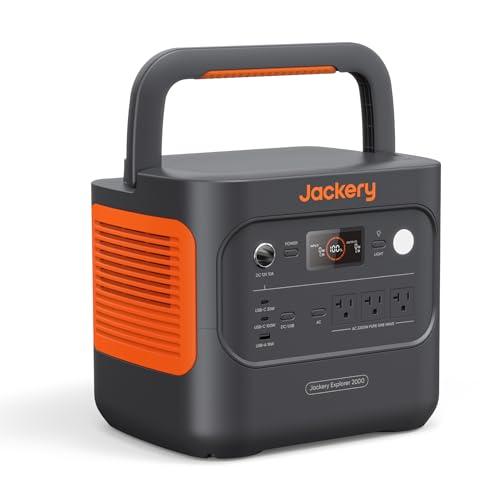
- 2,042Wh
- LiFePO4 (LFP)
- 2,200W continuous / 4,400W surge
- 39.5 lb
- 4,000 cycles to 70%+ capacity
- 1.33 hr full with Emergency Super Charge
- 3 years, extendable to 5
2,042Wh in 39.5 lb is 51.7 watt-hours per pound, the best ratio anywhere in this site's registry at any capacity. More importantly for most buyers, Jackery publishes 13.2 x 10.4 x 11.5 in — a near-cube that fits in a trunk well, a van cabinet or a closet shelf where the Anker's 18.1-inch width does not.
2,200W rated with a published 4,400W surge peak is the biggest start-up margin in the class, which is the specification that decides whether a compressor or a motor runs at all. Jackery also publishes 4,000 cycles, LiFePO4 cells, a full charge in 1.33 hours on Emergency Super Charge, and a 4 kWh kit that pairs the unit with a matching battery pack.
Jackery publishes no maximum solar input figure and no UPS switchover time for this model, and its 4,000-cycle rating is measured to 70% of original capacity rather than 80%. The base warranty is three years, extendable to five, against Anker's five-year line term. Two AC outlets is the other real limit — half the Anker's count.
Reasons to buy
- 39.5 lb and 13.2 x 10.4 x 11.5 in — smallest and lightest
- 51.7Wh per pound, best in this registry
- 4,400W surge peak, the biggest margin here
- Full charge in 1.33 hr with Emergency Super Charge
- 4 kWh kit available
Reasons to avoid
- No published solar input ceiling
- No published UPS switchover time
- Cycle rating measured to 70%, not 80%
- Two AC outlets
- Three-year base warranty
Buy it if: the box gets carried, or the space it lives in is measured.
Skip it if: you need a stated solar ceiling or UPS figure before buying.
2. The one to buy if it has to plug in more, or charge faster
Anker SOLIX C2000 Gen 2
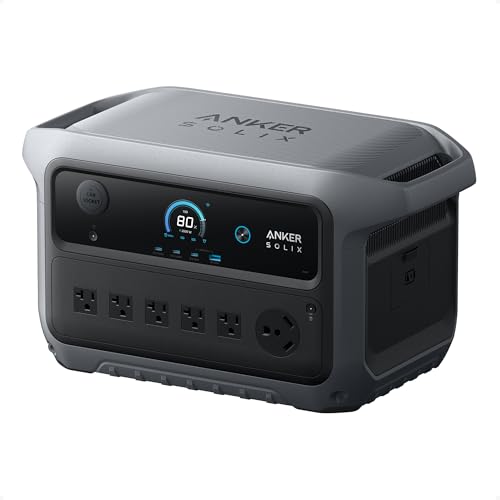
- 2,048Wh
- LFP (LiFePO4)
- 2,400W continuous / 4,000W surge
- 41.7 lb
- 800W
- 4,000 cycles to 80% capacity
- 100% in 58 min (2,600W AC + solar)
- 5 years
2,048Wh behind 2,400W continuous and a 4,000W peak, with four AC outlets including a NEMA TT-30R for an RV shore cord. Those 200 extra continuous watts are the difference between a 1,500W kettle with headroom and a 1,500W kettle near the ceiling, and the outlet count is the difference between plugging everything in and adding a power strip.
Anker publishes the figures Jackery leaves blank: an 800W maximum solar input, a 10 ms UPS switchover, and 4,000 cycles to 80% of original capacity — the stricter retention threshold, which makes the matching headline number a stronger promise than Jackery's. A full recharge in 58 minutes with AC and solar together at 2,600W is the fastest published figure in the class. Our Anker SOLIX C2000 Gen 2 review has the full sheet.
It is 2.2 lb heavier and, far more consequentially, 18.1 inches wide against the Jackery's 13.2 — the biggest footprint in the class. 800W of solar is also the lowest ceiling among the 2 kWh units that publish one, and the five-year warranty is Anker's term for the SOLIX line rather than a claim restated on this model's page.
Reasons to buy
- 2,400W continuous, 4,000W peak
- Four AC outlets including a TT-30R for an RV
- Published 800W solar ceiling and 10 ms switchover
- 4,000 cycles to the stricter 80% threshold
- Full in 58 minutes (AC + solar); expands to 4 kWh
Reasons to avoid
- 18.1 in wide — the biggest footprint in the class
- 2.2 lb heavier; 49.1Wh per pound
- 800W solar is the lowest published ceiling here
- The 58-minute figure needs solar as well as AC
Buy it if: more sockets, more output, and the fastest refill in the class.
Skip it if: the unit has to fit a narrow cabinet or a small trunk well.
Questions