Can a Power Station Charge an EV?
Technically yes, and the arithmetic is less encouraging than the socket suggests. What a full power station is worth in miles, and the one case where it is genuinely useful.

The short answer
Yes, but a full power station is worth a very small number of miles. The honest figure is arithmetic rather than opinion: a car rated at 3 miles per kWh gains about 3 miles for every kilowatt-hour you put in, so our largest unit at 3,840Wh - about 3,264Wh usable - adds roughly 10 miles, and a 1,024Wh unit adds roughly 2.6. Charging losses in the car's own onboard charger make both figures slightly worse. This is an emergency tool for getting to a charger, not a way to charge an EV at home, and nothing about the specifications changes that.
At a glance
Quick picks
Tap any row to jump to the full write-up. Weight is a column here because it is the spec that decides whether you actually carry the thing.
| # | Product | Best for | Capacity · Weight | Price |
|---|---|---|---|---|
| 1 | 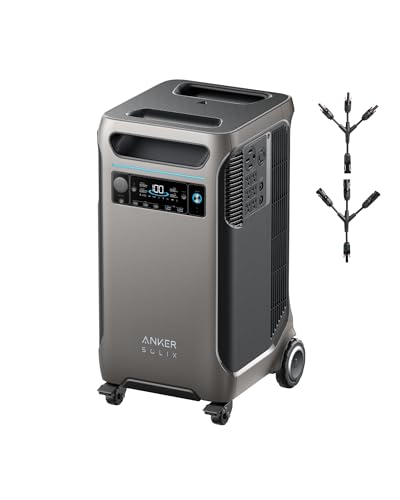 Anker SOLIX F3800 | The only unit with a real Level 2 socket | 3,840Wh 132.3 lb | Check price on Amazon |
| 2 | 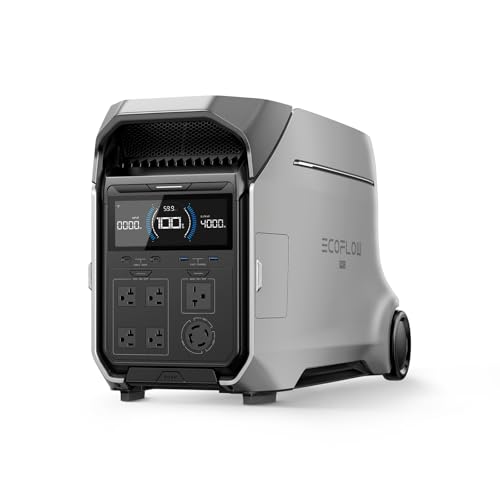 EcoFlow DELTA Pro 3 | Best capacity, with 240V output | 4,096Wh Weight n/p | Check price on Amazon |
| 3 | 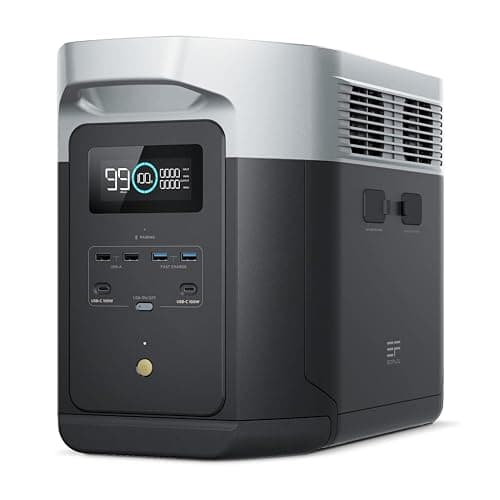 EcoFlow DELTA 2 Max | The realistic 120V option | 2,048Wh 50.7 lb | $1,028.99 · View on Amazon |
The arithmetic, in full
Every car publishes its own efficiency, as miles per kWh or kWh per 100 miles, and the spread between a small hatchback and a large truck is roughly a factor of two. So the only honest way to answer this question is to show the sum and let you substitute your own figure. The worked example below assumes 3 miles per kWh, which sits in the middle of the range for current passenger EVs - check your own window sticker or owner's manual.
The reason the numbers are so small is simply scale. A mid-size EV battery is somewhere around 60 to 80 kWh. Our largest registry unit is 3.84 kWh - about one twentieth of it. Portable power stations and car batteries are two orders of magnitude apart in the same unit of measurement, and no feature list closes that gap.
The three ways to connect, and what each gives you
| Method | Supply needed | Typical draw | From our registry |
|---|---|---|---|
| Level 1, 120V cable | A household outlet | About 1,440W at 12A | Any unit rated 1,500W or more |
| Level 2 via 14-50 | 240V at 30-50A | 3,800-9,600W | Anker SOLIX F3800 only |
| Level 2 via L14-30 | 240V at 30A | Up to 7,200W | Anker SOLIX F3800 |
| DC fast charging | Hundreds of amps, 400-800V | 50-350 kW | Not possible from any portable unit |
Level 1 is what most people will actually do, because it needs nothing but the cable in the boot and a household socket. At 12 amps on 120V that is about 1,440W, which every unit in our registry above 1,500W continuous can supply - but it also empties a 1kWh unit in about 36 minutes.
Level 2 through a NEMA 14-50 is the configuration that looks promising and mostly is not, because the faster you charge, the faster the power station empties. Going from 1,440W to 7,200W does not put more energy into the car; it puts the same energy in five times faster. The total is fixed by the battery you own, and that is the number that matters.
Where it is genuinely useful
- Getting to a charger. Ten miles is enough to reach a charging station from most places you would be stranded, and that is a real use case that justifies nothing else on this page.
- Topping up overnight at a remote site, if you have panels and days. 2,400W of solar input into an F3800, refilled daily and emptied into the car, is slow but it is not nothing.
- Keeping a plug-in hybrid useful. A PHEV battery is commonly 8 to 18 kWh, so a full 3.84 kWh unit is a meaningful fraction of one rather than a rounding error.
- Running the car's accessories without the traction battery - a 12V fridge, a laptop, lights while camping in the vehicle. This is what a power station is actually good at, and best power station for overlanding covers it properly.
Where it is not useful
As a home charger, because the power station itself has to be charged from the same wall socket you would have plugged the car into - with conversion losses at both ends. Putting a battery in the middle of that chain costs you energy and gains you nothing unless you are time-shifting to solar.
And not as a backup plan for a long trip, because the capacity simply is not there. If the worry is running out of range on a route, the answer is route planning rather than a 132 lb battery in the boot that is worth ten miles.
If what you actually want is the biggest battery you can own for the house rather than for the car, best power station for high-surge loads and can a power station power a house are the two pages to read instead - both are honest about the ceiling.
The picks in full
1. The only unit with a real Level 2 socket
Anker SOLIX F3800
- 3,840Wh
- LiFePO4 (LFP)
- 6,000W continuous / 9,000W surge
- 132.3 lb
- 2400W
- 3,000+ cycles
- 1,800W max AC input
- 5 years
A NEMA 14-50 outlet rated at 6,000W, which is the socket most portable Level 2 chargers plug into. This is the one unit in our registry that can present a car's own charging cable with the connection it expects rather than a 120V trickle - and at 6,000W continuous it has the output to drive it meaningfully.
Anker publishes 3,840Wh of LiFePO4, a 9,000W peak, 2,400W of maximum solar input, 1,800W of AC input, 3,000+ cycles, a 5-year warranty, a NEMA L14-30 also rated at 6,000W, six NEMA 5-20 20A outlets, and expansion to 53.8 kWh across six extra batteries. That expansion ceiling is the only configuration in our registry that would put a useful charge into a car.
3,840Wh at 85% usable is about 3,264Wh - roughly ten miles into a car rated at 3 miles per kWh, before the onboard charger's own losses. 132.3 lb on wheels. This unit is a house-backup appliance that happens to have the right socket, not an EV charger.
Reasons to buy
- NEMA 14-50 at 6,000W - a real Level 2 socket
- 3,840Wh, expandable to 53.8 kWh
- 6,000W continuous, 9,000W surge
- 2,400W maximum solar input
- 3,000+ cycles; 5-year warranty
Reasons to avoid
- About ten miles of range per full pack
- 132.3 lb
- No published UPS switchover
Buy it if: a house battery that can also reach a car in an emergency.
Skip it if: you want to charge an EV as a routine.
2. Best capacity, with 240V output
EcoFlow DELTA Pro 3
- 4,096Wh
- LFP (EV-grade)
- 4,000W continuous / 6,000W surge
- 80% capacity after 4,000 cycles
- 80% in 50 min
- 5 years (3-year standard plus 2-year extended)
4,096Wh and 120V/240V output - the largest single pack in our registry, and the 240V capability a Level 2 charger needs. EcoFlow publishes 4,000W continuous with a 6,000W peak and seven charging methods, plus expansion from 4 kWh to 48 kWh.
4,096Wh at 85% usable is about 3,482Wh, which is roughly 10.4 miles into a car rated at 3 miles per kWh. The expansion story is the interesting part: at 48 kWh you are in the territory of a genuinely useful charge, though at that point you have bought a stationary home battery that happens to be modular.
EcoFlow publishes 80% capacity after 4,000 cycles, 80% charge in 50 minutes and a 5-year term made up of three years standard plus two extended. It publishes no weight and no maximum solar input figure in its overview, and no receptacle breakdown - so whether your charger's plug fits is a question for the seller, not for this page.
Reasons to buy
- 4,096Wh - largest single pack here
- 120V and 240V output
- Expandable to 48 kWh
- 80% capacity after 4,000 cycles
- 80% charge in 50 minutes
Reasons to avoid
- No published weight or receptacle list
- Still only about 10 miles per full pack
- No published maximum solar input
Buy it if: the largest capacity, with a path to a real home battery.
Skip it if: you need to know the socket before you buy.
3. The realistic 120V option
EcoFlow DELTA 2 Max
- 2,048Wh
- LFP (LiFePO4)
- 2,400W continuous
- 50.7 lb
- 1000W
- 3,000 cycles to 80% capacity
- 2.3 hr; 800W car/alternator charging
- 5 years
2,048Wh and 2,400W continuous through six AC outlets. No 240V and no RV or EV receptacle, so this charges a car exactly the way most people actually would: the Level 1 cable that came with the vehicle, plugged into a household socket.
At 120V and 12 amps - the usual conservative Level 1 setting - the car draws about 1,440W. 2,048Wh at 85% usable is 1,741Wh, so this unit delivers about 72 minutes of Level 1 charging, which is roughly 1.7 kWh into the car and about five miles.
EcoFlow publishes 1,000W of maximum solar input, 800W of car and alternator charging, a 2.3-hour wall recharge, a switchover under 20 ms, 3,000 cycles to 80% capacity, 50.7 lb, a 5-year warranty and expansion to 6 kWh. It publishes no surge figure and no dimensions.
Reasons to buy
- 2,048Wh, expandable to 6 kWh
- 2,400W continuous, six AC outlets
- 1,000W solar and 800W alternator input
- 3,000 cycles to 80%; 5-year warranty
Reasons to avoid
- About five miles of range per full pack
- No 240V output
- No published surge figure or dimensions
Buy it if: the Level 1 cable in the boot, as a last resort.
Skip it if: you expected a meaningful charge.
Questions