EcoFlow RIVER 2 Pro Review
The most battery you can carry in one hand. Three years old, still sold, and still the only small EcoFlow with three quarters of a kilowatt-hour inside it.

The short answer
Buy it if you want the biggest battery that still travels like a small unit. EcoFlow publishes 768Wh of LFP, 800W of continuous AC with a 1,600W surge, 18.2 lb, a full wall recharge in 70 minutes, an EPS auto-switch under 30 ms, 80%+ capacity after 3,000 cycles and a five-year warranty. The catch is the charging ceiling in the other direction: 220W of maximum solar input on a 768Wh battery is roughly a four-to-five-hour refill in perfect sun, which makes this a unit you plug into a wall rather than one you live off a panel. It is also the previous generation — the RIVER 3 Plus that replaced it is lighter and newer, with less than half the battery.
What it is good at
768Wh at 18.2 lb is the whole argument. That works out to 42.2 watt-hours per pound, which is better than every small unit in our registry and close to what the full-size one-kilowatt boxes manage. The practical version of that number: this is roughly two and a half times the battery of a typical 300Wh unit, for about eight to nine pounds more. If you have ever run a small power station flat on the second evening of a trip, that is the gap this unit closes, and it closes it without becoming a two-handed carry.
Seventy minutes to full from a wall socket. EcoFlow publishes 0-100% in 70 minutes at a 940W maximum AC input. On a battery this size that is genuinely fast — faster in absolute terms than most 300Wh units manage, because they cap their input far lower. It changes how you use the thing: you can top it up over lunch, or in the hour before you leave, rather than planning a charge the night before. A battery you can refill in an hour is effectively larger than one you cannot.
800W runs more than people expect, and X-Boost stretches it. 800W of continuous pure sine wave covers a laptop, a router, a CPAP, lights, a television, a slow cooker, most blenders and a 12V camping fridge without thinking about it. EcoFlow's X-Boost mode lifts that to a published 1,600W for resistive loads — a kettle, a hot plate, a hair dryer — by reducing the voltage supplied rather than by delivering more power. That is a real feature with a real caveat: it works on heating elements, not on anything with a motor or a sensitive power supply. Surge watts vs running watts explains which of your appliances falls on which side of that line.
LFP cells, 3,000 cycles to 80%, and a five-year warranty. The RIVER 2 generation is where EcoFlow moved the small range to lithium iron phosphate, and it matters more here than the spec sheet suggests. Three thousand cycles to 80% of original capacity is roughly eight years of charging it every single day, against the few hundred cycles the older lithium-ion small units managed. If you are weighing this against a cheaper non-LFP unit, LiFePO4 vs NMC power station batteries is the honest version of that trade.
An EPS auto-switch under 30 milliseconds. Plug a load through the unit, leave the unit plugged into the wall, and if the mains drops the battery picks the load up in under 30 ms. That is fast enough for a modem, a router, a television or a games console. It is slower than the 10 ms figures Anker and BLUETTI publish on their current units, and for a desktop computer that difference occasionally matters — best power stations with UPS mode ranks the whole registry on exactly this specification.
Where it falls short
220W of solar input is the specification that should decide your purchase. This is the real limit of the unit and it is easy to miss. 768Wh of battery against a 220W input ceiling means a best-case solar refill of around four hours of genuinely good sun, and a realistic one closer to five or six once you account for panel angle, haze and temperature. Buying a 400W panel array will not help — the charge controller, not the panel, sets the ceiling. By comparison the much smaller RIVER 3 Plus also takes 220W, which means it fills from solar in well under half the time. If solar is your primary charging plan rather than a backup, this is the wrong unit in the range. How much solar input do you need works through why the ceiling governs and the panel does not.
It is the previous generation, and EcoFlow has moved on. The RIVER 3 Plus is the current small EcoFlow: 10.4 lb against 18.2, a newer chassis, three AC outlets, and an expansion battery that takes it to 858Wh. On raw capacity the RIVER 2 Pro still wins outright — 768Wh against 286Wh — but the newer unit can be grown past 800Wh if you later need it, and the older one cannot be grown at all. Buying last generation is not automatically a mistake, but it should be a decision rather than an accident.
No published expansion. EcoFlow lists no extra battery for this model on its product page. Whatever you buy is what you have, permanently. On a unit people buy precisely because they outgrew a 300Wh box, that is worth sitting with — the next step up from here is a full 1 kWh unit and a fresh purchase, not an add-on.
EcoFlow quotes operating noise of up to 62 dB. That is the fan under load, and 62 dB is conversation volume — noticeably more than the 25 dB Anker publishes for its small C300. In a tent, in a bedroom during an outage, or anywhere you are trying to sleep next to it, the fan is audible. Are portable power stations loud puts those published figures in order and explains when the fan actually runs.
EcoFlow does not publish an AC outlet count on the product page. The specification sheet gives the AC output as 800W total and leaves the socket count out; the Amazon listing says four. We record what the manufacturer publishes and flag the rest, which is the same rule applied everywhere in how we choose. Separately, several retailer spec sheets list the weight as 17.2 lb where EcoFlow's own page says approximately 18.2 lb — we use EcoFlow's number, which is the less flattering one.
How it compares
| RIVER 2 Pro | RIVER 3 Plus | BLUETTI Elite 30 V2 | Anker SOLIX C300 | |
|---|---|---|---|---|
| Capacity | 768Wh | 286Wh | 288Wh | 288Wh |
| AC continuous | 800W | 600W | 600W | 300W |
| Surge / lifting | 1,600W | 1,200W | 1,500W | 600W |
| Weight | 18.2 lb | 10.4 lb | 9.5 lb | 9.1 lb |
| Wh per pound | 42.2 | 27.5 | 30.3 | 31.6 |
| Max solar input | 220W | 220W | 200W | 100W |
| Full AC recharge | 70 min | 60 min | 70 min | 80% in 50 min |
| Switchover | Under 30 ms | Not published | 10 ms or less | 10 ms |
| Cycle rating | 3,000 to 80%+ | 3,000 to 80% | 3,000+ | Not published |
| Expandable | Not published | To 858Wh | No | Not published |
| Warranty | 5 years | Not published | 5 years | 5 years |
Read that table across the capacity row and the contest is over: the RIVER 2 Pro holds between 2.6 and 2.7 times what any of the others hold. Read it down the weight column and the cost is eight to nine pounds. Everything else in the comparison is small-print — the Elite 30 V2 switches faster, the C300 is quieter and charges to 80% sooner, the RIVER 3 Plus grows. None of those reverse a 480Wh difference if capacity is what you came for.
Against the EcoFlow RIVER 3 Plus specifically, which is the comparison most people are actually making: the RIVER 3 Plus is 7.8 lb lighter, has three AC outlets to this unit's unstated count, is the model EcoFlow is currently promoting, and can be grown to 858Wh with its wire-free extra battery. Even fully expanded it still holds less than the RIVER 2 Pro does out of the box. Buy the RIVER 3 Plus if the unit lives in a backpack or on a desk; buy the RIVER 2 Pro if it lives in a car trunk and has to last a long weekend.
Against the 1 kWh class — the Anker SOLIX C1000 Gen 2, the EcoFlow DELTA 3 Plus, the BLUETTI AC180 — the RIVER 2 Pro gives up about a third of the battery and more than half the inverter, and takes back six to seventeen pounds. That is the trade in a sentence. If nothing on your list draws more than 800W and you carry the unit more than you plug things into it, the smaller box is the better purchase. If you want to run a microwave, a space heater or a full-size refrigerator, it is not close: best 1000W power stations is the right tier.
What 768Wh actually runs
The figures below are nameplate bands. Read the plate on your own equipment — the sticker on the back, the base, or inside the door — because the spread inside a product category is far wider than the spread between power stations. The runtimes allow for inverter conversion losses, so they assume you never get the full rated capacity out to an AC socket.
| Load | Typical draw | Runtime |
|---|---|---|
| Phone charge, full | 15-20Wh each | About 35 charges |
| Router and modem | 10-20W | About 2 days |
| CPAP, humidifier off | 30-60W | About 2 nights |
| Laptop, working | 50-65W | 10-13 hours |
| Starlink Mini | 20-40W continuous | About 1 day |
| 12V camping fridge | 45W cycling at 40% | About 1.5 days |
| String lights and a speaker | 25-40W | 18-26 hours |
| Television, 50 in | 80-120W | 6-8 hours |
| Full-size refrigerator | 150W cycling at 35% | About 12 hours |
| Electric kettle on X-Boost | 1,500W nameplate | About 6 boils |
The useful way to read that is the middle of the table. 768Wh is two nights of a CPAP, a day and a half of a camping fridge, a full working day plus an evening of a laptop — and only hours of anything that makes heat. That last row is the one to be honest about: heating appliances empty this unit fast whatever the inverter says, which is why what size power station do I need is worth five minutes before you buy anything in this class.
Who should buy it
Somebody who has already outgrown a 300Wh unit and does not want to carry a 25-pound one. Car campers running a fridge for a long weekend. Van and trailer owners who want a second battery they can lift out and take to a tailgate. Anyone whose outage plan is a router, a laptop, some lights and a phone pile for two days, who charges from the wall before the storm rather than from a panel during it. In all of those cases 768Wh at 18.2 lb with a 70-minute refill is a genuinely strong combination, and the five-year warranty on LFP cells makes it a long purchase.
Who should not: anyone charging primarily from solar, because 220W into 768Wh is slow and no panel fixes it. Anyone who needs to run a microwave, a toaster or anything with a compressor above 800W. Anyone who will carry the unit on their back, where the RIVER 3 Plus's 10.4 lb is the better answer. And anyone who wants a unit they can grow later, because this one does not expand. If that is you, best expandable power stations ranks the registry on that axis, and best power stations under $300 covers the tier below.
The picks in full
1. Most capacity under 20 lb
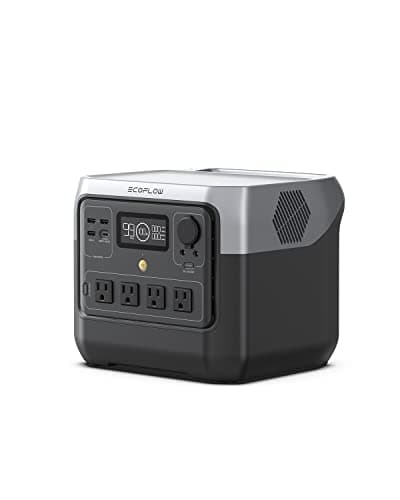
EcoFlow RIVER 2 Pro
- 768Wh
- LFP (LiFePO4)
- 800W continuous / 1,600W surge
- 18.2 lb
- 220W
- 80%+ capacity after 3,000 cycles
- 0-100% in 70 min (940W max AC input)
- 5 years
768Wh of LFP behind an 800W inverter with a published 1,600W surge, in 18.2 lb. That is 42.2 watt-hours per pound, the best ratio of any small unit in this registry, and it is roughly two and a half times the battery of a standard 300Wh box for eight to nine pounds more.
EcoFlow publishes a full wall recharge in 70 minutes at a 940W maximum input, an EPS auto-switch under 30 ms, 80%+ capacity after 3,000 cycles, a 100W USB-C port that works in both directions, a 100W car input and a five-year warranty.
The honest limits are a 220W solar ceiling that makes this a wall-charged unit rather than an off-grid one, no published expansion battery, operating noise quoted at up to 62 dB, and the fact that it is the previous generation — the lighter RIVER 3 Plus replaced it with less than half the capacity.
Reasons to buy
- 768Wh at 18.2 lb — 42.2Wh per pound
- 800W continuous, 1,600W surge via X-Boost
- Full from the wall in 70 minutes (940W input)
- LFP cells, 3,000 cycles to 80%+, 5-year warranty
- EPS auto-switch under 30 ms
Reasons to avoid
- 220W solar ceiling on a 768Wh battery — slow to refill from panels
- No published expansion battery
- Operating noise quoted at up to 62 dB
- Previous generation; EcoFlow now sells the RIVER 3 Plus
- AC outlet count is not published by EcoFlow
Buy it if: you want the biggest battery that is still a one-handed carry.
Skip it if: solar is the charging plan, or you need it to expand later.
Questions